
Bone density versus Skin Cancer – the Vitamin D conundrum
Reviewed August 2026
Calcitriol (bioactive Vit D, the steroid hormone) is known for regulating the levels of calcium and phosphorous in the body, and more specifically regulating the creation/destruction of bone and muscle health.
Normally bone density (managed by calcitrol) increases to a maximum when we're about 25 years old. It then stays relatively stable till we're about 35 and declines steadily across the rest of our lives. We want it to remain as good as possible for as long as possible – an important part of staying strong, fit and able as we age gracefully. To achieve this, we need to maintain good Vit D levels and provide our frame with the trigger to keep bone density up - that's weight bearing exercise. Walking briskly is a good option here.
So, how do we balance the need for sun exposure for bone health with the risks of sun exposure causing skin cancer? A very valid concern.
In January 2016 Cancer Council Australia, The Australasian College of Dermatologists, The Australian and New Zealand Bone and Mineral Society, Osteoporosis Australia and The Endocrine Society of Australia got together and put out recommendations on "How much sun is enough?" Here are the salient points:
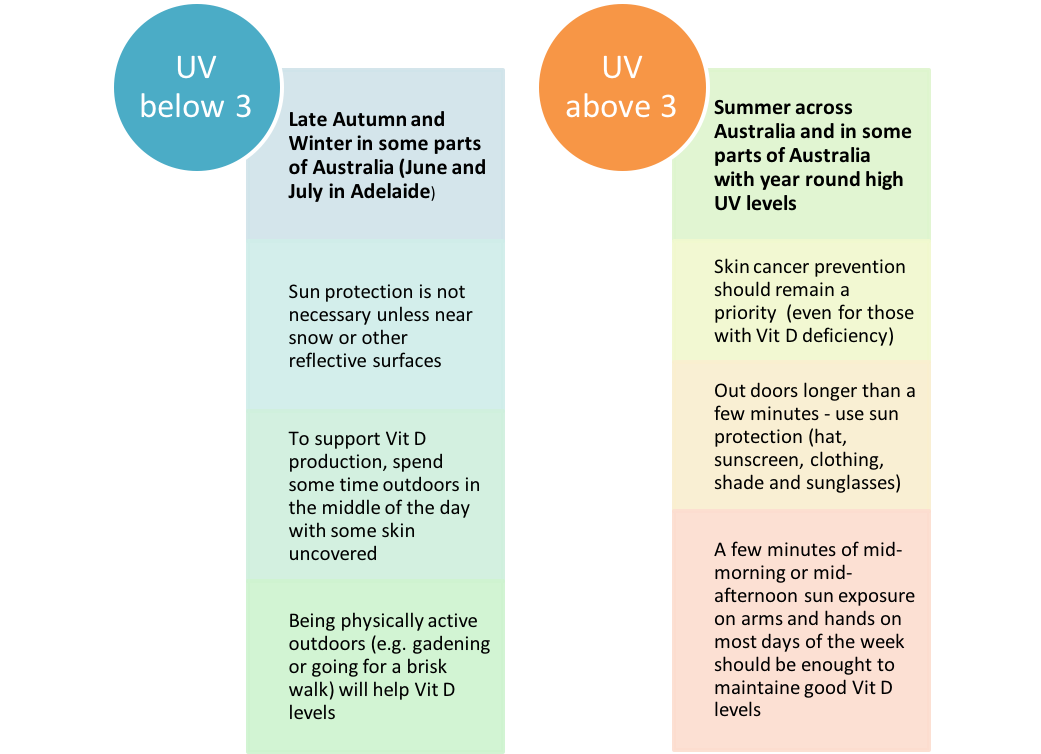
- During summer, most Australians have adequate Vit D levels just from doing typical day to day activities (e.g. walking for a couple of minutes to the car or the shop).
- If you will be outside for more than a few minutes and the UV Index is at or above 3, you need sun protection (slip, slop, slap, seek shade and slide on sunnies). N.B. in Adelaide, the average daily maximum UV Index only drops below 3 in June and July.
- Prolonged sun exposure does not cause Vit D levels to continue to increase, but it certainly increases the risk of skin cancer. Around two on three Australians will be diagnosed with skin cancer in their lifetimes, and 2000 Australians die each year as a result – we need protection against excessive UV exposure.
- Those considered at a higher risk of Vit D deficiency: people who have naturally very dark skin; people who avoid sun exposure due to a high skin cancer risk; those who are frail/elderly/chronically ill/institutionalised and live largely indoors; take medications which require sun avoidance; have conditions causing poor calcium and Vit D absorption; those who cover up for religious or cultural reasons.
- Vit D deficiency has been associated with:
- In children – a disorder called Rickets- soft, bendy long bones (e.g. leading to bowed legs) [We have seen a case of this recently in our practice. This is not a historical disease!]
- In adults - Osteoporosis- brittle bones that are more vulnerable to fractures [We see a lot of this. Spontaneous fractures are not fun and really cramp people's style.]
- Non-specific subtle symptoms: decreased immune function (getting sick/infected often); excessive fatigue and tiredness; depression; impaired wound healing; hair loss; increased risk of tendency to chronic pain.
If you are at risk of Vit D deficiency, please speak to your GP to determine if Vit D supplementation is necessary.
If you are at increased risk of skin cancer then wear sun protection year round, regardless of the UV index (e.g. an outdoor worker).
Yes, it's a bit of a tight-rope, but it is worth mastering the Vitamin D conundrum. Healthy strong bones and healthy skin are a priceless treasure - it's worth investing some time and energy on them.
At Adelaide Chiropractic Centre we see parts of your skin that you don't usually see, in areas where skin cancers are commonly found. We are constantly keeping our eye out for any skin changes or anything that needs referral back to your GP. Chiropractors are also interested in bone and joint health and we will work proactively with you to maintain your bone and joint health. We are experienced in co-managing people with osteoporosis.
Call us on 08 8221 6262 and make an appointment today.