
Time Sensitive
Reviewed August 2026
The brain keeps tabs on where the various parts of your body are by collating data on joint position from your muscles. With this feedback from your joints and muscles the brain then creates a map of where you are in space. It uses this map to pre-plan your movements so it can then send out instructions in a coordinated fashion to your muscles to get the task done.
Crisp, clean brain maps make for coordinated, smooth movements.
Blurry, fuzzy, disorganised brain maps make for jerky, unbalanced and unconsciously poor movements. An example of this might be whacking your elbow as you walk through a doorway or having trouble balancing on a previously rolled ankle. This because the brain (with its fuzzy map) doesn't have a clear picture of where your elbow actually is hanging in space or doesn't have a clear picture of how to coordinate the muscle action in your ankle to keep it stable to balance on, respectively.
I often throw out the comment, "use it or lose it, people!" Most commonly I'm referring to your physical fitness or the mechanical function of your joints and muscles (hardware). A very valid point! It turns out that this principal also applies to your brain (software), and particularly regarding these brain maps of where you are in space.
"Brain map" is a term that refers to a pattern of brain activity that happens when you do a particular thing or movement. There are brain maps for everything you do ~ from stepping forward with your right leg to winking cheekily at a friend or creating the flourish on the last letter in your signature.
These brain maps are constantly being remodelled and remoulded in response to how we use our body. They can take up more or less space in our brain according to how often we do that particular thing or activity. This is a function of neuroplasticity (read more here) and the fact our brain is changing and adapting to our world throughout our lifetime.
Thus the part of our brain recording and enabling our brain's model of where we are in space (which pre-programs our movements) expands and contracts according to what we do with our body. A chef who spends a lot of time every day chopping and preparing vegetables has an extremely crisp clear and big brain map for coordinating their hands to chop veggies efficiently and safely. A 60 year old who continued to sit cross legged on the floor regularly throughout their days will have an awesome brain map for this action and have no problems getting up and down to the floor to play with their grandbabies when that time comes. A person who learns to ride a unicycle will have a large crisp clear brain map for core control and balance...so long as they keep up the skill over time.
Conversely, a person who could do a back flip from standing (a-la Sam Kerr) when in their prime may not have such a clear and crisp brain map for this activity when they are 60 through lack of use of that particular collection of actions. A person who works with their arms above their head regularly through life, but allows their upper body to decondition (become weaker) later in life develops a steadily diminishing map of shoulder movement in their brain with time...this can evolve into shoulder and neck problems if not addressed. Can you hear an echo? ..."Use it or lose it...."
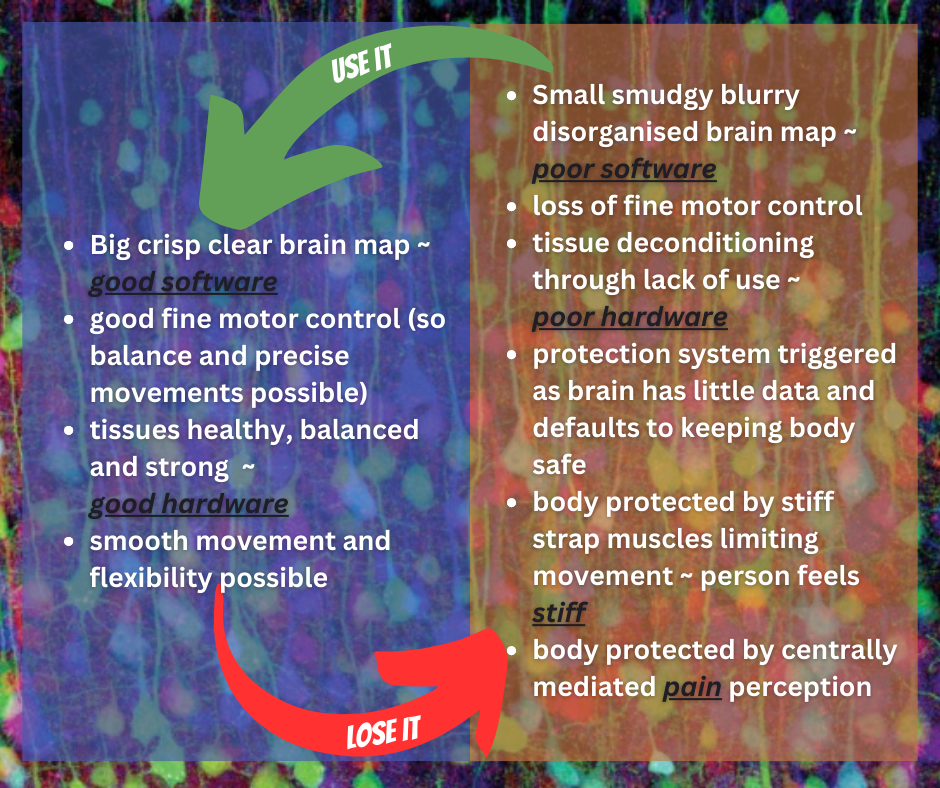
There is, of course, a continuum between large crisp clear brain maps where the brain can perform with great precision, to smudgy blurry smaller brain maps which lead to a loss of fine motor control, tissue deconditioning and activation of the protection system (pain). Transition along this spectrum is driven by two factors:
- How you use your body
- Time
I have spent a significant amount of time (ha!) clarifying the question "How active are you?" in three blogs this year. They cover the pitfalls of sedentary lifestyle, how much exercise is optimal for you, and is walking enough to tick the box on your exercise needs (including a discussion on the 10,000 step phenomena).
Here I wanted to talk about time.
We all know that it takes work and time to create strong fit bodies. That hardware (strong muscles and bones) then requires time and effort to maintain. We also know, to our collective frustration, how quickly strength/fitness slips away without that appropriate maintenance. Right?
So, how fast do you think our software (quality brain maps) deteriorates without use?
Interlude ~Time is an interesting thing. Physicists have a lot of fun with it. I just wanted to pause here and have a chuckle about 30 minutes.Usually when I talk about 30 minutes I'm encouraging people to either
- a) stand from their seated position every 30 minutes and get their body moving to keep their frame and nervous system healthy (...hmm...relevant in this blog, indeed...), or
- b) ensure they are doing a minimum of 5 lots of 30 minutes of exercise (including two resistance training sessions) each week to meet their exercise needs.
Here is a random and incomplete list of other things that happen in the space of 30 minutes:
There was some funky research done in 2006 by Stavrinou et.al. where they looked at hand movement and how this was represented in the brain (the brain map). They showed that the brain map of hand movement became fuzzy, disorganised and smaller in response to restricting finger movement after only 30 minutes!
Brain maps deteriorate after only 30 minutes
of limited movement data from joints!!
Research that has added another insight to this puzzle was published in 2017 ~ Schubrun et. al. went on to show us that after an injury, with less use, the brain map of the affected body part becomes fuzzy disorganised or smudged. So, our brain shrinks down to how we are using it in daily life.
Yes. You read that right. In the context of "use it or lose it", not moving your body and keeping strong impacts on both your ability at the level of your muscles and joints, and ALSO shrinks your brain's capacity for function too! That ups the ante on "use it or lose it" somewhat!
From here we come back to the Moseley et. al. work on pain and the Meisingset et. al. work on spinal stiffness and pain. In summary, this research shows that blurry/fuzzy/smudged brain maps lead to a loss of fine motor control, deteriorating condition of the tissues and activation of the centrally mediated protection system.
In the first stage of centrally mediated protection the brain registers a lack of data from the joints and muscles due to less movement. Less movement data constitutes a risk as without that data there is a greater chance of something going wrong with preplanning future movements. The brain deals with this by throwing all the long strap muscles (for example: trapezius and scalenes in the neck; latissimus dorsi, quadratus lumborum and gluteal muscles in the lower back) into increased tension just to brace everything and keep it safe. People perceive this as stiffness and, incidentally, it feeds into even less movement data and escalates the problem going forward.
The next step the brain executes in centrally mediated protection is using pain as the stick in the "carrot and stick" analogy for encouraging a person to avoid behaviours and activities which the brain perceives (based on previous experience) as putting the person or tissue at risk of damage (read more here). This pain kicks in BEFORE the tissues are at any risk of actually sustaining damage. It thus stops a person far short of what their body is actually capable of doing. This is what's happening when a person is experiencing chronic pain.
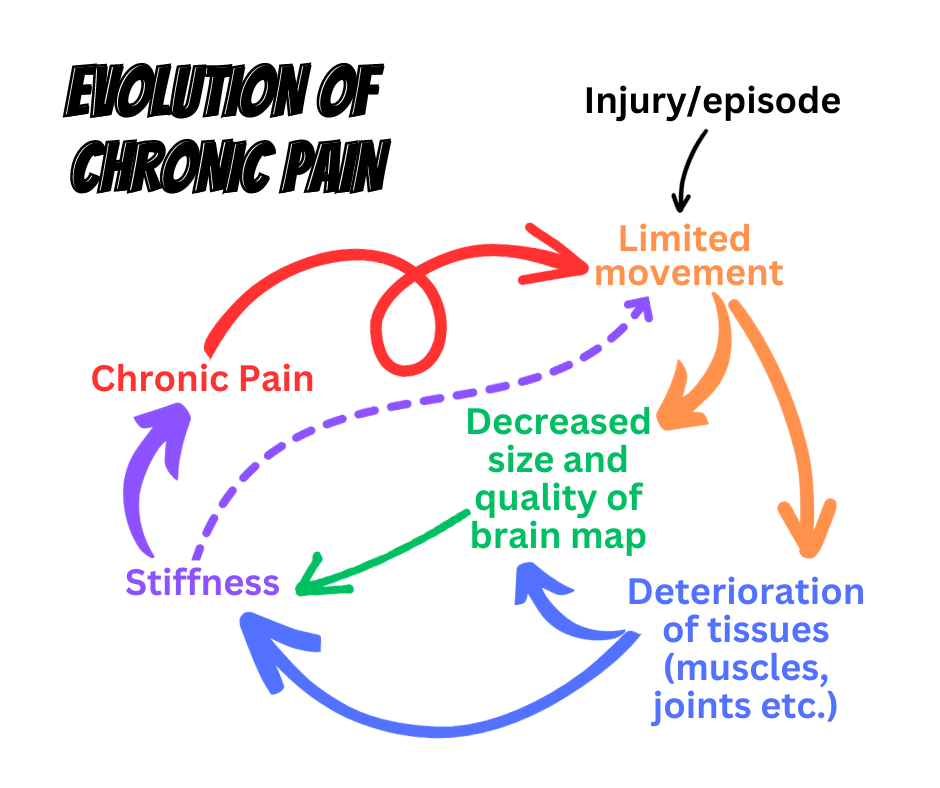
For this reason, chronic pain can be viewed as
a "low usage" indicator and damage warning system.
As a person who helps many people deal with the pain and dysfunction they're experiencing, the big question here is ~ how do we stop this chronic pain cycle and move people towards optimal function?
Firstly, do not despair! Neuroplasticity, the lifelong adaptability of our brain and nervous system, works in both directions. Yes, it can deteriorate with lack of movement data over time, but it will also recover given the correct care and some more time.
The short answer is to get the body moving. Chiropractic adjustments work to stimulate the sensors in the joints and muscles to fire and provide movement data to the brain. This promotes the restoration of crisp clear brain maps. Concurrently we want to promote people to move more and sit less such that a good flow of movement data is maintained to the brain and they slowly build confidence in their physical frame again ~ teaching the brain "yes we can...". Ultimately, in moving more at the level of the joint and the body as a whole, we recondition both the hardware of the body (bones, joints, muscles) and the software (the brain maps and centrally mediated protection system).
Whether this system is working at it's optimum, or if there is a dysfunction somewhere in the software or the hardware, time is important. The system is time sensitive. There are two aspects to bear in mind here:
- If an acute injury is not managed and rehabilitated well, limited movement in the area can lead to the development of chronic pain patterns. Chronic pain is defined as pain persisting beyond the time required for the tissues to heal ~ three months (read more here). So get suitable guidance to recover from your injuries well. Don't wait till the problem is chronic and we need to rehab your brain as well as your frame.
- Being still, a part of you or your whole body, for any longer than 30 minutes will result in the associated brain map becoming small, smudged, blurry and disorganised.
Lack of movement over time shrinks your brain!!
Keep that body moving for crisp brain maps and strong healthy bodies. Give us a call at the Adelaide Chiropractic centre on 8221 6262 to make a time to speak to one of our chiropractors about working with your nervous system to optimise your health...and manage your pain too.
References
-
"The Beautiful Brain" by Jeff Lichtman
-
Stavrinou ML, Della Penna S, Pizzella V, Torquati K, Cianflone F, Franciotti R, Bezerianos A, Romani GL, Rossini PM. Temporal dynamics of plastic changes in human primary somatosensory cortex after finger webbing. Cereb Cortex. 2007 Sep;17(9):2134-42. doi: 10.1093/cercor/bhl120. Epub 2006 Nov 16. PMID: 17110591.
-
Schabrun SM, Elgueta-Cancino EL, Hodges PW. Smudging of the Motor Cortex Is Related to the Severity of Low Back Pain. Spine (Phila Pa 1976). 2017 Aug 1;42(15):1172-1178. doi: 10.1097/BRS.0000000000000938. PMID: 25893342.
-
Bray H, Moseley GL. Disrupted working body schema of the trunk in people with back pain. Br J Sports Med. 2011 Mar;45(3):168-73. doi: 10.1136/bjsm.2009.061978. Epub 2009 Nov 2. PMID: 19887441.
-
Meisingset I, Woodhouse A, Stensdotter AK, Stavdahl Ø, Lorås H, Gismervik S, Andresen H, Austreim K, Vasseljen O. Evidence for a general stiffening motor control pattern in neck pain: a cross sectional study. BMC Musculoskelet Disord. 2015 Mar 17;16:56. doi: 10.1186/s12891-015-0517-2. PMID: 25888215; PMCID: PMC4377005.