
Concussion
Reviewed August 2026
Our body is an amazing thing. Yet another example of this is the cerebrospinal fluid (CSF) that creates a buffer between our bony skull and our jelly-like brain. The CSF is exactly the same density as our brain – this means we can dance the night away throwing ourselves around, defy gravity at Bounce or Lattitude and head a soccer ball, all without the clever jelly getting splattered on the inside of our skull with disastrous consequences – that being our death. This is a good thing, excellent design in fact. There is, however, a limit.
When the force of impact exceeds the parameters of the CFS's ability to protect our brain, the brain does get slammed on the inside of the skull (on both sides sequentially in a whiplash-type event) and the brain gets bruised. In the "bruised" part of the brain, smooth communication between the nerves is compromised. This results in some funky (sometimes scary) symptoms and is called a concussion.
A concussion is a traumatic brain injury. The classic cause of this is a blow to the head sustained during a motor vehicle accident (MVA) or a sporting accident. It's important to remember a person can sustain a concussion without hitting their head – for example when a force hits a person's body and their body and head gets whipped around (picture a rugby tackle or that marvellous non-contact sport netball...).
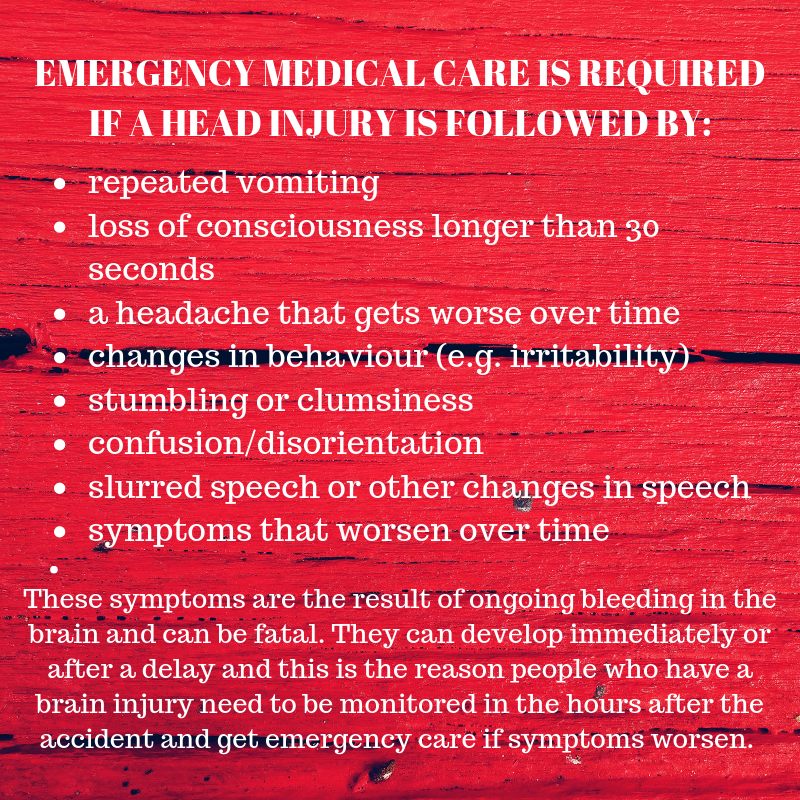
Some concussion symptoms can come on immediately (headache, temporary loss of consciousness, confusion or feeling as if in a fog, amnesia surrounding the traumatic event, dizziness, nausea/vomiting, slurred speech, delayed response to questions, fatigue), but some can come on through the course of the following hours or days (concentration/memory complaints, irritability or personality changes, sensitivity to light/noise, sleep disturbances, anxiety/depression, altered taste/smell) (1).
Loss of consciousness is actually very rare, occurring in less than 5% of sports related concussions.
If loss of consciousness lasts longer than 30 seconds it may indicate more significant intracranial injury (an emergency situation!) (5)
Any suspected concussion should be evaluated by a medical doctor within 1-2 days of the injury, even if emergency care isn't required (1,2).
Little kids are a special case. Infants and toddlers bump their heads often, but they can't tell us what they're feeling. The Mayo Clinic recommends watching for the following signs: appearing dazed, listless and tiring easily; irritability and crankiness; loss of balance and unsteady walking; crying excessively; change in eating or sleeping patterns; lack of interest in favourite toys. The Mayo Clinic go on to recommend that "If your child doesn't have signs of a serious head injury, remains alert, moves normally and responds to you, the injury is probably mild and usually doesn't need further testing" (1).
In the sporting world there is contention. Players get injured and they want to keep playing when they perceive the concussion symptoms to be negligible just a few minutes after the impact. There may be pressure from the club staff or even parents to "get back out there and make it happen". This is a problem.
There are two risks when it comes to concussions (especially in sport). The first is second impact syndrome ~ which is rare, but happens when someone experiences a second concussion event before their brain has healed from the first event. This results in rapid and usually fatal brain swelling(2,5). Most cases of second impact syndrome happen in people under the age of 20 years (5).
The second risk associated with concussion in sport is Chronic Traumatic Encephalopathy (CTE). This happens when someone experiences multiple concussion injuries to their brain over the course of years. CTE is a degenerative brain disease involving progressive memory problems, changes in a person's personality and slowness of movement (1,4).
In America, elite footballers have sued the NFL alleging the sporting body knew the risks of repeated concussions and CTE, but covered it up to keep players on the field and entertaining the fans – at the cost of progressively deteriorating brain function for the players over time. Those players got a $765 million settlement package in 2013(4)...but their brains will continue to deteriorate and they won't know their families in time.
Athletes should NEVER return to vigorous activity while the signs of a concussion are present and should NOT return to play on the same day as the injury (1).
Research shows that "generally, concussions self-resolve within 7-14 days. High school and collegiate athletes may have an extended recovery time of 21-28 days"(3,5). However, there may be even longer term consequences.
Since concussion is a traumatic brain injury that affects the function of the brain, a person may not look unwell, but signs of that dysfunction can persist longer than these times imply. Post-concussion syndrome is defined as symptoms of concussion that persist for weeks or months after the concussive event.
At this point I think it's worth remembering that each concussive event is different and predicting symptoms and recovery times is a bit like asking, "How long is a piece of string?"
So what do we do about concussions when they happen? Once cleared of any nasty possibilities by the medical system, it used to be just rest (+/- over the counter pain medications) and return to activity as you feel better. We now know that concussion is a functional injury to the brain which has cognitive (e.g. concentration, focus, memory) and physical (e.g. balance (dizziness), headaches, coordination) impacts. Current opinion on how we manage concussion has moved past, "just rest up and use medication to ease the pain".
1. See a medical doctor within 1-2 days of a significant head injury if emergency help wasn't required in the first place.
2. "Radical rest for a couple of days." It's easy to intuit what physical rest is - just stop exertion of any kind and take it easy (do keep moving though – research shows that concussion affects the autonomic nervous system impacting on blood flow to the brain, heart and remainder of the body. Gentle, sub-symptom threshold activity improves the blood flow and helps with healing the concussed area in the brain (6)), however, what constitutes cognitive rest? Unfortunately for our intensely connected youth, cognitive rest means NO SCREENS! No text messaging, no watching television, no playing video games, and no school until symptoms improve (7).
3. For those with persisting dizziness, neck pain and headaches physical therapy (chiro/physio) will promote cervical (neck) and vestibular (balance) rehabilitation (3,6).
4. Once symptoms stabilise, ease back into activity – both cognitive and physical – but ease is the operative word here. The goal is to keep the challenges to the brain below the threshold where lingering concussion symptoms are triggered. So if the concussed person starts feeling dizzy, headachy or fatigued, then they've done too much. This method progressively rehabilitates the brain from the trauma it received during the concussion (6,8).
So why is your friendly chiropractor talking to you about concussion? When a person hits their head or their body gets whipped around so their brain gets bruised on the inside if their skull, often their neck is traumatised too. This whiplash type event can disturb the function of the upper neck and the local neurology contributing further to the headache, movement and balance symptoms caused by the concussion. People with concussion often present to chiropractic practices with headaches and neck pain. Chiropractic spinal care optimises cervical spine biomechanics and promotes a return to normal neurology in the neck helping to rehabilitate the whiplash like trauma to the neck and deal with persistent concussion symptoms like headaches and dizziness (3,6).
Once the medical doctor has determined that concussion symptoms are not going to deteriorate further give us a call at the Adelaide Chiropractic Centre on 8221 6262, we can help.