
OTC Pain Medications (a tool)
Reviewed August 2026
 Our local pharmacist, Mr Brad Price (and through him, the Pharmaceutical Society of Australia), has provided me with the following information. Please, if you have any questions or need qualification of the below information with respect to other medications you are already taking or other reasons for taking OTC pain medications (I am focussing on acute back pain in this article), then have a conversation with your pharmacist or GP.
It has been shown repeatedly that early diagnosis of the reason for your pain, and prompt qualified advice regarding how to deal with it, can prevent the likelihood of acute pain transitioning to chronic long term pain(1). So when you feel back or neck pain see your chiro/physio/GP straight away to get advice. Leaving it and "hoping it will resolve itself" or "being stoic" leaves you vulnerable to a chronic pain syndrome which is a much trickier beast to manage.
"Data shows that 94% of patients presenting in primary care (with acute low back pain) have non-specific low back pain (has no underlying serious pathology), while serious disease accounts for only 1% of cases and the remaining 5% have radiculopathy (irritation of the nerve that causes pain or pins and needles in the leg)"(1)
Once the diagnosis is simple non-specific LBP and you are getting the appropriate help from your musculoskeletal therapist (chiro/physio) then here is the advice I was given on the pharmaceutical front regarding OTC pain medications:
Using OTC Pain Medication for Acute Non-specific LBP
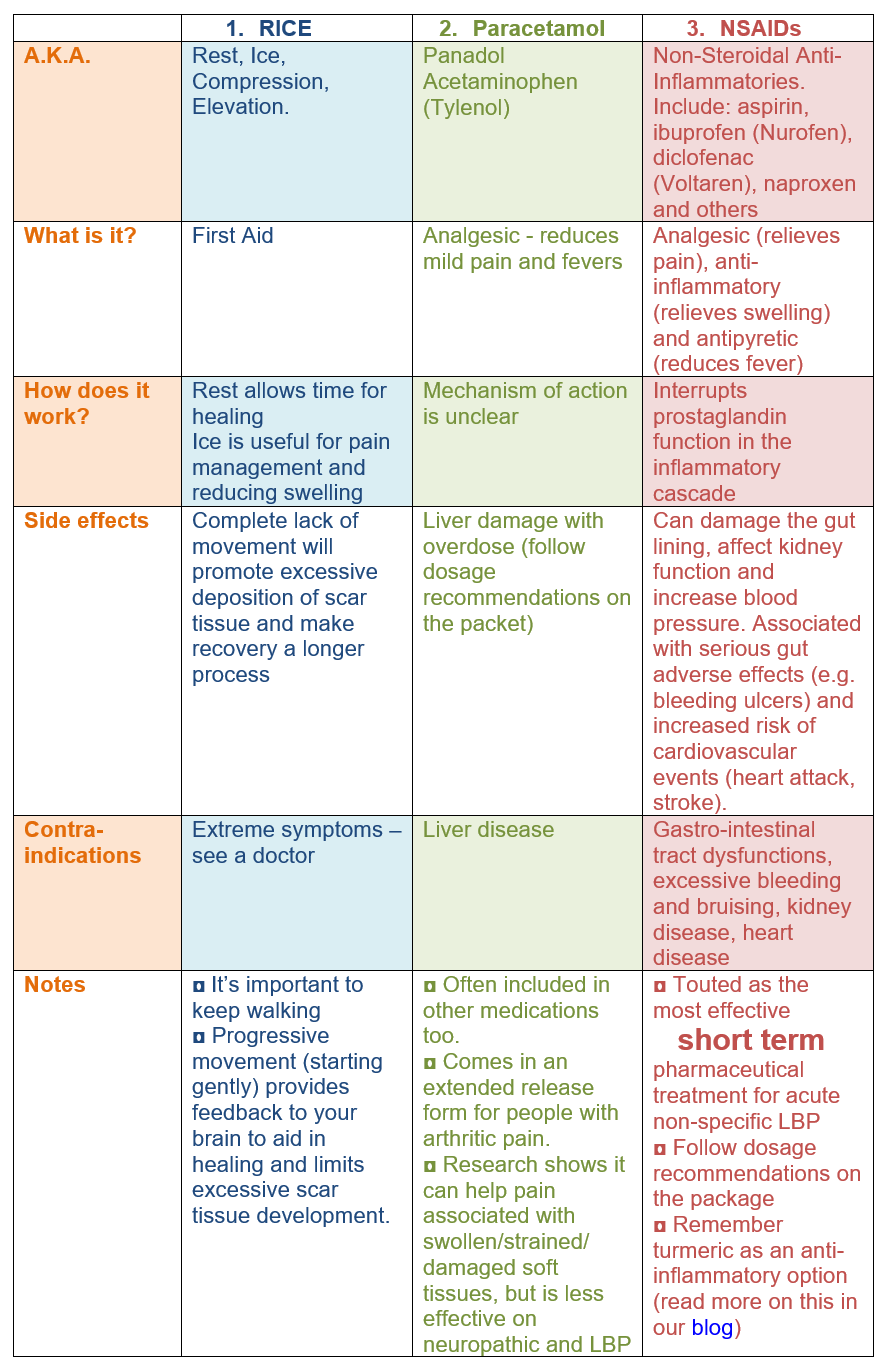
Note:
- the PSA advise that paracetamol/ibuprofen combination tablets should only be used in cases of mild acute pain after RICE has been tried. They should only be used for a few days and have a higher risk factor for bleeding over and above that found for the individual drugs (1).
-
Bed rest is not helpful for back pain and might even slow recovery (3).
Some of you will have heard about the research that has been released in the last couple of years saying Paracetamol and NSAIDs don't help back pain (4,5). This research pertains to the effect of these OTC medications on chronic pain (pain that lasts longer than three months).
Something to be mindful of is the goal. Most people think that the goal in taking pain medications is about feeling no pain so they can get on with their normal activities. They forget that healing takes time. Inconvenient, but true. In this context OTC pain medications can be used as a tool used to take the edge off acute pain and allow more normal function while healing occurs. These medications don't always remove pain from your perception entirely and they are time dependant (once the body clears the medicine from your system the pain may return). Sleeping, for example, is vital to healing and good headspace ~ everything is easier to manage after a good sleep. If the OTC pain medication helps you get a better sleep at night in the early days after an injury – this is a good thing. [Remember, here we are talking about acute pain, not chronic pain – the goal and management plan is entirely different with chronic pain.]
Many people, when taking OTC pain medications is discussed, say, "No. I don't like taking tablets." This is often said with a stiff upper lip and a whack of stoicism. I firmly believe that it is entirely up to the individual. However, at this point I'd like to remind people that these medicines are a tool. There is a place for them. If you know the reason you are feeling pain (diagnosis from a professional, not Google) and have a plan for your recovery, then appropriately used OTC pain medications can be a useful tool to take the edge off and make your recovery a little less onerous. Remember, the guidelines on how long is safe to take these medications is on the packet. Don't take them longer; else you may end up with liver, kidney or gastrointestinal tract problems beyond the duration of your original LBP.
Before taking OTC pain medications each person should do a quick risk/benefit assessment of their situation. It is best if you consult your pharmacist or GP if you are taking other medications concurrently. Each individual can make their own minds up about taking OTC pain medications. Pain perception (how you are feeling pain at any given time) is influenced by a myriad of things (headspace, hormones, sleep, stage of healing...) and your need for this tool will vary accordingly.
Does it seem funny ~ a chiropractor talking about pain medications? It shouldn't. We at the Adelaide Chiropractic Centre want the best outcomes for our people. If your prompt recovery requires something beyond our scope of care we will always refer you to the appropriate care provider. ..and as I've said many times in these blogs, knowledge aids in healing. So we share this knowledge. Be informed about OTC pain medications, speak to your pharmacist or GP, and use them wisely. It's your body.