How chiropractic care can help with stiffness
Reviewed August 2026
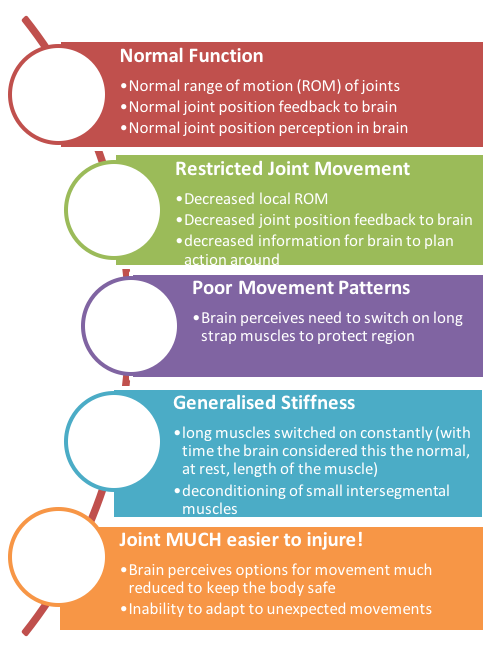
Current neurological research is producing evidence that STIFFNESS is a middle of the spectrum sign of dysfunction in our spine and nervous system. It's actually a protective strategy our brain employs when it doesn't have a clear picture of how our frame is working.
Normally the brain receives constant information from our joints and the small muscles that bridge them about how the joint is positioned in space (kinaesthetic awareness). The brain uses this information to coordinate and control our body's movement.
When the joints are not moving well (due to bad habits, old injuries or poor posture, for example) the feedback from the joints to the brain is impaired. With an incomplete picture of what's going on at the joint, the brain goes into protection mode. To keep the joints safe, the brain switches on all the long strap muscles in the region; making that region of the body STIFF and harder to move.
If left this way eventually the brain forgets that there's more length available in those long strap muscles, forgetting that the joint normally has a greater range of motion than it currently has. In chronic cases the brain even edits these possibilities out of its neural network; this is why we need to gradually reintroduce movements as a part of rehabilitating a chronic joint. In addition to this, the tiny muscles that stabilise the joint deteriorate through lack of use (this happens in days). This is called ‘MALADAPTIVE REORGANISATION'.
Maladaptive reorganisation leaves the brain without the tools needed to adapt to unexpected movements; like miss-stepping off a gutter, finding the watering can heavier than anticipated when lifted, or suddenly needing to catch the kamikaze child who launched themselves off the back of the couch at you... and in this situation the joints and soft tissues of the body are much more readily damaged.
It is now postulated that chiropractic adjustments, in reintroducing movement to restricted joints and stimulating neurological feedback to the brain, assist with resolving ‘maladaptive reorganisation' of the brain. This is how we help with the generalised stiffness you feel. The adjustments we introduce to your spine helps the brain have a more complete picture of how the joint is functioning; this in turn promotes more normal musculoskeletal function.
Maybe we should consider STIFFNESS a warning signal, rather than just an irritant... maybe if a person came in for their adjustment when they felt STIFF, then we could head off the pain all together.
If you're experiencing stiffness, give the team at [site_name] a call on
[site_phone] and schedule your next appointment today.