
Forward Head Posture
Reviewed August 2026
When joints are lined up the way they're built to work, they function much better. Another way to say this is that the joints are being maintained in a good posture. Think about a person who has flat feet, and consequently knocked knees – they are unlikely to be the best runner. As chiropractors we spend a lot of time talking to people about their posture because good posture occurs when all the joints are lined up the way they're built to work and they function best in this alignment. Chiropractors work to optimise alignment in the joints of the body.
Head posture is no different. When the bones of the neck are aligned optimally within the cervical lordosis (natural forwards curve in the spine at the neck) then the heavy weight of the skull and the brain are balanced well on top of that comparatively narrow neck, and the muscles of the neck and upper back are maintained at a healthy tone. In truth it's like balancing a bowling ball on top of your thin neck and if it's not balanced correctly then that bowling ball becomes terribly heavy and really hard work to keep up.
Research shows that in correct posture the average human head weighs between 4.5 and 5.5 kilograms (1,2). With forward head posture there is an increase in the work load the tissues of the neck must do to maintain the position of the head. The load progressively increases as the biomechanical lever of the neck is asked to suspend the weight of the head forward at greater angles. In 2014 Dr Keith Hansraj, (Chief of surgery at the New York Spine Surgery and Rehabilitation Medicine, New York, New York) modelled the increase of load the tissues of the neck have to deal with as the head is progressively displaced forward (1). The results can be seen in the chart below:
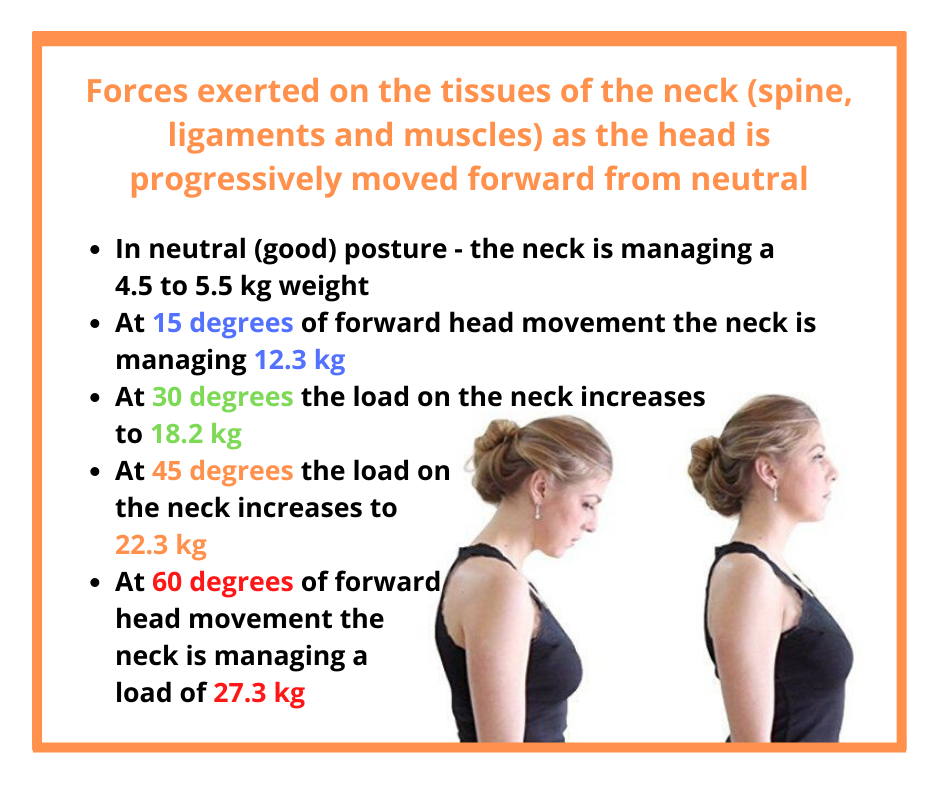
The muscles of my neck and upper back ache just contemplating those figures!
How often do we sit with our heads forward in today's world of technology? Holding our body in a poor posture out of habit or old injury is one thing. Compound this with hours a day at a desk job or the hours some spend hanging over their smart phones...and we know the smaller the screen, the worse the posture. There are also a myriad of different activities that we do every day with a head forward posture – from cooking and jigsaw puzzles to hand craft and breast feeding.
Imagine the extra work your neck and upper back are forced to do when you get lost in a candy crush/Sudoku escape moment or a social media frenzy on your phone. The muscles are working overtime at a lengthened state, the ligaments are at full stretch constantly and this disrupts the feedback loops to the brain which provide it with a sense of where you are in space (proprioception and kinaesthetic sense). In addition to that, forward head posture causes the front of the discs to experience increased load which can lead to accelerated degeneration. If you do this long enough (weeks, months...) neuroplastic changes in the brain edit out the correct length that the muscles and ligaments are supposed to be at for neutral posture to be an option (read more about this here). Forward head posture really is not good for your body.

Research published in 2019 by Smith et. al. has also shown
"When neuromuscular function at the neck is impaired either by pathology, trauma or by...(neck fatigue)...in normal subjects [such as that caused by forward head posture] balance and movement control have been shown to decrease." (2)
So, in plain English,
- the research shows that forward head posture affects the biomechanics of the upper neck,
- which in turn changes the messages the tissues of the neck are sending to the brain (proprioceptive feedback)
- and thus disrupts the brain's picture of the biomechanics in the area (kinaesthetic awareness)
- which can lead to poor movement patterns and accelerated degeneration of tissues.
- As the proprioceptive feedback from the upper neck is a vital part of the triumvirate (neck proprioception + vision + inner ear information) of data sources the brain collates info from to give us our sense of balance (where we are in space and which way is up in the gravity field), forward head posture also interferes with our sense of balance
- which has been shown to increase falls risk.
The Journal of Gait and Posture has recently accepted an article from Moustafa et. al. which is to be published in 2020 (3). This research reaffirms that forward head posture alters the feedback from your upper neck to your brain and interferes with our ability to balance and prevent falls. It then goes further and shows that forward head posture, and the aberrant feedback this produces, causes the brain to change how the autonomic nervous system functions (ANS).
The ANS is the part of the nervous system that does its thing without us thinking about it. It is divided into the Sympathetic Nervous System (SNS – involved in managing all fight and flight responses) and the Parasympathetic Nervous System (PNS - involved in managing those processes involved in rest, digestion, reproduction and repair).
Moustafa et. al. showed that forward head posture causes an overreaction of the SNS. This could lead to an imbalance between the two branches of the ANS with overactivity of the fight/flight state and a predisposition towards things like anxiety.
The good news is chiropractic care is well documented as being able to improve proprioception, especially in cases of sub-clinical neck pain, lower back pain and advanced age (4,5,6). We are also very good at working with people to improve and optimise their posture. We adjust the spine to improve proprioception, provide targeted exercises to restrengthen the frame and improve brain mapping, and discuss strategies to change those habits that are perpetuating the poor posture.
Give us a call at The Adelaide Chiropractic Centre on 8221 6262 and make an appointment now. We can help you reduce any forward head posture and also optimise the posture of your whole frame.