
Which comes first ~ the tissue damage or the pain?
Reviewed August 2026
So which does come first ~ the tissue damage or the pain? This sounds like a "which comes first, the chicken or the egg?" kind of question, but actually, this is not really a question at all any more. The research is clear, and contrary to how we've been taught to view pain and injury in the past, we now know that pain happens first, then the tissue damage. Unsurprisingly, it can be hard to get your head around this idea, but it comes back to the concept of what pain is and the role it plays in our bodies.
Just to be clear. We do NOT get pain sensation signalled back to the brain from damaged tissues...no matter what the makers of over the counter painkillers and anti-inflammatories would like us to think. This is why the only drugs that have an impact on severe pain actually act in the brain, not in the damaged tissues of the body.
Here is a snapshot of how David Butler and Lorimer Moseley, our Explain Pain gurus, convey this idea ~
"Okay, let's stand up, face each other a few metres apart. Pretend I am PAIN and everything in front of me is safe, but behind me is tissue damage. You are walking slowly towards me, doing something that is taking you towards tissue damage. As you approach, I say, "Slow down, stop. Stop. STOP. STOP!" If you had stopped when I asked you to "slow down" there would be no trouble, but because it took to the last "STOP!" for you to pause in front of me – you now have a flare up. You are in a lot of pain, but can you see you haven't walked past me yet, so I have prevented you from reaching damage? This is how a flare up works. It tells you that you have come too close, not that you went too far.
"Unfortunately, many people think that you have pain once you are already damaged. This is wrong. In this scenario, I (being PAIN) don't say anything until you have walked past me and arrive at damage. This is NEVER how pain works. Pain stands between you and damage and is always keeping an eye out for you (1)."
We've spoken about pain and how the brain uses pain, and the lack thereof, as a carrot-stick tool to keep a person's behaviour within boundaries that the brain considers "safe" ~ and that it employs this tactic well before there is risk of actual tissue damage...even to the extent of orchestrating a local inflammatory response to match the sensation of pain!
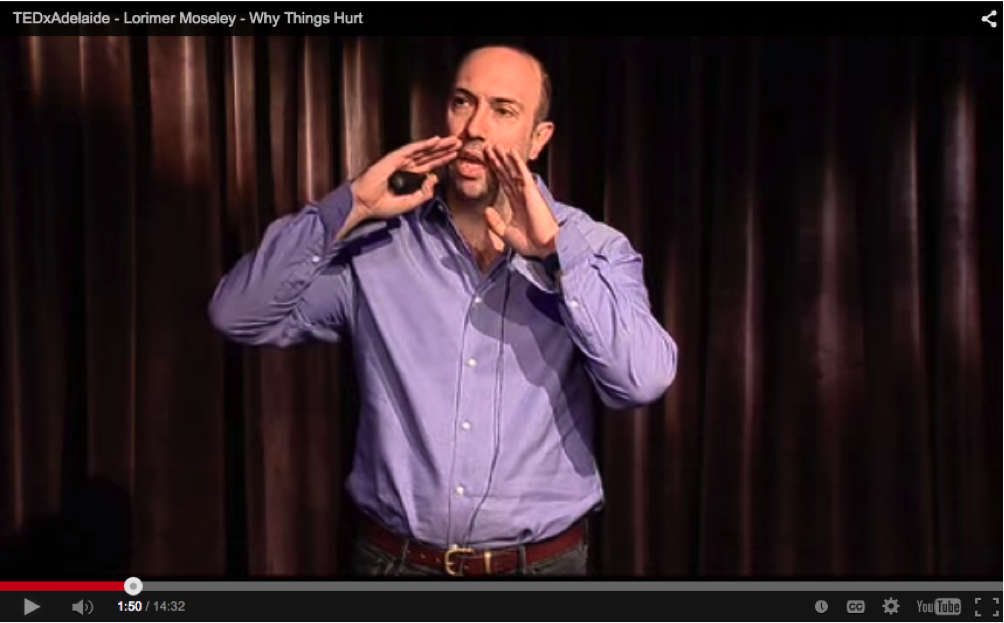
How the brain uses this pain tool is based on your previous experiences in life. Lorimer Moseley shares a great personal example of this in the following video about being bitten by a brown snake and almost dying, then years later being scratched by a stick on the same patch of skin (a very similar sensation to that he experienced when being bitten by the snake) and was thrown into pain, unconsciousness and neurological reaction by his brain to "keep him safe from the snake"....despite the reality that there was no snake there that time.
So the brain makes up data to fill the gaps in what it knows to be true from the feedback from your sensory system. It makes crystal ball predictions and acts on those assumptions ~ whether that means you do or don't hit your elbow as you walk through the lounge door; or whether you leap to safety from that "stick that was a snake in a former life"; or whether you feel safe to play the second half of the netball game given you strained your ankle last week...all with the goal of keeping you safe. Brains have been known to become overzealous on this front to the point of severely limiting our capability and quality of life, thus stopping us from doing the things we want to do. Another name for this is chronic pain.
To help the brain get it right we need to ensure it is getting good information from the body. With good data the brain will be less likely to fill the gaps with assumptions based on previous experience. On the musculoskeletal front this means keeping your body moving, both on a body-wide scale (being strong, fit and able) and on the scale of individual joints (to ensure the brain has a good data on joint position sense (proprioception) and on your position in the gravity field (kinaesthetic sense)).
Chiropractic care is known to stimulate proprioceptive feedback to the brain and promote better kinaesthetic awareness. Chiropractors enable those joints that are not moving well to function better and this improves the communication between the joint position sensors and the brain. With this clearer data stream, the brain can plan its movements better. People experience better function in the joints, better coordination in complex movements and better balance, to mention just a few benefits(2,3,4).
So, when a person comes to see us with a musculoskeletal pain we need to determine if,
(a) there is actually current traumatic damage to a particular tissue, or
(b) if it is a flare up or aggravation based on the experiences that person has had in the past where the pain is a reflection of the brain keeping that person safe from the risk of experiencing that trauma again.
Whether it is an acute musculoskeletal trauma or a chronic pain that has been triggered, we can help.
A thought ~ being mindful that those early warning "shots across the bow", "Danger Will Robinson", type pains are actually there to keep us safe from damage... Maybe we could listen to them more and stop before we do ourselves damage...rather than blazing on through and paying the price of "wilful deafness" to the brain's messages in the coin of wasted time when we can't do the things we love doing and the unpleasant sensation of pain.