Just Breathe
Reviewed August 2026
Many people walk in my door with their shoulders up around their ears, their scalp tight, or clenching their teeth. These signs of tension being held in the body are often unconscious and they are also an indicator of how well the person is managing the current challenges in their world. It's a sign that our nervous system and headspace is out of balance.
Another thing I look for is how well a person is breathing. Have you ever noticed yourself breathing shallowly or quickly? Not using all of your lung space? It's usually associated with being a bit wound up, either in your headspace or due to muscular tension you are holding in your frame. If you're upset this can be really obvious.
Brace yourself – a little bit of neuroanatomy here to lay the foundations for how tight muscles, too much on your plate and breathing are linked, and what we can do to unsnarl the potential mess....
- The Nervous System is divided into the Motor system (which runs our consciously controlled muscles) and the Autonomic system (which unconsciously manages everything else).
- The Autonomic Nervous System (ANS) manages respiration, cardiac, digestive, renal, reproductive, metabolic, healing and sleep functions in the body.
- The ANS is divided into the Sympathetic Nervous System (SNS – which switches things on and revs them up for a fight/flight response) and the Parasympathetic Nervous System (PNS – which slows things down for rest, recovery and repair).
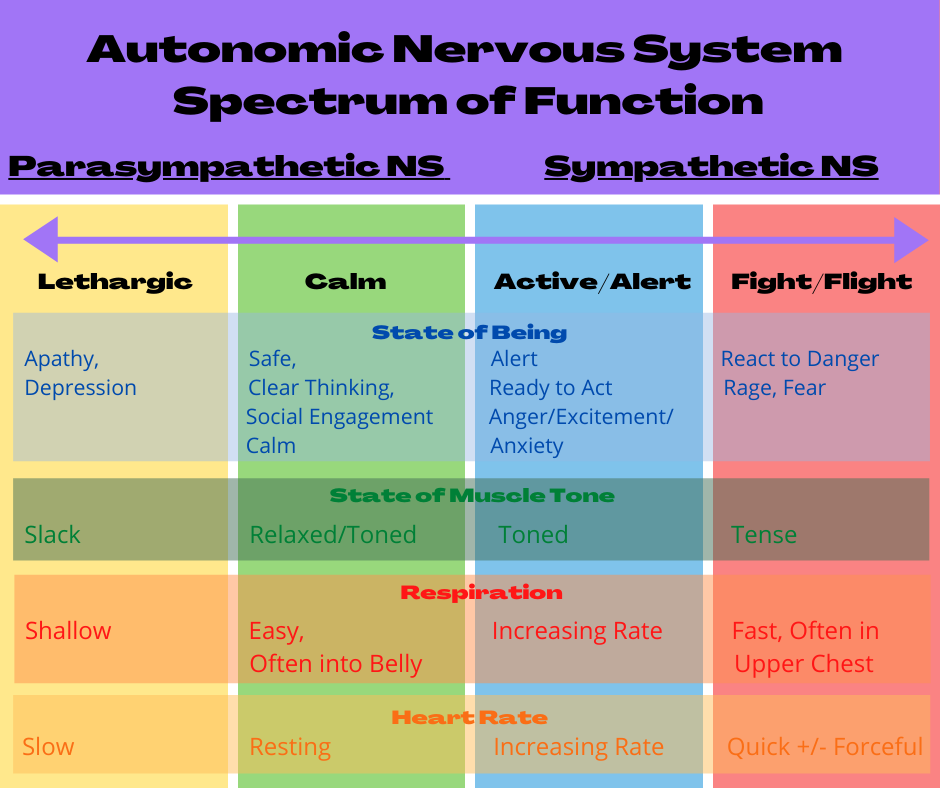
- You can look at ANS control of the body as a continuum of function with overactivity of the PNS at one end (characterised by apathy and depression) and heightened SNS function at the other end (characterised by being ready to face danger, or the fight/flight response).
You can see on the chart below how a person's headspace, muscle tone, breathing rate and heart rate are all connected to where a person might be on this ANS spectrum at any one point in time.
 (4)
(4)
My person with their shoulders around their ears - they're hanging out at the SNS end of the ANS spectrum. A place where the fight/flight response is wound up to 11 on the dial and anxiety is common. Interestingly, the reason for the tense muscles in the first place (e.g. challenged headspace (worry, stress), poor posture, neck injury, headache) doesn't matter, the presence of the muscle spasm will feed back through the nervous system to affect both bodily function and headspace to a similar level of alertness of the ANS.
Those high shoulders I keep mentioning are a good example of how our emotions can affect our physical body. The cool thing is that it's a two way street – what we do with our physical frame can affect our emotional state too. Classic examples of this are:
- Shifting your posture affects your state of mind [e.g. Watch Amy Cuddy talk about how you hold your body affects your state of mind ~ https://www.youtube.com/watch?v=RWZluriQUzE]
- Putting a smile on your face when you're feeling down will shift the head space in a positive direction.
- Consciously relaxing muscles, such as in yoga or meditation, will calm your mind.
My chiropractic adjustments will help to reduce the muscle spasm and stimulate the brain to work on bringing the musculoskeletal system back towards neutral, or calm. A massage therapist, physio or acupuncturist can implement other techniques that can help on this front too. However, there is another strategy that will facilitate that change, one that each and every one of us has access to at any moment in time ~ working with the breath. Given one of my goals is to empower people and give them strategies to keep their bodies working at their best on a day to day basis I often spend time teaching people how to access their breathing as a tool to manage the stresses in their world, both physical and mental.
"Breathing is like solar energy for powering relaxation: it's a way to regulate emotions that is free, always accessible, inexhaustible and easy to use"
Christopher André.
How we breathe affects our whole body and our mind. When it's out of control it can cause or amplify problems. Research shows breathing difficulties can cause panic attacks and chronic breathing difficulties are associated with a more muted anxiety (1). It is estimated that 60% of people with Chronic Obstructive Pulmonary Disease (COPD), who have a very limited lung capacity, have anxiety or depression (1).
There is ample research evidence that breathing well shifts you down the ANS spectrum of function towards calm and all the positive mental and physical benefits that are associated, including more relaxed muscles.
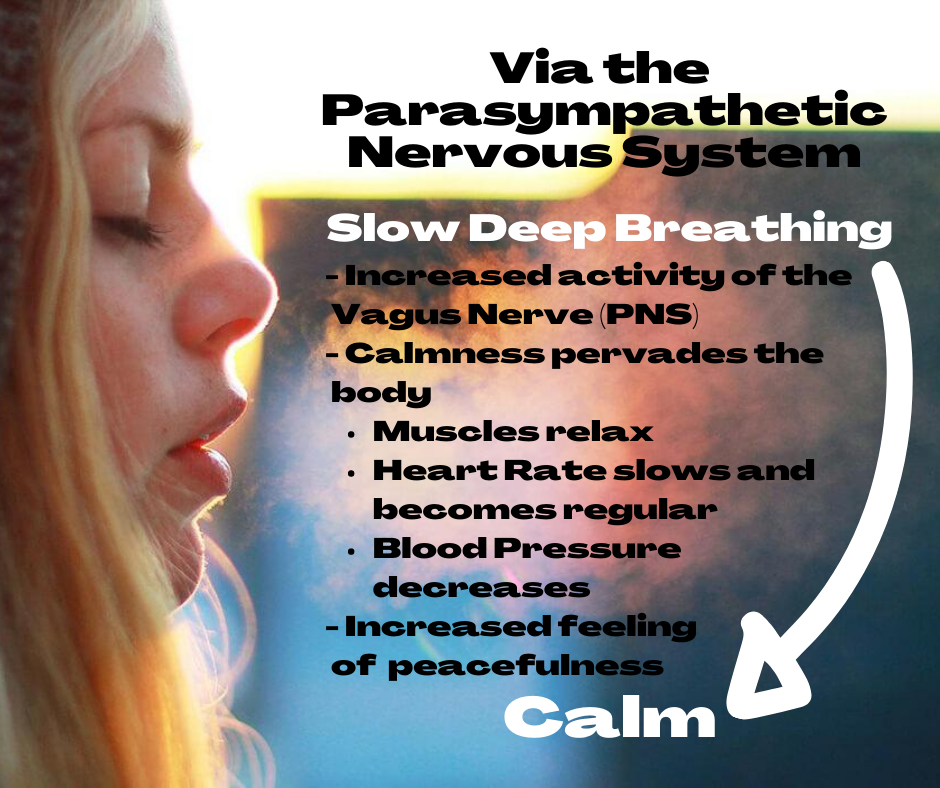
It is understood that deep breathing alters our body and headspace through two mechanisms concurrently. The first is via the Vagus Nerve. Consciously controlling your breathing causes increased activity in the Vagus Nerve, which is a part of the PNS. Via this mechanism the balance in the ANS spectrum of function is tipped towards calm and this can be measured in a person's muscular tension, HR and BP as they all shift concurrently.
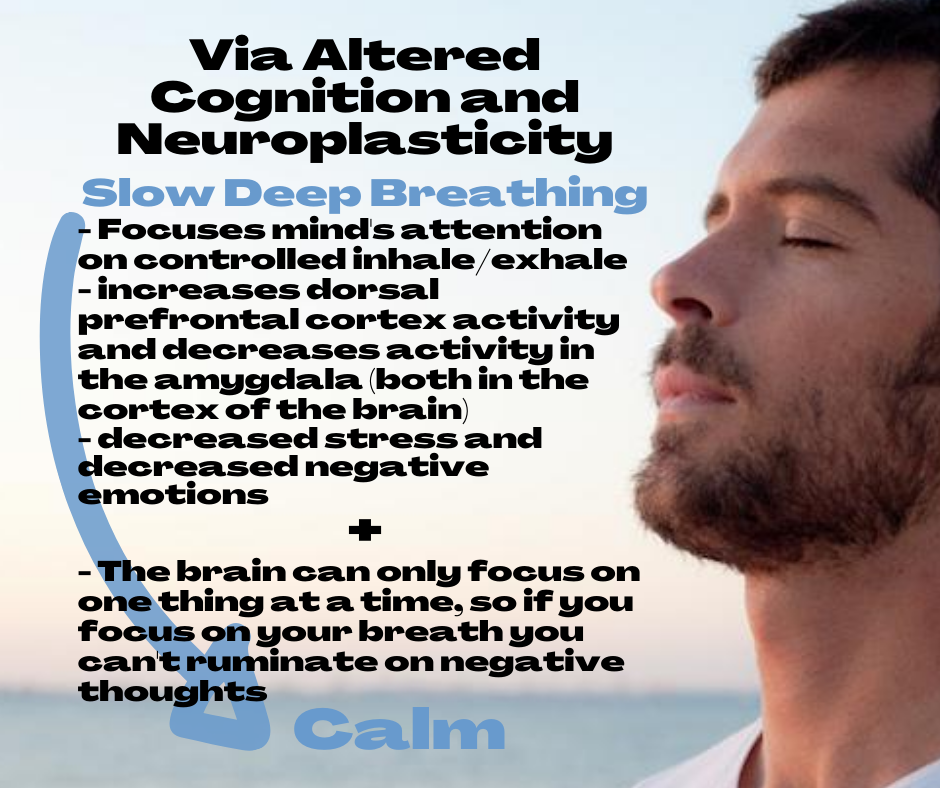
The second means through which deep breathing shifts us away from fight/flight, anxiety and tense muscles is via shifting where our consciousness is focussed. Our conscious mind can only focus on one thing at a time. Focussing on how you are breathing and shifting towards slow deep breathing changes the activity in the emotional centres in our brain causing both a decrease in stress response and a decrease in negative emotions. In addition to this change in the cortex of the brain, if you focus on your breath you can't be thinking about other things such as negative thoughts. So deep breathing helps you jump off the hamster wheel of thought that can pull our headspace into a hole and thus promotes that state of calm we're after.
Regular deep breathing exercises can actually rewire your brain so stress less readily pushes you down the spectrum of ANS function towards fight/flight. This happens through neuroplasticity ~ where the brain is constantly adapting and rewiring itself in response to the feedback it is receiving from within your body and from the outside world. Regular deep breathing exercises can shift a person so "calm" describes their state more often than not. It's a good place to live in. [Read more about neuroplasticity by clicking on this link.]
Two deep breathing techniques have been validated by clinical studies: "Follow your Breath" and "Alternate Nostril Breathing". You can access the details of how to do them by clicking on this link. Another technique highly recommended by therapists is the 365 technique:
365: The name given to a common technique recommended by therapists to counter accumulated stress: at least three times a day, breathe six times per minute (inhaling for 5 seconds and exhaling for five seconds each time) for five minutes. Repeat all 365 days of the year (1).
Changing the length of the inhale or exhale is another element that can help a person focus on and control their breath. It's been suggested that you can tip the balance of function in the ANS towards the PNS and calm by belly breathing (breathing so your navel moves away from your spine on inhalation) and making the in breath shorter than the out breath. For example, breathing in for the count of four, holding the breath a moment and breathing out for a count of six. Focussing on the details here reigns in an overwhelmed or catastrophizing mind and the cadence of the breath shifts the neurology ~ calm is the end result.
Some people are put off by how easy this sounds. Too simple to be effective? No, simply an elegant triggering of an intricate system. A wonderful way to gain control and self-manage the challenges the world throws at us. A great way to off-load stress and prevent it building up in our physical bodies or messing with our headspace.
When is the best time to use the breathing techniques?
- They can be used in the moment when you recognise that you're experiencing a stressful episode such as before an exam, before public speaking or before competing in a sporting event.
- Research shows that for those who experience insomnia 20 minutes of slow breathing exercises before bed significantly improves sleep (fall asleep quicker, less episodes of waking in the night and quicker returning to sleep if one does wake) (2).
- People who live with chronic anxiety or depression will also benefit from implementing regular deep breathing sessions, managing episodic peaks of symptoms and shifting brain patterns through neuroplasticity.
- Breathing exercises will also help to counter the signs of stress that can accumulate in the physical body in time. As mentioned above, it does this by shifting a person towards calm along the ANS spectrum. The reduction in tension in muscles towards normal tone and the concomitant relief from pain is a very welcome change [especially for that person with their shoulders up around their ears and a neat sidestep away from the potential looming headache that could have eventuated].
As Dr Christophe André (psychiatrist at the Sainte-Anne Hospital Centre, Paris) says,
"Why restrict breathing techniques to negative emotions. It is also worth applying them to pleasurable moments, to take time to appreciate and remember them. In short, one can pause and breathe for enjoyment as well as to calm down. (1)"