
The Meerkat Effect
Reviewed August 2026
Those of you who have been following us on Facebook @AdelChiroCentre have recently been enjoying (I hope) my Monarto-inspired observations about the animal kingdom's solutions to common issues of the human frame (see more here). Compiling those analogies has reminded me of another animal metaphor I use a lot to help people understand why they're feeling ongoing pain, and as an example of when our brilliant brains can become overzealous in keeping us safe from injury.
In every moment of life our nervous system is collecting data from the environment around us (need my sunnies because it's glary today; cat fur is tickling my nose; oh, the coffee smells good!), and the environment within us (full tummy; sprained ankle from an injury a week ago still tender when walking; worried about that thing next week; whoever designed this chair should take out a patent on torture devices!). The brain collates all of this data, triages it in each moment, and then orchestrates our response. Absolutely awesome.
Sometimes, life throws us curve balls (e.g. accidents, injury, illness, loss, emotional trauma). Living through "curve ball" moments triggers our sympathetic nervous system response of fight and flight. If you apply the "orchestra" analogy of "brain conducting bodily function" explanation of the human brain and body, then these orchestral moments of fight/flight are analogous to the "Jaws" two toned theme of terror ~ da, da......da, da...... You can feel your body bracing for disaster just thinking about that music, can't you?
[N.B. I discuss the Autonomic Nervous System and the sympathetic/parasympathetic spectrum of function in much greater detail in the blog I wrote on Breathing ~ your way to control where you sit on the Autonomic Nervous System spectrum in your favour - anywhere, anytime. Read more HERE]
Sometimes people get dealt a whole bunch of curve balls in life. This can lead to a scenario where the brain, which bases its predictions about what's coming in life on previous experience, is expecting trouble. In response it becomes hypervigilant, and instead of this nervous system having a range of sensitivity between zero for "nothing/dysfunctional" and 10 for "over the top/disaster" and happily sitting in the middle at "isn't that interesting/hmm, do I need to do something here?", the range spins out to a catastrophized 11, a.k.a.: "it's-the-end-of-the-world-as-we-know-it!!!" and the brain spends every day in an anxious mode of "it could be a major problem". To keep its body safe, this brain ramps up the significance of its perceptions of the environment within and without – technically, this is referred to as having central sensitization. A Centrally Sensitized brain and nervous system can overreact to things that a non-centrally sensitized brain wouldn't even register as a threat. It's an example of where the much lauded neuroplasticity of our brain effectively shoots us in the foot!
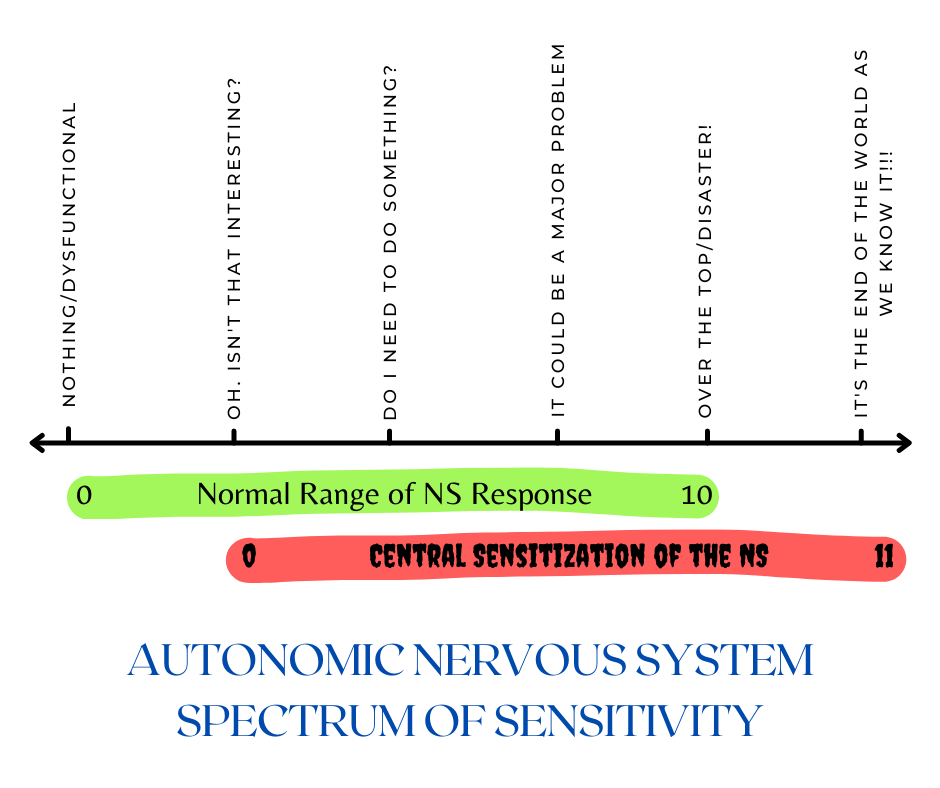 It's perfectly normal to be more sensitive after a "curve ball" while the body is resting, repairing and returning to normal function. This extra sensitivity keeps you from doing yourself further damage while healing occurs, but once the problem is healed then the brain's sensitivity returns to normal range. With a string of curve balls the centrally sensitized brain becomes oversensitive as it anticipates further threat at any moment. An example of this might be someone who burns their tongue on some hot food. Normally the brain will increase the significance of the perception of heat in the mouth while the tongue is healing. If, however, the brain was centrally sensitized, then the person may not be able to drink hot drinks or eat hot food thereafter - even though the person's tongue had healed. This is an example of the brain being overzealously protective and working to prevent any possibility of further burning happening in the mouth.
I often describe this to people as the brain being like a meerkat. The meerkat is alert and ever watching. It picks up every minor change to its environment with the goal of keeping its family safe, and does a good job of it too. Our nervous system can be like meerkats. In emergency situations this can be perfect, just the way it's meant to work. However, if this alert protective mode persists beyond the emergency/trauma/stressful event then we have central sensitization.
With central sensitization the brain is zealously vigilant at keeping the body SAFE. The "meerkat effect" is switched on constantly. It sees the little things as major dramas and often gives a person the perception of pain or dysfunction and, as a consequence, limits their activities to what it considers to be the "safe zone" of function (which, incidentally, is less than what the healed tissues are actually capable of). Central sensitization can be part of the story for people who experience anxiety, fibromyalgia, IBS and chronic pain, among others. The trigger that sets off an episode of centrally sensitised reaction can be anything that the CS brain perceives as a threat ~ examples might include: a movement that is similar to how a joint (now healed) was damaged in the past; hearing a phrase spoken by someone randomly that reminds you of a traumatic episode; a smell or a piece of music or a place that reminds you of a time you were under threat. All of this whether you're actually at risk or not...your brain remembers and it is determined to keep you safe.
Thankfully we can work with a "meerkat-ish" brain and nervous system and slowly re-teach it (through working with the neuroplasticity of the brain) what normal, safe movement and function is. This is something we work on with people at the Adelaide Chiropractic Centre each day. It takes time, persistence and work on the part of the individual, but it can be done.