
Achy Bones and Vitamin D Deficiency
Reviewed August 2026
Sunshine is indelibly linked with healthy bones in my mind. That might seem like a non-sequitur...except for the existence of the fourth vitamin science discovered in 1922 ~ vitamin D (Vit D) (9).
"Our body takes the cholesterol in our skin and uses UVB from the sun to make Vitamin D (Vit D). Vit D swings through the liver and the kidneys, receiving a few structural tweaks, to become the steroid hormone version of Vit D, calcitriol. We get approximately 80% of our Vit D from ultraviolet-B (UV-B) induced production of Vit D in the skin (i.e. from exposing our skin to sunlight) and the rest from dietary intake (1). It is very hard to get Vit D from our diet - you'd have to eat mountains of fatty fish often to meet the body's needs. Thus, sunshine is the best source.
"Calcitriol (bioactive Vit D, the steroid hormone) is known for regulating the levels of calcium and phosphorous in the body, and more specifically, regulating the creation/destruction of bone (which is an ongoing process that happens every moment of every day) and muscle health.
"Normally bone density (managed by calcitriol) increases to a maximum when we're about 25 years old. It then stays relatively stable till we're about 35 and declines steadily across the rest of our lives. We want it to remain as good as possible for as long as possible - an important part of staying strong, fit and able as we age gracefully. To achieve this, we need to maintain good Vit D levels and provide our frame with the trigger to keep bone density up - that's weight bearing exercise. Walking briskly is a good option here."
The above may look familiar to regular readers of this blog as it is taken from one of the first blogs I posted on the website: "Bone Density versus Skin Cancer ~ The Vitamin D Conundrum" (read more here).
Often this time of year brings our first run-ins with the sun for the summer. Usually we're getting back into the swing of managing our sun-smart choices to avoid the possibility of skin cancer, which is a serious danger for Australians. In the blog referred to above I've discussed the delicate balance we have to dance between avoiding the sun (due to the associated skin cancer risk) and getting enough sun exposure to keep calcitriol in normal range. Today I want to delve a little deeper into the minutiae of Vit D and bone health.
It turns out that there are receptors for calcitriol on every cell in your body, not just in your bones. In fact, Vit D/calcitriol is not just a vitamin, it's a steroid hormone which is involved in hundreds, if not thousands of biological processes throughout the body. Vit D is intricately involved in many processes revolving around the metabolism of calcium (Ca2+) and phosphate (PO3-). The research to date has established that Vit D is thus involved in the following processes: bone metabolism; skeletal muscle function; immune system function (research done on lung infection, sepsis and cancer); energy levels (fatigue); the neurology around chronic pain and headspace (depression); and kidney function (diabetes type 2 and gestational diabetes) (1 2 3 4 5,6,7,8,9).
Simple does not come in to play when it comes to Vit D and its widespread roles in the body, however, the goal today is to talk about Vit D and musculoskeletal pain. Let's tease out some pertinent details from the research.
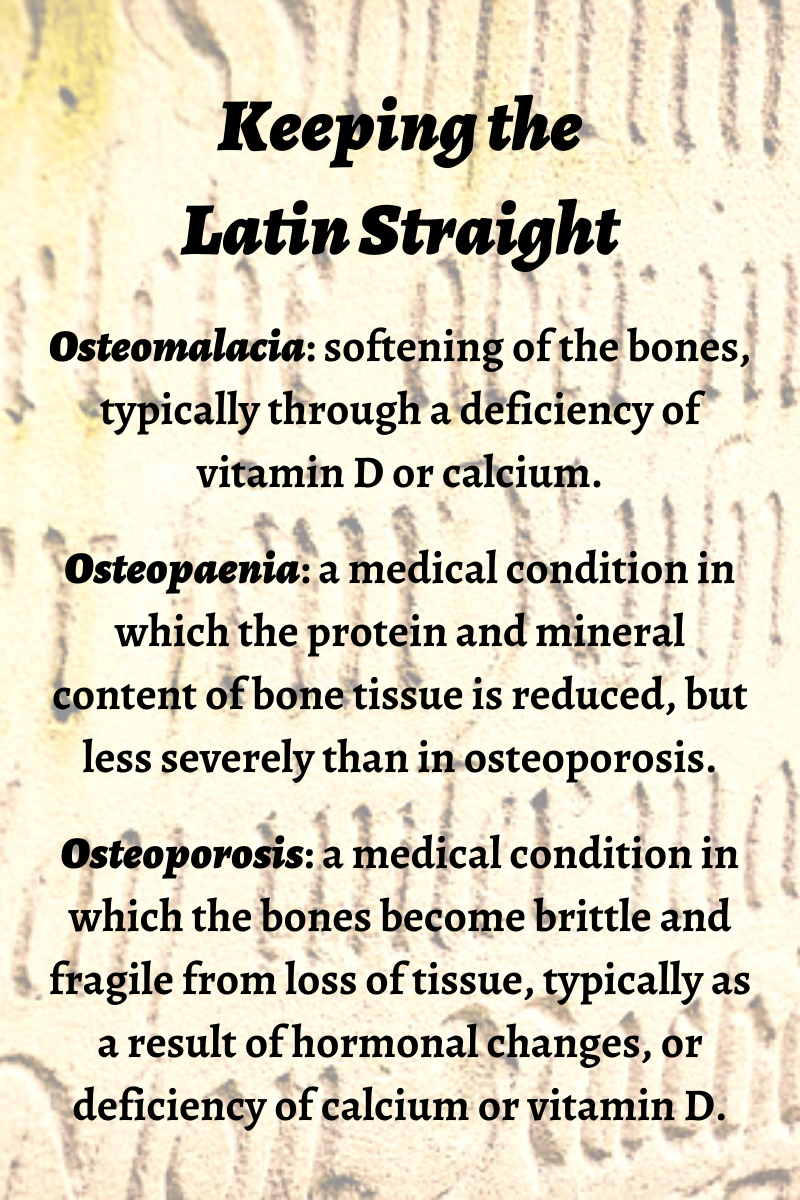
Vit D deficiency disturbs the ability of the cells which maintain healthy bone density and quality (osteoblasts and osteoclasts) to build and keep optimal bone mineralisation. This makes the bone "weak". On x-ray this shows up as bones looking less dense than normal ~ an effect the radiologist will call "osteopaenia" in the x-ray report.
Osteomalacia is the technical term for softening of the bones and is most often caused by Vit D deficiency. In kids it's called Rickets and is more severe because the bones are still growing, which complicates matters greatly and it can lead to malformation of bones. The important thing to know here is that in osteomalacia the lack of Vit D has caused a failure to build good quality bone.
Note that osteoporosis is different. People are diagnosed with osteoporosis when the bone density drops below the normal for their age. In contrast to osteomalacia, osteoporosis is an erosion of bone that has already been built. Once osteoporotic, the poor quality of the bone, which is described as being brittle, leads to increased risk of fracture (read more about osteoporosis in our previous blog HERE). [Incidentally, it is possible to have both osteomalacia and ostoporosis at the same time ~ oh, those poor bones!!]
So, for clarity, osteoporosis is an erosion of bone that has already been built (and Vit D does not play such a large role in this process). Osteomalacia is a failure to build bone properly in the first place due to vit D deficiency (4).
Okay. I did mention it was complicated, but now we get to the "why is Vit D deficiency painful???"
The Mayo Clinic describes osteomalacia symptoms as being "dull aching pain most commonly in the lower back, pelvis, hips, legs and ribs. This pain can be worse at night or when you're putting weight on the affected bones" (4,6). Most people don't even consider that it might be possible that their bones are aching and this sensation is often perceived as achy muscles.
The physiology behind the aching bones of osteomalacia is intricate (7):
- Vit D deficiency (for whatever primary cause)
- Decreased Ca2+ absorption such that the needs of the body are not met
- Increased production and secretion of parathyroid hormone as the body tries to conserve Ca2+ by changing how it's managed in the kidneys
- This stimulates the kidneys to make more calcitriol, but they can't because there's not enough Vit D
- In the bones two things happen:
- As a result parathyroid hormone activates the osteoclasts in the bones to break down bone and release Ca2+ into the blood stream. This causes osteopaenia and osteoporosis.
- The parathyroid hormone causes the kidneys to excrete calcium phosphate. This means there is not enough calcium phosphate to mineralise the bones properly. Despite this osteoblasts (bone building cells) keep making bone matrix (which in a healthy body gets filled with good minerals to create strong bones) and without the minerals the result is "soft bones", or osteomalacia.
- It is believed that the demineralised bone matrix binds water molecules, and as it hydrates, it expands. This effective swelling of the bone matrix places pressure on the innervated and sensitive periosteum (the outer layer of the bone), and this is the source of the bone pain associated with Vit D deficiency.
So, for those who have gone cross-eyed at all that detail ~ in essence:
Vit D deficiency makes the bones soft and the bony matrix then swells putting pressure on the local nerves in the periosteum (the outer layer of the bone) causing a dull achy pain.
Vit D deficiency also causes muscle weakness and muscle pain (especially in proximal muscles ~ those around the shoulders, hips and spine) (3,7,8,9). The detailed dance of Vit D and Ca2+ within skeletal muscle cells (the muscles we can consciously move): (a) isn't completely nutted out by the scientists yet, and (b) would give anyone other than a biochemist who specialises in muscle physiology conniptions...including me...so we'll skip to the summary:
[for those who want the detail, I recommend reading Dzik and Kaczor's review on the subject cited below (9)]
Vit D deficiency alters how muscle cells use energy. This results in the muscle contracting more slowly, not being able to contract with as much force (being weaker) and promotes muscle atrophy (deterioration, possibly the source of pain). Because this effect is concentrated in fast twitch fibres (those that allow fast reactions) this affects a person's reaction times and coordination resulting in an increased risk of falls.
So Vitamin D deficiency affects the musculoskeletal system by:
-
making bones soft and achy,
-
making muscles slow, weak, uncoordinated and achy,
-
and by increasing the risk of falls and fractured bones.
A blood test is the best way to ascertain if you are suffering with Vit D deficiency. Currently the definition of being Vit D deficient is having a blood serum concentration of Vit D below 50nmol/L or 20ng/ml(2). Remember, we get 80% of our Vit D through UVB exposure (the sun!). If supplementation is required, increasing dietary intake isn't going to cut it. Supplementation needs to be targeted and specific to your needs and that requires guidance from your GP.
In the past large doses every 3 months were recommended, we now know this is not the best way to do it (except in critical care). A daily dose leads to a stable availability of Vit D, but there is still no international consensus on the optimal level of Vit D supplementation (2). Note, it is possible to take too much and develop Vit D toxicity, so please follow your GP's guidance. Also you must have Vit D AND Ca2+ supplements to improve osteomalacia (1).
So if you feel achy in your frame and the regular management strategies for musculoskeletal complaints have been exhausted, consider your Vit D levels. Have a conversation with your GP. Follow this up. It might have wider consequences than you know and it can be so easy to fix.
References
-
S Pilz et. al. "Vitamin D Testing and Treatment: a narrative review of current evidence." Endocr Connect. 2019 Feb; 8(2): R27-R43
https://www.ncbi.nlm.nih.gov/pmc/articles/PMC6365669/
-
K Amrein et. al. "Vitamin D Deficiency 2.0: an update on the current status worldwide." European Journal of Clinical Nutrition. January 2020; 74:1498-1513
https://www.nature.com/articles/s41430-020-0558-y
-
A Jones and K Hansen: "Recognising the musculoskeletal manifestations of vitamin D deficiency" J Musculoskeletal Med. 2009 Oct: 26(10); 389-396
https://www.ncbi.nlm.nih.gov/pmc/articles/PMC3188408/
-
P Ingram "Vitamin D for Pain" https://www.painscience.com/articles/vitamin-d-deficiency-and-pain.php
-
F Spritzler, "8 Signs and Symptoms of Vitamin D Deficiency" July 2018 https://www.healthline.com/nutrition/vitamin-d-deficiency-symptoms
-
https://www.mayoclinic.org/diseases-conditions/osteomalacia/symptoms- causes/syc-20355514
-
https://www.mayoclinicproceedings.org/action/showPdf?pii=S0025-6196%2811%2962740-7
-
Michael F. Holick, M.D., Ph.D "Vitamin D Deficiency" N Engl J Med 2007; 357:266-281 DOI: 10.1056/NEJMra070553
-
Katarzyna Patrycja Dzik and Jan Jacek Kaczor "Mechanisms of vitamin D on skeletal muscle function: oxidative stress, energy metabolism and anabolic state". European Journal of Applied Physiology (2019) 119:825–839 https://www.ncbi.nlm.nih.gov/pmc/articles/PMC6422984/#:~:text=Result,development%20of%20skeletal%20muscle%20atrophy