
Can Kids Exercise Too Much?
Reviewed August 2026
In almost every blog I've written and in most conversations with patients I will fit in an encouragement to do more exercise or maintain the good job the person is doing on the exercise front. As Dr Robert Butler (MD, former director of the National Institute on Ageing in America) said,
"If exercise could be packaged in a pill, it would be the most widely prescribed and beneficial medicine in the nation."
Exercise is important, but as with everything, there is a spectrum of possibility and an optimum range to maintain. This is really important when it comes to growing bodies. Unfortunately, many kids in Australia don't get enough exercise and, while that is a concern, today I wanted to talk about those kids who play a lot of sport. When is it too much and how can you prevent injury in these little dynamos?
I currently have a bee in my bonnet about sporting codes demanding huge hours of training for junior members. How that limits variety in the young person's world (physically and socially), plays havoc with the balance in their school/home life (and that of their family) and, not least of all, sets them up for musculoskeletal damage that we used to see in 25-30 year old adults, not 12-15 year olds, as we are seeing now. The sequelae of which can be a bad headspace around sport and or a drop in self-esteem (because the child was "incapable" of the heights everyone was driving them towards and had built up as a reasonable expectation) that they carry into the rest of their lives like dragging a mill wheel behind them.
As Jenni Guest (Physiotherapist) comments –
"...the bar is continually being raised, so coaches and team managers, parents' and students themselves, are pushing children harder in training. Competitions' goals are moving higher, speeds are increasing and weights are increasing, in dance, technical tricks are more complex ... all now to a point where children are required to perform beyond their level of physiological, mental and emotional development. This in turn is leading to potential damage to neuromusculoskeletal systems and wear and tear on emotions and endurance mechanisms. At times, even if children are doing something for fun or social reasons, they could potentially feel the commitment of demands for that of a career."
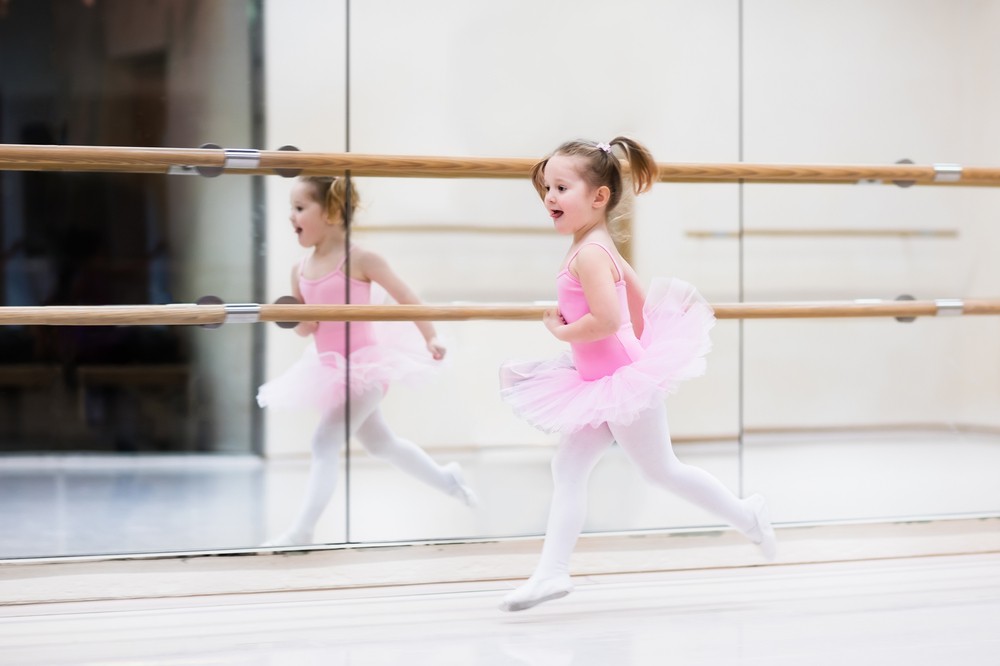
The issue with kids and lots of sport is the fact that their bodies are still growing. There are two possible vulnerabilities in the body here: overuse injuries at the bone/tendon junction and damage to the bones themselves (either at the growth plate or due to lack of bone mineralisation).
In periods of rapid growth the bone grows faster than the muscle and there is increased force placed on the junction between bone and tendinous insertion of the muscle naturally. With kids that play a lot of sport these junctions are repeatedly stressed creating an overuse injury. A common example of this is Osgood-Schlatter's Disease where the child experiences an aching pain at the knee below the patella that is aggravated by playing sport and once they stop playing the pain stops. This is often caused by running sports such as athletics and soccer.
When a bone grows it does so from plates of specialised tissue called growth plates that sit beneath the ends of the bones. There is a weakness at the growth plate until the bone has completed growing (at about 15 years for girls and up to 22 for boys). Repetitive force through the growing bone can damage these growth plates which in turn can cause the bone to grow abnormally. At worst this can require surgery to resolve. An example of this is an apophyseal hip injury (also known as Slipped Capital Femoral Ephiphysis (SCFE) or Perthes' Disease) which is seen in sports like soccer and gymnastics.
The body is still growing till 18 years of age and bones are still mineralising and getting stronger till 25. Repetitive force through a not fully mineralised bone can cause stress fractures. We see this commonly in runners and fast bowling cricketers.
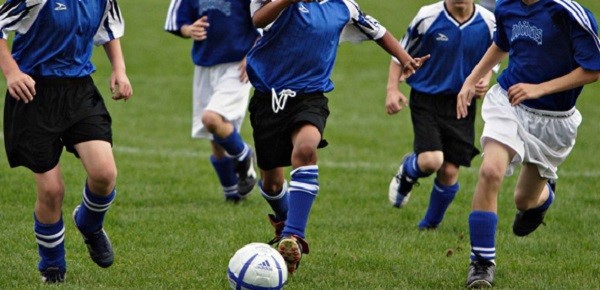
So how much sport is too much?
The Guidance from Science, Sports Physiologists and Paediatricians is as follows:
- Children aged 6 and up need at least 1 hour of physical activity each day.
- The general consensus when it comes to organised sport is the kids should practice/play a maximum of one hour per year of age per week (so an 11 year old can do a maximum of 11 hours of organised training and games per week).
- No more than 5 days per week of one sport.
- Kids should not specialise in one sport before puberty.
- Children should be encouraged to try a variety of sports.
- Children should join one team and one sport per season.
- Kids who are passionate about one sport should take 2-3 months off per year from that sport (i.e. 1 month out of every 6 off).
- Rest days are required for recovery of the tissues as kids are skeletally immature – that's one day off per week from organized activity. Time not being so active is needed to build quality muscle and bone, and to get stronger. [This can be unstructured play and is not a licence to sit in front of computer games!]
- Long distance running is not recommended for kids under 18 years of age as it can damage growth plates in bones and lead to malformation of joints.
- Weight training at the gym:
- 6-12 years old – use their own body weight against gravity (push ups, squats, sit-ups)
- 13-18 years old – cardiovascular equipment only (treadmills, exercise bikes, cross trainers, no weights)
- 18 years old - free access to gym equipment, including weights, but still need at least one day a week when they do not go to the gym for recovery of the tissues
"Young athletes who participate in a variety of sports tend to have fewer injuries and play longer, thereby maintaining a greater level of physical activity than those who specialise before puberty"
American Academy of Pediatrics
Variety is an important point. A variety of different sporting activities (e.g. swimming, dance and football) will cross-train the body so that one joint doesn't take the brunt of the load in the same way constantly.
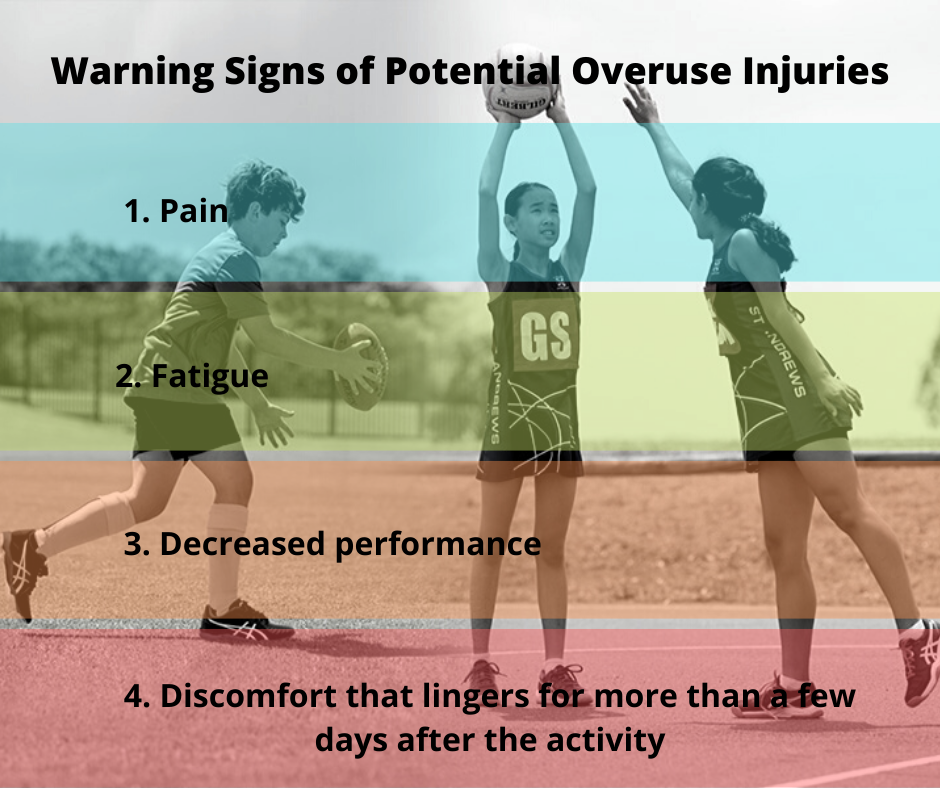
That said, each child is different and what one child will thrive on might be too much for the next. So what do we keep an eye out for to prevent overuse injuries in our kids? Firstly, stick to the guidelines detailed above. Then be alert for the following: pain, fatigue, decreased performance or discomfort that lasts more than a few days after the activity.
It is also important to remember that "burnout" can be a problem for kids that do too much too. Signs of burnout include disturbed sleep and a reluctance to go to an activity they once loved. The last thing we want is for kids to lose their good relationship with physical activity – that would lead to poor lifestyle choices as an adult and all the detrimental health risks that come with those poor choices.
With the start of the school year many parents are currently juggling umpteen after school commitments into the family calendar. It can be overwhelming - especially when there might be multiple kids and multiple sports. Finding a balance for the child and for the family can be tricky. Remember the guidelines above. Let the experts take the flack when you inform your little cherub that a variety of activities would be better than five days of one sport and that a day off from organised activity is mandatory – for the health of their growing body and for everyone's sanity!
-
https://journals.sagepub.com/doi/abs/10.1177/1941738117690847 (viewed 11/2/20)
-
http://www.ortho.ufl.edu/sites/ortho.ufl.edu/files/handouts/Preventing-Overuse-Injury-In-Children_0.pdf (viewed 11/2/20)
-
https://www.webmd.com/parenting/raising-fit-kids/move/features/how-much-exercise#1 (viewed 11/2/20)
-
https://www.irishtimes.com/life-and-style/health-family/parenting/children-and-exercise-how-much-is-too-much-1.2728318 (viewed 11/2/20)