
Fascia, the bits in-between
Reviewed August 2026
Fascia. Most people I asked today only knew "fascia" as "a ligament-y-like-thing on the bottom of your foot that can be quite painful" [they're thinking of plantar fasciitis]. You'd be forgiven for thinking the same – even the musculo-skeletal experts out there have downplayed fascia's importance as "just connective tissue that we dissect out as inconsequential as we try to get to the important stuff" [muscles, organs, joints]. These perspectives really do the magnificent web of tissue that runs throughout our body a significant disservice. In all fairness though, science has only started to reveal fascia's role in the body in the last decade or so.
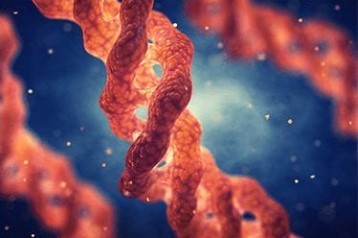 Fascial tissue has three main components. It consists mostly of strong collagen fibres (as seen in the adjacent electron microscope image) with fewer stretchy elastin fibres, and then the cells which constitute only 5% of the tissue (which is a tiny amount).
We now know there are two types of cells in the fascia: fibroblasts (makes collagen and elastin fibres); and fascicytes (makes the hyaluron-rich extracellular matrix, or ground substance – hyaluronic acid is the thing which makes our fascial layers glide).
These sheets of tissue are arranged in layers, and the layers can be made of "dense" or "loose" fascia. The dense fascial layers are strong and less elastic, working to transfer forces across the body. The loose layers of fascia are filled with a watery "ground substance" (containing hyaluronic acid) which acts like a lubricant such that the different layers can slide and glide across one another during movement.
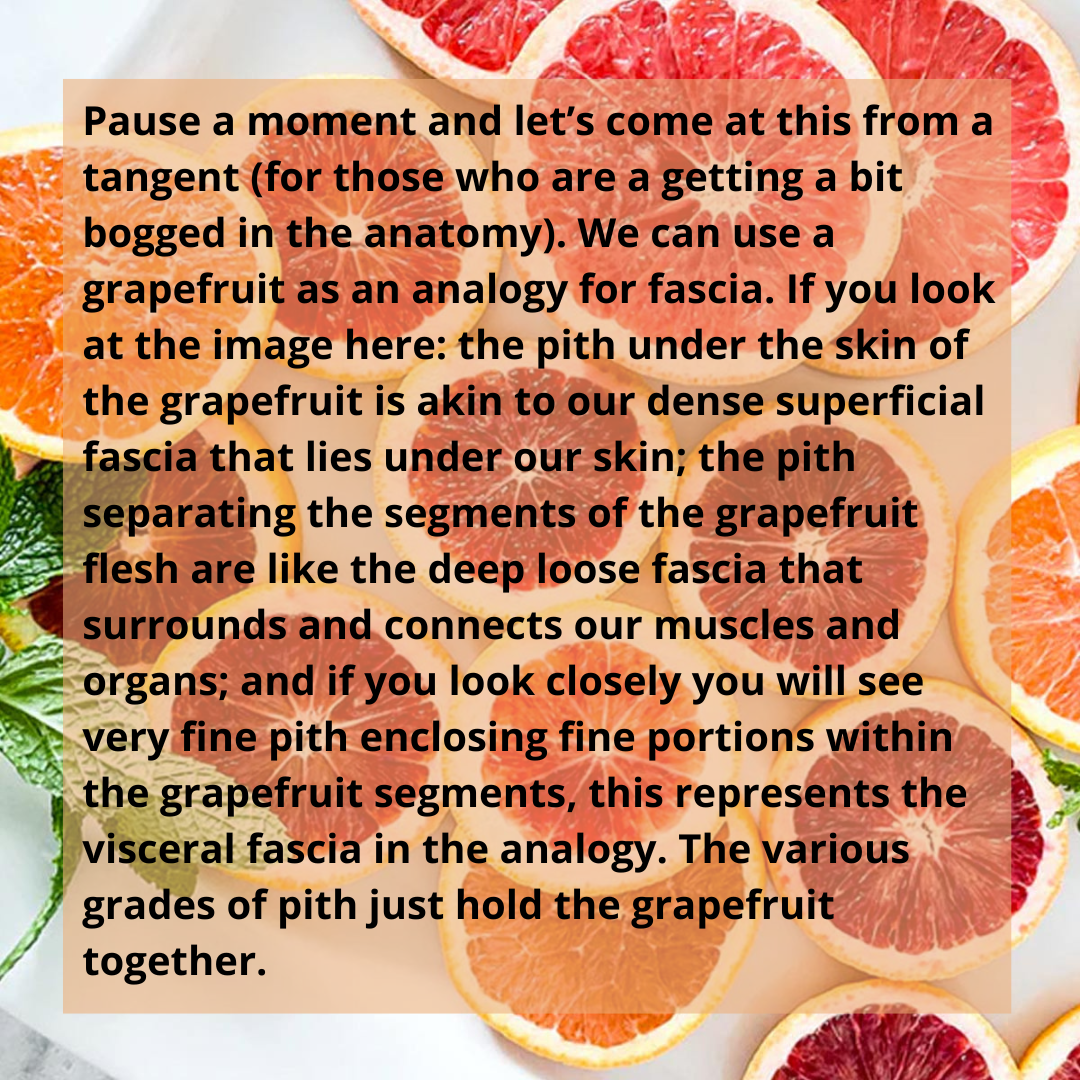
This fascia is divided into three categories: the superficial fascia, a dense collection of layers under the skin; the deep fascia, a looser web of layers that surround our muscles and organs and connects them to one another; and the visceral fascia which lines the body cavity and holds the organs in place.
In total, the fascia is an intricate network that holds the body together.
As with every tissue in the body, fascia contains nerve endings which provide data back to the brain about the goings on in the body. In the superficial fascia under the skin these nerves collect data about pressure, temperature and movement. The deep fascial nerves (found around muscles and organs) collect data about proprioception (where we are in space) and nociception (pain). Interestingly, research shows that the deep fascial nerves produce the sensation of radiating pain (like that experienced in Delayed Onset Muscle Stiffness (DOMS) and fibromyalgia) as opposed to the localised pain perceived on stimulation of pain receptors in the skin and muscle tissues.
The funky thing about fascia is that the fibroblasts and fibrocytes that build it respond to the forces we put through our bodies to create strong sheets of tissue that hold things in place and transfer forces through the body. Or they create stretchy webs that allow for movement. The extracellular matrix (or ground substance) in the fascia also responds to how we are treating it, resulting in a spectrum of fascial tissue function ranging from free gliding movement to stiff restricted movement. Our fascia is thus plastic and dynamic, and the state of our fascia is a direct result of how we have used it...another reflection of our health status in the moment.
 Okay, enough anatomy and histology.
Why does your fascia matter?
...and how does it impact on you each day (beyond preventing you from existing as a mixed-up pile of mush on the floor :))?
"People with chronic lower back pain (LBP) have thoraco-lumbar fascia that is 20% stiffer than people without LBP" Langevin
Fascia gets "stiff" when multiple layers get stuck together and the loose layers stop sliding. Science has identified a bunch of different things that influence how stiff our fascia is. Here's a thought provoking (though surely far from complete) list:
- Lack of movement allows stiffness in the fascia where adhesions are created and collagen fibres physically link adjacent layers. Stiff fascia can limit movement and alter movement patterns (causing excess load on other tissues ~ muscles and joints) and it is conceivable that it could also impact on the function of your organs (e.g. limiting lung volume or smooth bowel movement).
- New thinking relates post exercise soreness and stiffness to injury or inflammation in the fascia (A.K.A. DOMS).
- Prolonged inflammation in the fascia causes the body to establish more pain nerve endings in the fascia, rendering a person more sensitive to pain (a possible reason for Fibromyalgia).
- Prolonged stress ramps up the fight/flight reaction in the autonomic nervous system, more adrenalin is produced which results in increased fibroblast transition to myofibroblasts (inflammatory cells) and consequent fascial contraction (= stiff fascia).
- Oestrogen contributes to making more elastic fascia (...so maybe menopause brings greater stiffness...?).
Thus, the relative stiffness of our fascia is the sum total of hormonal, chemical and mechanical input over time.
If stiff fascia contributes to reduced movement and increased pain perception, it follows that stiff fascia is something we would like to avoid. The best news here is that most of these factors influencing fascia can be moderated by your daily lifestyle choices.
According to the research which delivered us the understanding dot pointed above, both an anti-inflammatory diet (read more here) and maintaining a good headspace (read more here) would help to reduce stiffness in our fascia. But should we be stretching?
Movement is required to keep our fascia healthy. Not just the layers of collagen and elastin that hold us together, but also specifically the ground substance (or extracellular matrix). This ground substance functions as a shock absorber and is an important part of our immune system which is relevant to inflammatory disorders, scar tissue formation and the spread of cancer. We want it healthy!
In 2020 pig based research, Langevin et al established that stretching the lower back for 5 minutes twice a day both
- Reduces the size of an area of inflammation, and
- Stimulates a series of anti-inflammatory changes in the fascia.
Subsequent 2021 studies at Harvard Medical School are also suggesting that inflammation is down-regulated after stretching.
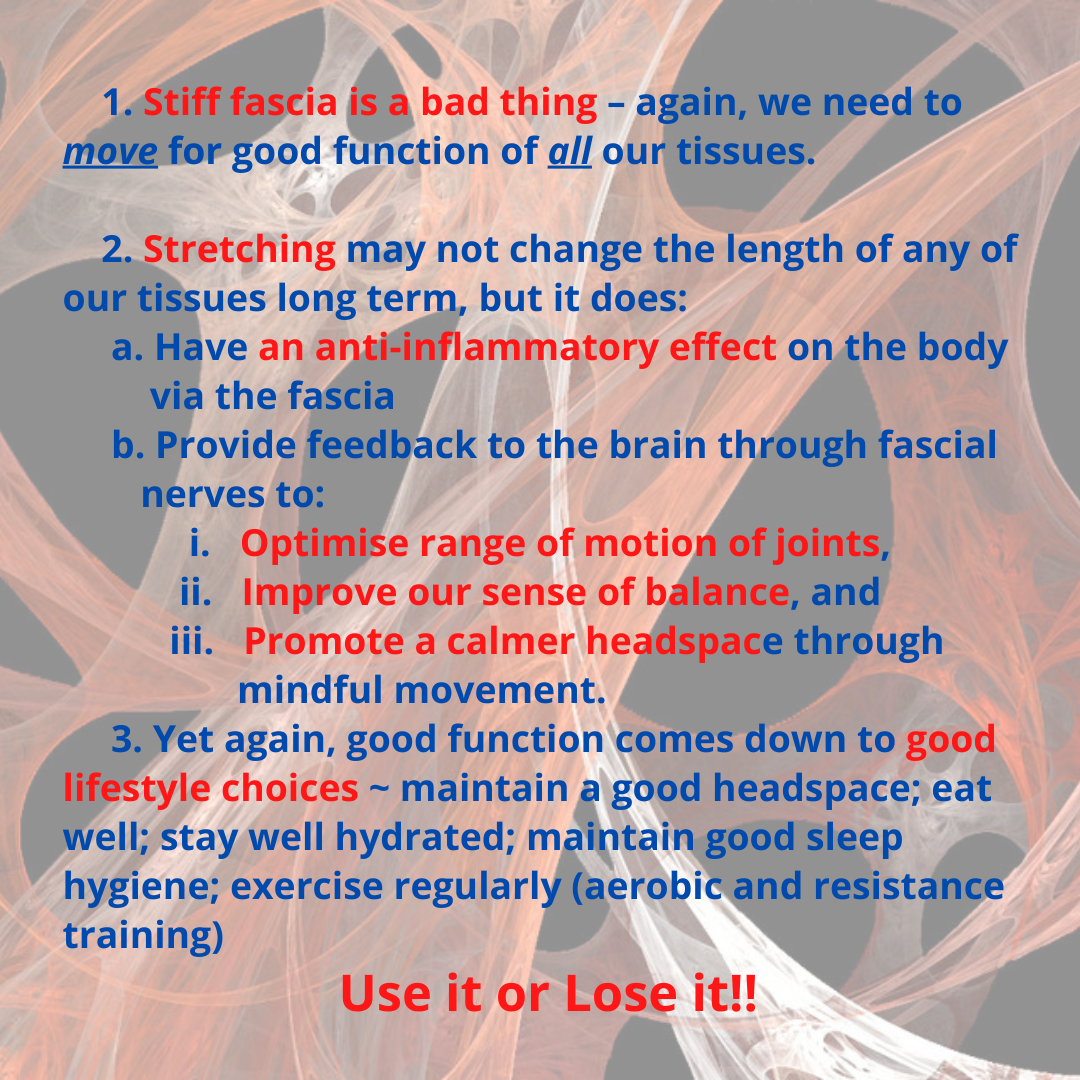
This makes the question, "To stretch, or not to stretch?" seem a bit of a no brainer, but historically there has been significant contention on the topic. I will address this in my next blog, but I've summarised the bits that grab me out of all these myriad of puzzle pieces below:
As a chiro I'm always telling people they need to move. This growing understanding of fascia and its vital role in how our body functions only serves to reaffirm that human bodies need to move, and move often, for optimal function and health.
References:
-
Vergara D. M., Berrueta L., Langevin H. + 4 Authors; 2020, "Establishment of a Novel Porcine Model to Study the Impact of Active Stretching on a Local Carrageenan-Induced Inflammation", American Journal of Physical Medicine & Rehabilitation
https://www.semanticscholar.org/paper/Establishment-of-a-Novel-Porcine-Model-to-Study-the-Vergara-Berrueta/0daff7a991b7761b0ab008cfd81baa5bb27afa6c
-
Stecco C. et al, 2018 "The fasciacytes: A new cell devoted to fascial gliding regulation", Clin Anat. 2018, 31(5):667-676
https://pubmed.ncbi.nlm.nih.gov/29575206/
-
Wilke J., "What is it good for? An evidence-based review of stretching in sport and movement"; Fascia in Sport and Movement, Chapter 10, p 117-28; 2021 Handspring Publishing, United Kingdom
-
Williams C., 2022; "Your second skin", New Scientist, 14 May 2022, p 38-41