
How Active Are You? ~ (a) Sedentary Behaviour
Reviewed August 2026
Well, thankfully better minds than mine have bent their neurons to the task of figuring out this health conundrum. Unsurprisingly, it turns out to be a little more complicated than just "walk 10,000 steps each day" ...though that will definitely help!
This blog evolved into a behemoth. So much so that I ended up dividing it into three parts because there was just too much data to digest in one hit. It spans from death as a measure of health (not the good end of the spectrum!), to comparing apples with oranges on the exercise front (is there a "best" kind of exercise?), to a 1960's marketing whim turning into a worldwide exercising phenomena that actually holds water scientifically (!). I found it interesting. I hope you find some gems of knowledge to help you stay healthy along the way too.
Part A ~ Sedentary Behaviour
There is a list. A "Compendium of Physical Activities" (CPA), which documents how much energy our bodies use to perform each task. This CPA is a very comprehensive list. For example, there are 17 different measures for how much energy you use riding a bike ~ from racing and drafting behind another rider to cycling for transit to work to riding an unicycle...! These days they've calculated equations to enable you to tailor the numbers to an individual with respect to age, sex, height and weight. This makes the list much more useful.
This gives us a handle on type and frequency of activity.
Then, instead of using a measure of health, which has too many moving bits to quantify simply, these scientists have used the absolute of death as their stick in the mud. They talk about it in terms of all cause mortality.
"All Cause Mortality" is a statistical measure of a population's risk of dying due to any cause (disease, trauma, hazardous exposure). It is measured in clinical trials and used as an indicator of the safety or hazard of an intervention. Having a lower all-cause mortality risk is ideal, as it means you are less likely to develop or die from any cause of death, including the leading ones.
[Incidentally, the Australian top 5 leading causes of death 2017-2021 are: ischemic heart disease (heart attack), dementia, cerebrovascular disease (stroke), lung cancer, and chronic lower respiratory disease.]
It turns out that your all cause mortality risk, your chance of dying for any reason, is affected by your level of activity ~ both how intense your physical activity is (type and frequency of activity) and how often you do it (duration).
Spin this morbid, death focussed measure around, and this means our health and wellbeing is directly affected by the type, frequency and duration of activity we put into our days.
The next step was to categorise the energy expended doing different activities into categories of energy expenditure so the scientists could compare apples with oranges (e.g. the energy expended during an hour of Pilates being compared to that used in an hour of badminton).The scientists measure the energy used to do a particular activity in units of Metabolic Equivalent Task (MET). One MET is defined as a ratio of work metabolic rate (how much energy is being used in the body to achieve that task) to the standard resting metabolic rate (RMR = 1kcal/(kg/h)).
Thus, physical activity is categorised as
- (a) Sedentary Behaviour (1.0 - 1.5 METs)
- (b) Light Intensity (1.6 – 2.9 METs)
- (c) Moderate Intensity (3.0 – 5.9 METs)
- (d) Vigorous Intensity (>6 METs)
Aha!! Finally we come to that word ~ SEDENTARY.
SEDENTARY BEHAVIOUR is defined as any waking behaviour such as sitting or leaning with an energy expenditure of 1.5 MET or less.
Some examples of sedentary behaviour include television viewing, playing video games, using a computer, sitting at school or work and sitting while commuting.
So, why is being sedentary bad? Because it increases our risk of all cause mortality! There has been oodles of scientific effort put into the nitty gritty of why and how sedentary behaviour impacts our health in a negative fashion. I've collated a summary in the graphic below. I'm sure future scientific efforts will show us this is not a complete list of effects and consequences, but it's a daunting enough list to get me moving more.
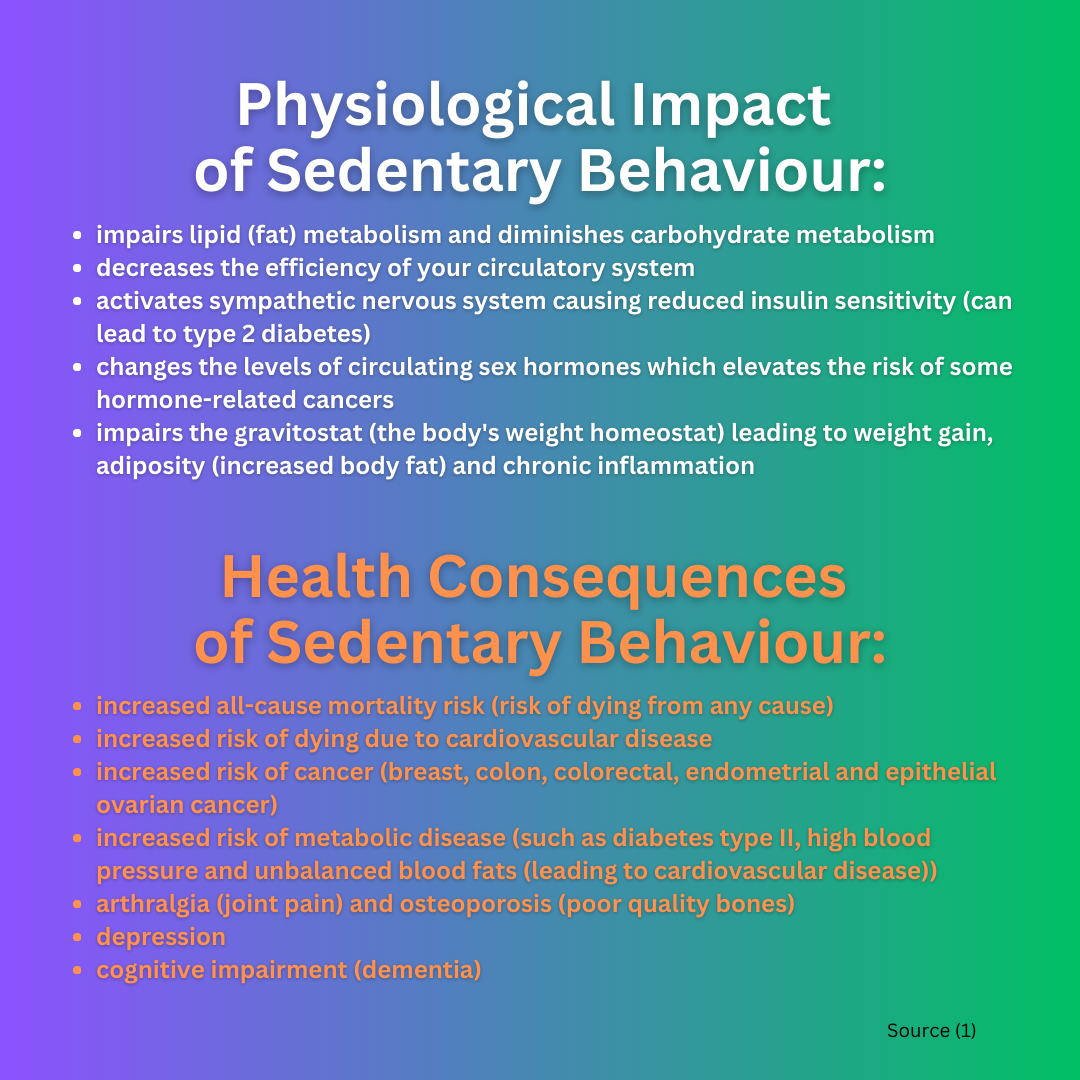
We know that spending too much of your day being sedentary increases your all cause mortality risk more than being a smoker does, and decades of public health efforts have made us all very aware of the health dangers of smoking cigarettes. That says it all.
Examples of Light Intensity activity include walking slowly, playing pool (billiards), croquet, fishing, and light housework such as cooking, dusting, ironing, vacuuming, folding laundry, washing dishes, and putting away groceries.
Examples of Moderate Intensity activity include golfing, swimming, brisk walking (at least 4 kilometres per hour), water aerobics, dancing (ballroom or social) and gardening.
Examples of Vigorous Intensity activity include jogging or running, swimming fast, cycling fast or on hills, singles tennis, football, and aerobics.
Further research into sedentarism has parsed out what forms of inactivity have the worst impact on your all cause mortality risk. Sedentarism affects both your physical health and your mental health.
Mentally active sedentary behaviour such as reading books or newspapers, driving, attending a meeting, knitting, sewing or using a computer increase all cause mortality risk, but do not impact on the risk of developing depression. Mentally passive sedentarism, such as watching TV, sitting listening to music, sitting perusing social media on a screen and talking while sitting are linked to an increased risk of depression. It is postulated that passive sedentary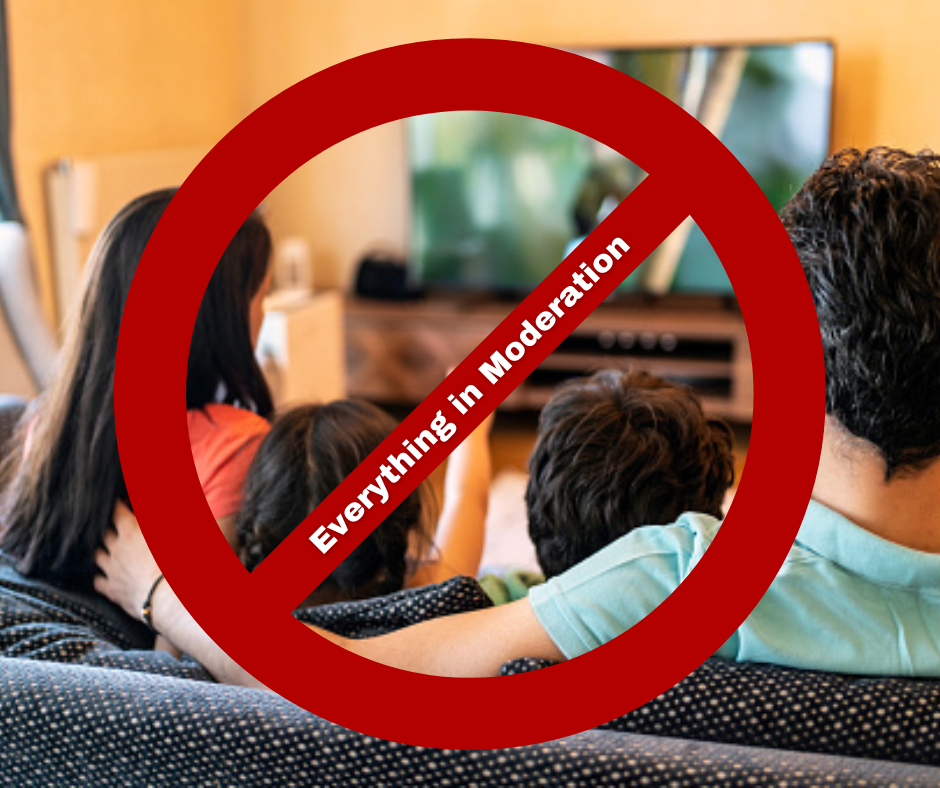 behaviours are linked to depression through either lowering in person social interactions or reducing the time being physically active.
It seems that TV watching is the worst kind of sedentary behaviour. Neither the brain or the physical frame are being stimulated. Research shows that television viewing for over 3 hours per day increases a persons mortality risk regardless of the physical activity they do. People who watch television for 5 hours or more per day have "markedly high mortalities". It really doesn't help if you don't move much and you eat more.
As a chiropractor, I come up against sedentary behaviour when a person has been less active to the point where they start losing their strength. The muscles stop doing their job as well, the body weight starts hanging off ligaments and joints, posture and optimal function of the frame slides, pain and discomfort start to be a part of the person's day, and their ability to achieve the things the want to do starts to decline. After time this develops into arthrosis (inflammation of the joints and joint pain). This is also called deconditioning.
Another facet of this that is relevant to the care I provide is that sedentary behaviour in the form of lack of weight bearing activity, means we lose the trigger to lay down strong healthy bone. This leads to osteopaenia and osteoporosis, and consequently an increased risk of falls and broken bones. You can read more about this here.
These are just a couple of reasons why I'm always encouraging people to be more active and exercise regularly. There is an everyday opportunity here to choose a higher quality of life for yourself. It seems like a no-brainer to me.
So what must we do to shift this? Be more active is the short answer. The good news is that research shows a person with a sedentary lifestyle can make changes which have a big impact on their all cause mortality risk quite easily though. It only takes 30 minutes of activity added to your day to shift your all cause mortality risk!
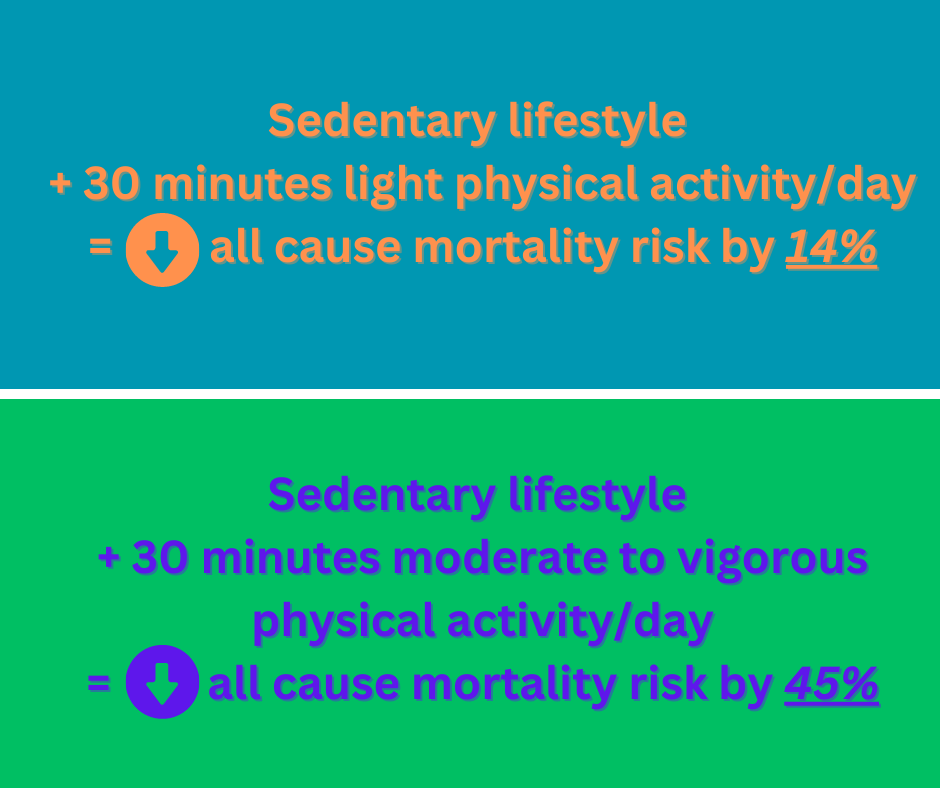
It's important to note that the risk factors associated with a sedentary lifestyle also decrease in magnitude with an increase in the number of times you break sedentary behaviour in a day. So sitting at the desk or in front of a screen for hours at a time is mitigated by introducing movement breaks. Getting outside in your lunch break and going for a brisk walk is an excellent change to introduce (read more about this here), but if you can also set an alarm to remind you each 30 minutes to have a mini stretch/movement break, that's one step better.
2022 research by Moore et.al shows that for people who sit for 7.5 hours per day, if they can interrupt the sitting every 30 minutes for a 2 minute "activity snack" of walking or 15 body-weight-only squats there is a significant improvement in digestion and maintenance of muscle mass and quality. So their gut works better and they stay stronger. An excellent pay off for effort in my book!

For me it's simple. We need to move to stay healthy. Move often, use our whole body and make sure resistance (e.g. weights/swimming/resistance band/reformer Pilates) is part of the deal. If we don't move our body deteriorates, our brain deteriorates and our all cause mortality risk increases.
People who choose a sedentary lifestyle live fewer days, and those days are of a lesser quality health wise. Move it or lose it. (Anyone hear an echo...?)
In the next blog we will look at just how much exercise is enough to lower our all cause mortality risk and keep us healthy. You can access the next blog by clicking on this link.