
Backpacks
Reviewed August 2026
At the start of the year there's a huge flurry to get all the kids ready for school again. Uniforms (when do they not shoot up like weeds over summer?!), stationary, new shoes, new bag.... I had several families come in and ask for tips regarding or tweaks to their kid's school backpacks. This is something I'm always happy to do as how a growing body carries this load is important. Sometimes parents just need to outsource the good advice they already know regarding backpacks, as teens may take advice from an authority outside the family unit that they would only perceive as white noise coming from loving parents.
Additionally, throughout the year I regularly advise people on the bags they use to transport their daily needs ~ including the dastardly laptop computer. The brick of knowledge, communication and poor posture (laptop) has amplified the need for students and office workers to be mindful of how they are transporting this load. The covid-19 driven work from home (WFH) revolution has ratcheted it up even more, as people are now lugging their entire offices (plus or minus the kitchen sink) to and from the workplace several times a week.
So lets revisit the ergonomics of carrying a load and how to make a backpack work for you rather than being a source of trouble biomechanically.
Carrying a load (including lifting it onto your back)
Even the lightest load carried for a long time can be a challenge to your body (imagine the page in medieval times being punished by holding a 500g rock at arm's length, shoulder high for hours... Hmm...can't resist the parallel with people in current times holding their phone at arm's length...:)). For that reason, paying attention to how we carry a backpack matters.
[The dimensions of the backpack, the straps and how you fit them to your body, plus how you pack the load into the bag are all factors that are relevant here, but we cover those details below.]
The cardinal lifting rules:
- Bend your knees and lift with your legs (see our blog on how to lift well here)
- Keep the load close to your body
- Keep the load balanced evenly
- Don't let the load shift around
- Lift only what you are fit for (that pertains to both weight in kilograms AND duration in time; also, "what you are fit for" is age related in terms of whether the skeleton is still growing or not)
That said, getting a loaded backpack onto your back without risking your spine takes a little forethought. Lifting, scooping one arm through a strap and hoisting to twist the whole thing onto your back...not a problem for someone fit and strong, but I can't tell you the number of times I've had someone come to me describing just this method of injury.
In an ideal world we have both time and a handy waist high surface. Lift the backpack safely onto the surface with the straps facing you. Turn your back to the bag and slip both arms into place. Fasten waist/chest straps. Lift with your knees. Voila!
The right bag
[Here I'm talking about daypacks and school bags, not a hiking backpack that would hold all your worldly belongings for a trek in the bush or an adventure around Europe.]
Bags are like chairs ~ in that they may look awesome, but make you feel absolutely miserable if you spend any length of time using them. Some designers have a lot to answer for and this is another example of "looks are not everything"!!
Bags with one strap, whether over-the-shoulder or across-the-body may be convenient for access to the contents of the bag, but they inherently create an uneven load across the body. This may not be an issue if you have a strong upper body/neck and the weight is light, but if you don't tick both of these boxes, bags with one strap will upset your spine over time.
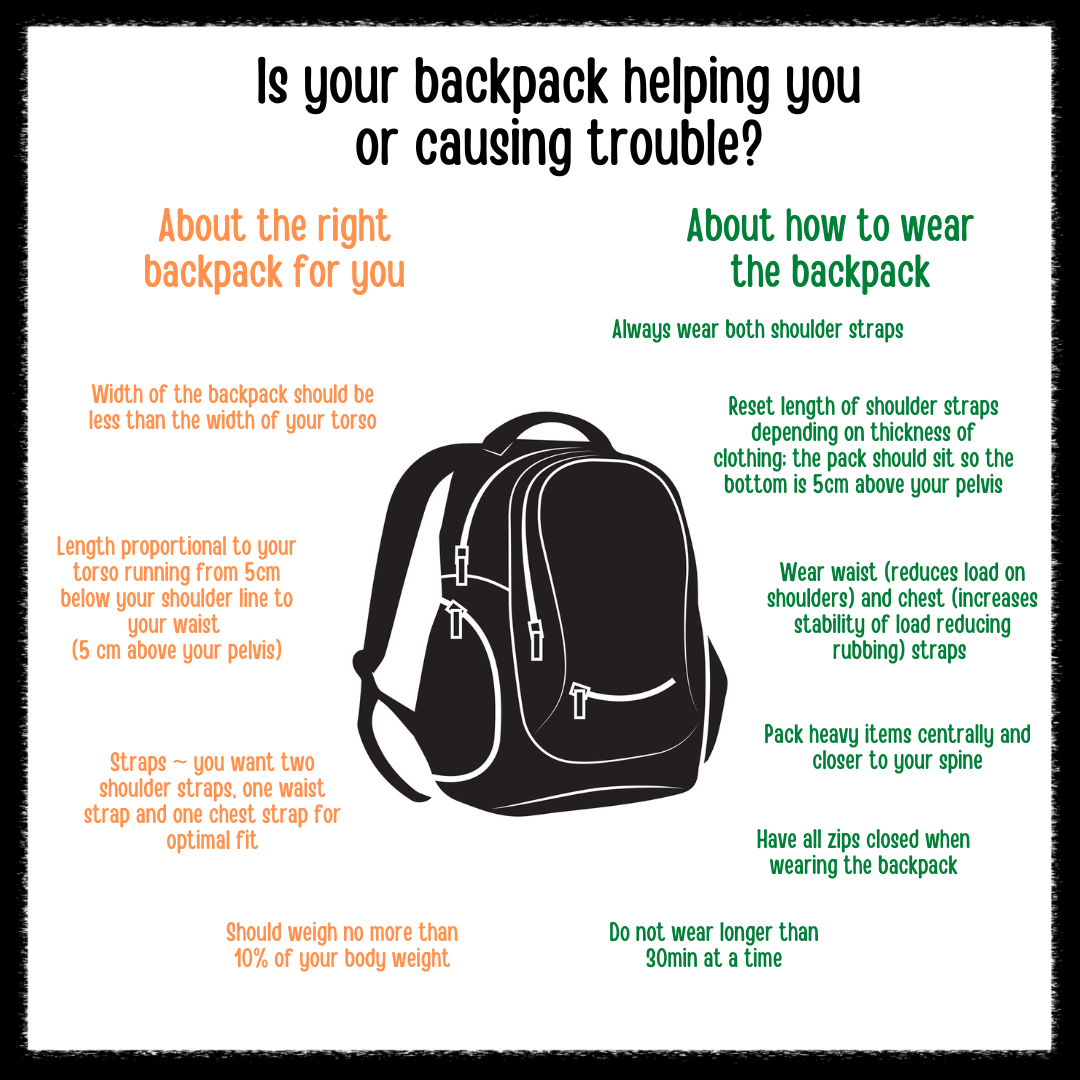
Backpacks, having two shoulder straps, promote a more even load and a happier body. Add a waist strap and the load is transferred through to your pelvis and legs properly. Go one step further with a chest strap and the load becomes more stable and the incidence of chaffing from the shoulder straps is reduced. Straps, when used, help you carry the load well.
Ideal dimensions (especially important for kids ~ a bag to "grow into" will not help their spine grow well):
- Length: it should run from 5cm below the top of your shoulder to 5cm above the waist.
- Width: less than the width of your torso
- Weight: no more than 10-20% of your body weight ~ this is a huge issue with school students, they need to use their lockers at school)
The Australian Chiropractic Association collaborated with Spartan to develop a backpack that ticks all the boxes. You can find more details on that here.
Fitting the backpack to you
I think I've mentioned shoulder straps a lot already, but there's more. The length of the shoulder straps will affect how the load of the backpack impacts your spine.
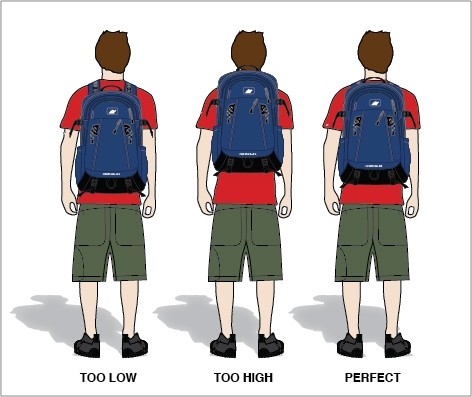
The length of the shoulder straps should place the backpack top 5cm below the top of your shoulders and the bottom of the backpack at waist level. If this is not achievable then you may need a shorter backpack (especially relevant for kids).
As mentioned above: the waist strap transfers the weight to your pelvis and legs; the chest straps will hold the backpack close to your body, stabilising the weight and preventing chafing.
It's worth mentioning that if you change the number of layers of clothing you're wearing, you'll need to alter the length of the shoulder straps to suit. Without this adjustment the load on your shoulders and lower back changes, and not in a good way. People often leave the straps loose to accommodate an extra layer of clothing now and then – again, this is playing fast and loose with your spinal health.
Packing the backpack with a little thought will also help how your body deals with the load. A day pack should weigh no more than 10% of your body weight. Heaviest items such as the brick/laptop should be placed closest to your spine (carry weights close to your body). Other materials should be placed so they don't move around as you walk so a shifting load doesn't stress the spine.
What NOT to do in the interest of having a happy spine:
- Wearing the backpack by slinging one strap over one shoulder = uneven load on the neck/upper back/shoulder and poor posture which can affect the way you walk and cause problems in other joints such as the lower back, hips and knees.
- Wearing the backpack with both straps, but with the shoulder straps too long and no waist belt = the person leans forward to support the weight of the pack causing poor transfer of weight to the pelvis plus the bag will swing side to side creating shear forces through the spine. This results in subsequent shoulder, thoracic spine and lower back pain and strain.
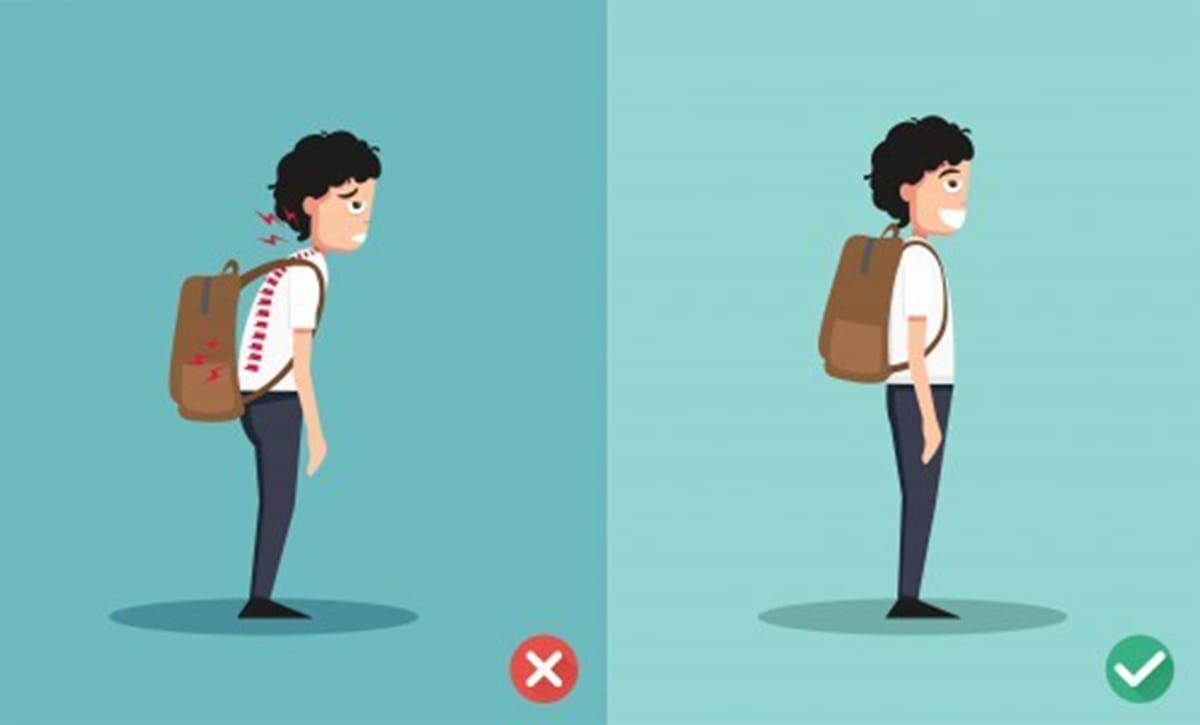
- Packing too much into your backpack weight wise (should be no more than 10% of your body weight). In this case excessive weight on the shoulders can impact on arteries and nerves in the neck causing neck pain and other problems in the arms (e.g. pain, pins and needles, weakness, cold).
- Wearing the backpack for too long a period of time. Ideally we should not wear a backpack longer than 30 minutes at a time. Our body (and brain) needs a change of posture and more movement through our spine, and other joints, than is available when wearing a backpack.
Please don't choose a backpack just because it looks a particular way. Choose one that suits your body. Then use it as designed to lessen the load on your body. Your body will thank you for it!
If you would like some more tips on fitting your backpack to you feel free to bring it along to your next appointment. Give us a call at the Adelaide Chiropractic Centre on 8221 6262 to make a time now. Looking forward to seeing you soon!