
“Pins and needles” (P&N), “tingling” or “prickling” in a hand or foot (or thigh, or shoulder, or along a rib…it can happen anywhere on the body) is a complaint many people present at my practice with looking for help. It can be a quite distracting and disturbing feeling that interrupts your day (or night) and makes you wonder, just what is it that your body is trying to tell you?
Let me interpret 😊
So what causes P&N?
The causes for P&N can be split into two main categories. Those caused by reduced blood supply to the region, and those caused by irritation to the nervous system.
Let’s cover blood supply first. At the less sinister end of the spectrum are those moments when you’ve sat or layed in a particular position for a period of time such the blood flow through to that part of the body is restricted to a degree. Then, with the plumbing backed up and less oxygen supplied to the tissues, the brain gives you the sensation of P&N in the area, making you uncomfortable/bothered enough to get moving. This movement and changed biomechanics allow the body to get the blood flowing again ~ problem solved.
At the more serious end of the spectrum, we have vascular claudication. This is when the body lays down fatty plaques inside the blood vessels limiting the amount of blood that can get through. This happens mostly in the legs. In this scenario, the amount of blood reaching the legs and feet can be restricted. Add physical activity, and the mind and heart may be willing, but the vascular system just can’t get the blood where it needs to go due to the restricted space, and a lack of oxygen to the tissues results in P&N.
With vascular claudication, the P&N are activity based ~ they come on after you walk a certain distance, but stop if you rest for 5-10 minutes when the vascular system catches up and brings the oxygen supply to the leg back into balance. Other signs that come with vascular claudication include cramping, aching, heaviness, cold skin, or pale colour in the extremity. If you are experiencing such a pattern with P&N, you need to speak to your GP about a referral to a vascular specialist.
The other reason for paraesthesia, or P&N, is irritated nerves. This is something I help people with every day in my practice. If the brain detects that a nerve is stretched, squashed, chemically irritated (the most common, e.g. by inflammation) or damaged, it will shout about it and ask for you to change your actions (the activities that caused the problem). It does this by giving you the sensation of P&N in the patch of skin which is supplied by the affected nerve. It’s quite a predictable map, which is why the chiro or musculoskeletal therapist wants to know exactly where you are feeling your P&N.
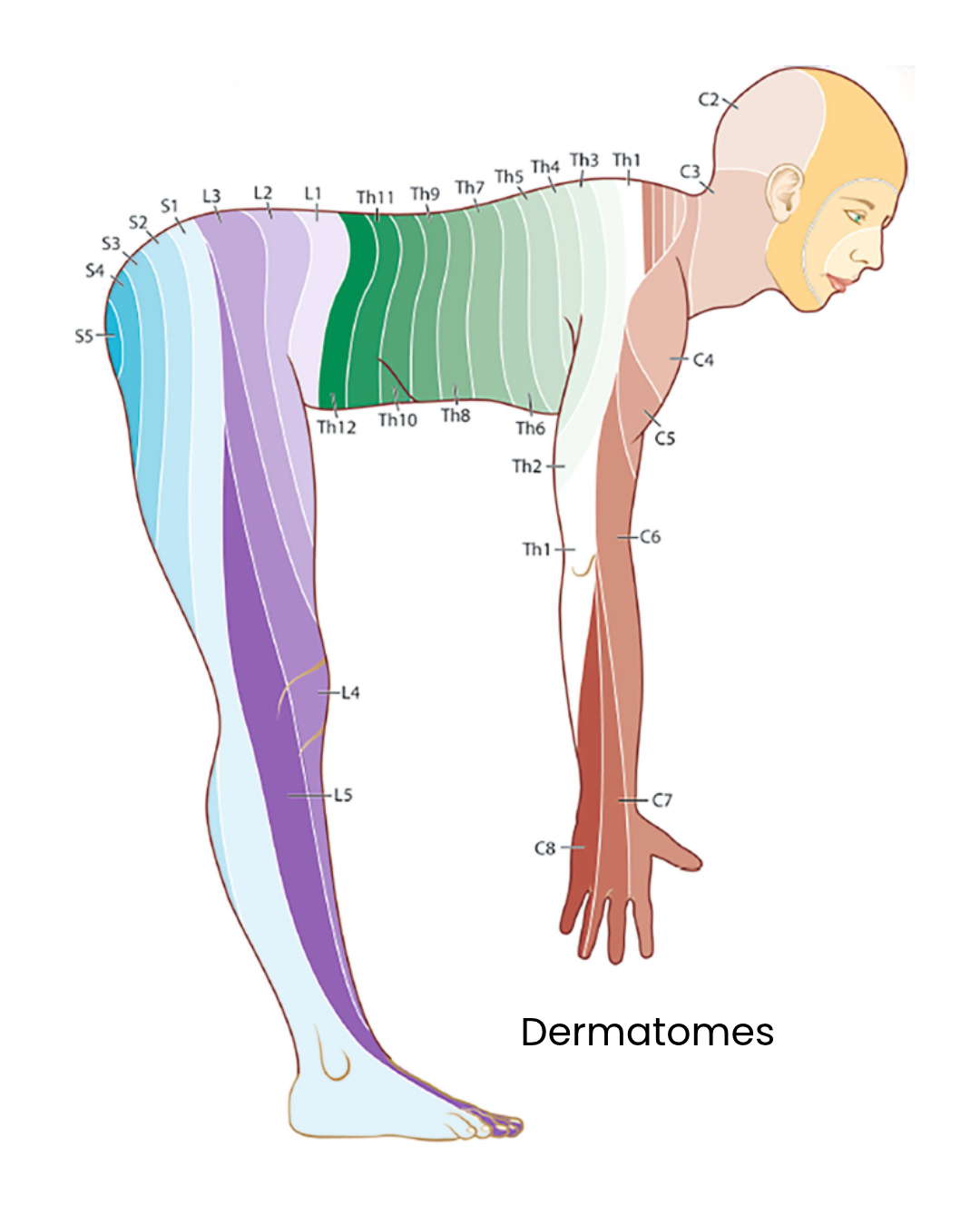
Irritated nerves can happen anywhere along the length of the nerve ~ from the base of the skull and spine through to the groin, elbow, wrist (e.g. carpel tunnel syndrome), between the bones of your feet and so many more. This is why, as a chiropractor, we look at your whole body, and not just the part that’s complaining, as it all works together (read more here). It is important to determine where along the length of the nerve the irritation is happening. For example, the symptoms of carpel tunnel can come from nerve irritation at the neck OR nerve irritation/lack of blood flow at the wrist. Sometimes, it’s a bit of both. It’s important to clarify the source of the problem or someone might choose an ineffective solution. Always best to begin with conservative care and progress to the more intrusive solutions if they are necessary.
Technically, neurological P&N falls under the umbrella heading of paraesthesia, which means altered sensation. Paraesthesia covers a variety of altered sensations such as ants crawling or water flowing over your skin, pain, burning, P&N or tingling, a little more/less sensitive to touch, dull and through to numb. It’s not nice when your skin doesn’t feel like you know it’s supposed to.
Another facet of paraesthesia is that the intensity and frequency of episodes can shift as the issue is either progressing or recovering. An example of this is a person recovering with care who might experience: a progression from pain in a limb, to P&N, to intermittent (off and on) P&N, to less frequent episodes of light P&N, to just a heightened awareness of the area at times, and back to normal sensation with healing.
There are two other causes of P&N or tingling that I wanted to flag:
1. Vitamin B6 (pyridoxine) Overdose
The original paper linking Vit B6 overdose with peripheral neuropathy (P&N in the soles of the feet, progressing to a sock of P&N) was published in 1983 by Schaumberg et. al.
The body uses vitamin B6 in numerous enzymatic reactions, including neurotransmitter production, amino acid metabolism, glucose metabolism, lipid metabolism, haemoglobin synthesis and function, and gene expression. Intake of food-based sources of pyridoxine will not cause toxicity. The only reported cases of vitamin B6 toxicity are from supratherapeutic dosing (i.e. more than the recommended therapeutic dose) of supplements or iatrogenic.
Cool. So why am I mentioning it as an issue? In 2023 there was a bit of an uproar about Vit B6 and P&N, or peripheral neuropathy, in people’s feet. Due to people taking daily supplements of B6 (which boosts people’s energy ~ so people like taking it) and supplement companies like adding it to all their supplements so people feel good and associate that feeling with that company’s supplement (a little cynical…maybe…). Ultimately, people were consuming more Vit B6 through taking supplements than ever before. Suddenly more people were arriving in neurologist’s offices with this kind of peripheral neuropathy.
A couple of things on this. The RDI for Vit B6 in Australia is: 1.3 – 1.7mg per day. Some people are more susceptible to Vit B6 toxicity that others (genetic tolerance one way or the other). If caught early, it is possible that removing Vit B6 from your diet (or just stopping the supplementation) can reverse the peripheral paraesthesia. It’s worth checking the total amount of Vit B6 in your supplements.
Ironically, the symptoms of Vit B6 deficiency look just like symptoms of Vit B6 overdose. Ironic. Everything in moderation people.
2. Shingles
It’s worth noting that Shingles can cause P&N in the dermatome (patch of skin) that the nerve affected supplies.
You can only get shingles if you’ve had chicken pox some time earlier in your life. If you did, sometimes the chickenpox virus settles in the nerve roots near your spine and lays dormant, waiting for a time when you are run down and it can take advantage. For this reason, it is known as an opportunistic infection.
As the virus reactivates, there may be light cold symptoms, but often the first symptom is P&N, numbness, itching, or sharp, burning pain on one side of the body in the relevant dermatome. This is often on the trunk or face.
At this stage there is a window of opportunity of 72 hours where you can go to the GP and have anti-viral medication which can halt the process (especially important for the immunosuppressed and the elderly). This is worth doing as, untreated, in some cases, the P&N can evolve to a severe pain that can persist for quite some time.
P&N may seem innocuous, and sometimes they are. However, at other times there is a bigger story, and taking action early in the piece will have better outcomes in the long run.
To help your health care specialist, take note of: when the P&N started; where you feel the P&N (and if that’s changing); how often you feel the P&N; the intensity of the altered sensation (and if that’s changing); if there’s anything else that’s different across the same time you’ve been feeling the P&N. This information will help them determine what’s happening and what the best form of care is for you.
A little note before you go…
The information in this article is intended for general education only and should not be taken as individual health advice.
If you have questions or concerns about pins and needles, please speak with your healthcare provider. Dr Tamara is always happy to help you understand what might be going on and guide you towards the most appropriate next steps, whether that involves conservative chiropractic care or a referral to another healthcare professional.
Sometimes, the best first step towards feeling better is simply knowing where to start.
References:
1. Schaumberg et.al “Sensory neuropathy from pyridoxine abuse: A new megavitamin syndrome”; The New England Journal of Medicine, Volume 309, Issue 8, pages 445–448 (Published August 25, 1983)
https://www.nejm.org/doi/pdf/10.1056/NEJM198308253090801?referrer=https%3A%2F%2Fwww.google.com%2F
2. Heminger and Wills 2023 “Vitamin B Toxicity”