
Fantastic Feet…and NOT so Fantastic Plantar Fasciitis
Reviewed August 2026
Feet are pretty wonderful. They're made up of some amazing structures and enable us to traverse a whole array of different surfaces by being so adaptable. They store force to give our step more spring and they're a vital contributor of data to our brain's balancing calculations. They keep us moving! As with many parts of our bodies though, we rarely appreciate their great work till they stop working without us thinking about them.
Painful feet are not fun. From cramping in bed to arthritic joints to gout (excruciating!)...unhappy feet are no fun at all. Being unable to get around and just do our usual thing at our regular pace really takes the shine off the day.
Today I wanted to talk about a common cause of foot pain, plantar fasciitis. That's some funky Latin for a whole lot of ouch! The confusing thing about this one is that it can cause a few different kinds of pain in different people: under the ball of the foot, under the heel or where the calf muscle inserts into the back of the heel (Achilles tendon)...however, the same structural dysfunction is the cause.
In the USA "it is estimated that approximately 1 million patient visits per year are due to plantar fasciitis. Plantar fasciitis accounts for about 10% of runner-related injuries and 11-15% of all foot symptoms requiring professional care. It is thought to occur in 10% of the general population as well. It may present bilaterally in a third of cases."(1)
Plantar fasciitis occurs in people of all ages, but there is a peak incidence in women ages 40 to 60 years. While women are twice as likely to experience plantar fasciitis in their lifetime, in younger people the incidence is equal between the sexes (1).
A little anatomy ~ the bony arch of the foot and the line of tissue that runs between the heel and the ball of the foot (the plantar fascia) work together to maintain the inner arch of the foot. This orientation is important for flexibility, spring and transfer of weight through the foot as we walk and run.
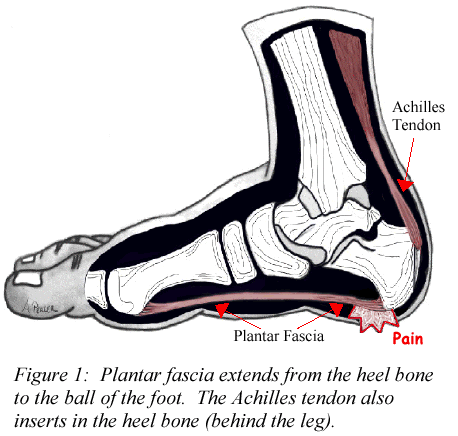
The bony arch can drop due to misaligned bones or degeneration of the joints in the foot. The bony arch can also be collapsed if the gastrocnemius muscle (calf muscle) is too tight and thus places a constant strain on the plantar fascia (preventing it from having the springy capacity it is supposed to provide as we walk/run). The plantar fascia can become strained at its insertions through loss of integrity of the bony arch or through repetitive strain over time.
When the plantar fascia is strained it pulls on the insertions at the heel and the ball of the foot causing local inflammation. This causes a focal sore spot and over time the brain may lay down bone here in an effort to repair the situation (creating, for example, a heel spur or a bone spur under the first metatarsal, or a bony spur growing from the heel up into the Achilles tendon). Unfortunately, these spurs only serve to make the problem worse on the pain front.
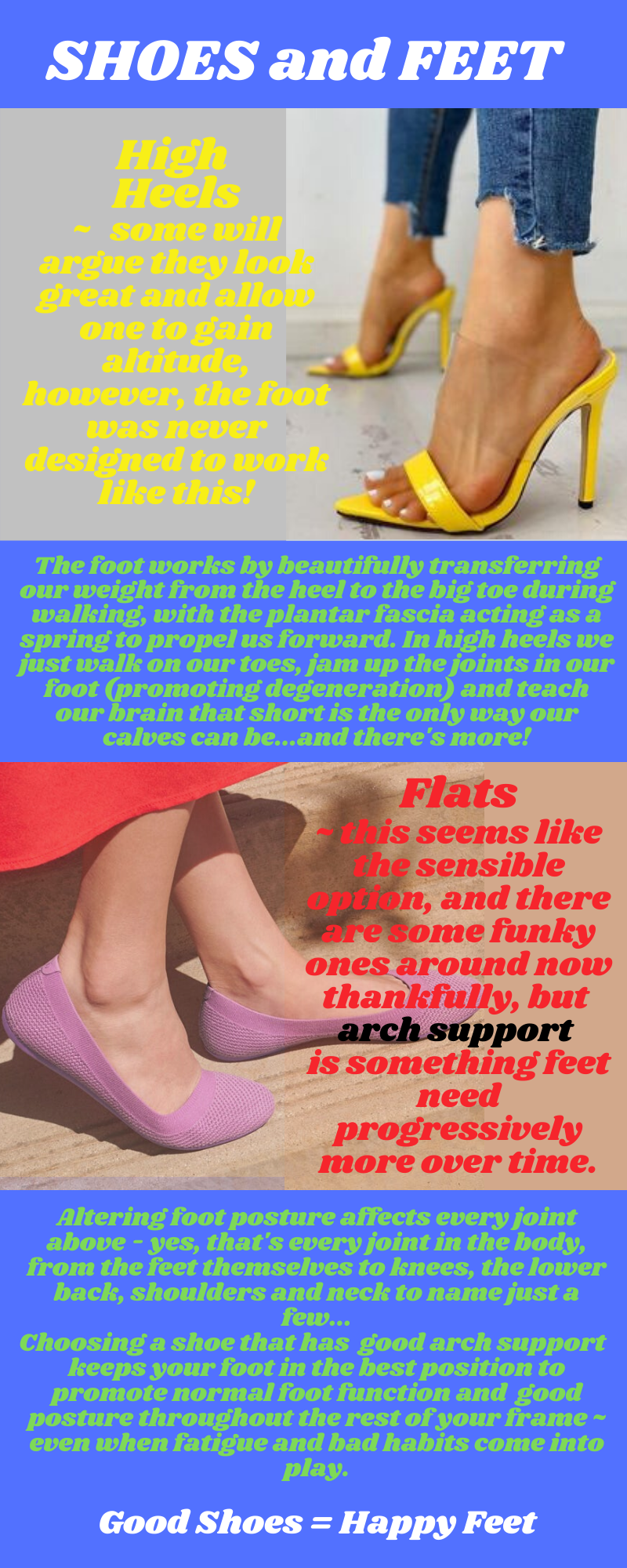
When it comes to managing plantar fasciitis, prevention really is best. Take good care of your feet! Choosing the right shoes is important. High heels may seem like a good idea at the time, but wearing them regularly will challenge the biomechanics in your feet (there is a significant cost beyond the increased incidence of fractures and damaged ankles) and flats with no arch support are also a problem. Good supportive shoes throughout life, especially for your sporting activities, are a worthy investment.
If you feel tenderness in the soles of your feet, deal with it EARLY in the piece. See your chiropractor/podiatrist/physiotherapist. We will get the joints realigned and give you strategies to manage the causes of the inflammation in the plantar fascia and related tendons...not just make use of over the counter anti-inflammatories (read more here) and endurance "till it goes away" ~ which is the common self diagnosis and management strategy most people implement initially. That rarely bears fruit. Knowledge and tailored plans for the individual, that's what your health team is here to provide, and with it, a much better prognosis.
Being chiropractors, we know alignment of the joints is vital for good function of those joints (including the muscles and ligaments related to the affected joint) and that misalignment at one joint affects the function of the joints around it. It's like the old song, "The foot bone's connected the knee bone...hip bone...back bone...etc." It all works together. This is why when you complain about a joint pain we will ALWAYS check the joints above and below the painful one too. We know that lower back problems can impact on how the forces travel through your leg and that other joints will have to change the way they're working to compensate and this can cause other secondary problems – sometimes this shows up in the feet. Likewise, altered gait due to a painful foot (limping) can work its way up the kinematic chain of the leg joints and impact on spinal function, causing back pain. Sometimes it's hard to tell which came first, the back trouble or the foot issues. This is why chiropractors and podiatrists work so well together.
Incidentally, people can have a dropped inner arch of the foot without having plantar fasciitis. This is commonly referred to as a flat foot, pes planus in Latin. It can be a genetic trait or it can be acquired through injury or degeneration over time. As mentioned above, the other joints of the body (ankle, knee, hip, pelvis, lower back and so on...) will be misaligned in the process of adapting to the flat foot and this may cause secondary musculoskeletal problems in the body. Take care of your feet. Keep your feet well supported and they'll support you well.
Give us a call at the Adelaide Chiropractic Centre today – we can check your alignment and help you to keep moving the way you were built to move.
(1) https://emedicine.medscape.com/article/86143-overview#a6