
Maps
Reviewed August 2026
Maps help us find our way and make sense of our world. When it comes to the Earth we have maps of continents, maps of underwater mountain ranges, maps of city road networks, maps of topography, maps of water catchment, maps of mineral disbursement, maps of volcanic activity, maps of magnetic fields surrounding the planet...and the list goes on. All help us understand and navigate this world we live in.
I think it's fair to say the brain can be considered a complex inner world. Very clever scientists are continually adding to our collection of maps that help us understand how the brain does all the truly remarkable things it does. We have anatomical maps of the brain, maps for the regions of the brain that are involved in particular processes, and maps of those regions in greater detail that clarify which areas of that region control the relevant process in each part of the body. We have maps showing which information travels in which pathways through the brain and spinal cord. We have maps of different types of brains which step out and map the brain's evolutionary development through time.
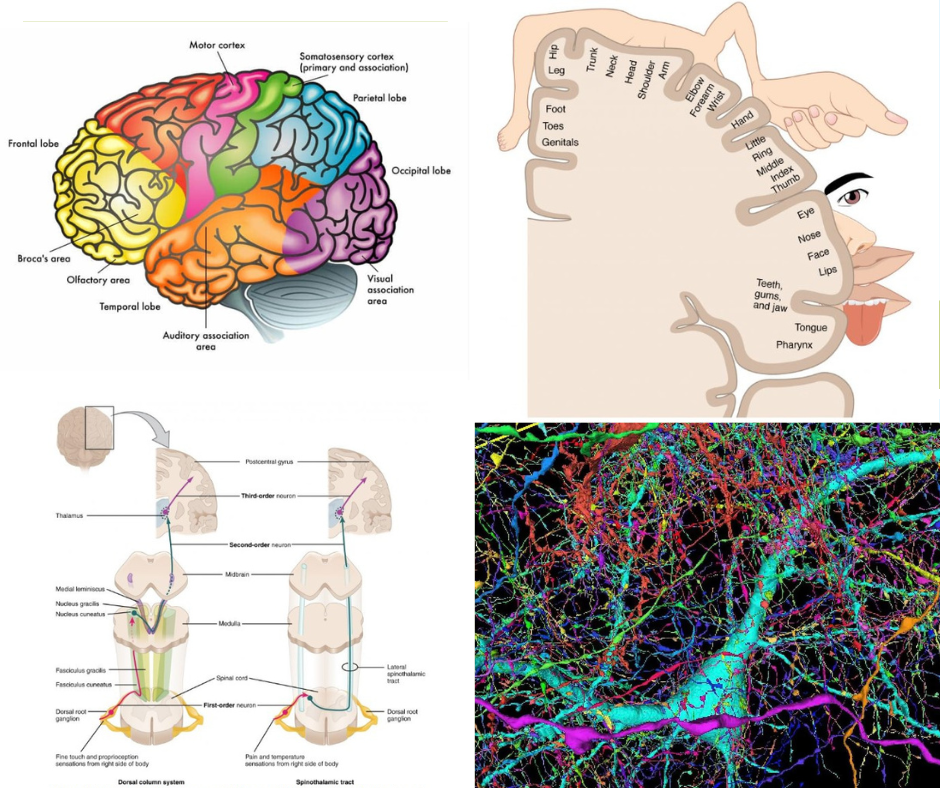
In 2015, scientists at Harvard University successfully mapped a rice  sized part of a mouse's brain. The map created depicts a dense and intricate three dimensional maze of cells, and the 1,700 synaptic junctions that connect them.
1,700 synapses in a space the size of a grain of rice...phenomenal!
It's no wonder we are yet to plumb the complexities of the brain...and no surprise we'd like a map!
At the end of 2023, our clever scientists across the globe published their collective work creating a new map of the brain. This work has put paid to our old picture of the brain consisting of two types of brain cell: neurons (the nerve cells that transmit messages from a to b) and glial cells (the nerve cells that are the support crew for the neurons).
Siletti et. al. used single cell RNA sequencing to identify all the different types of cells in the brain ~ there are 3313! They then went on to establish a map of where these different cells are located in the brain ~ an atlas of the brain. [So cool!! Yes, I'm a nerd ~ that excites me :)] Such an amazing resource to aid in future appreciation and understanding of our complex and wonderous brain!
So scientists have mapped the kinds of cells in our brain and where those types of cells dwell in the brain. The next step is working on mapping the connections between those cells ~ the synapses. This is no simple task as the synaptic connections between brain cells are changing all the time. They change in response to everything that we experience ~ internally (inside our bodies) and externally (in our environment) ~ every day.
Feedback from inside and outside our body promotes molecular changes in the synapses between nerve cells which upregulate or downregulate the status quo for functions in the body (like heart rate, resting tension in a muscle, release of bile enzymes into your intestines for digestion, and appropriate amount of tears to lubricate your eyes).
Our memories, and how we feel about them, are stored in the synapses between our brain cells.
The way we move and think are reflected in particular patterns of neuronal activity that can be reliably plotted out by taking real time recordings on a device such as a functional magnetic resonance image machine (fMRI). These pictures reflect what is now known as a "brain map" for that action or thought. Interestingly, it turns out that these brain maps are individual enough that in 2015 scientists were touting this technology as a way to identify individuals in a similar fashion to the way fingerprints are used.
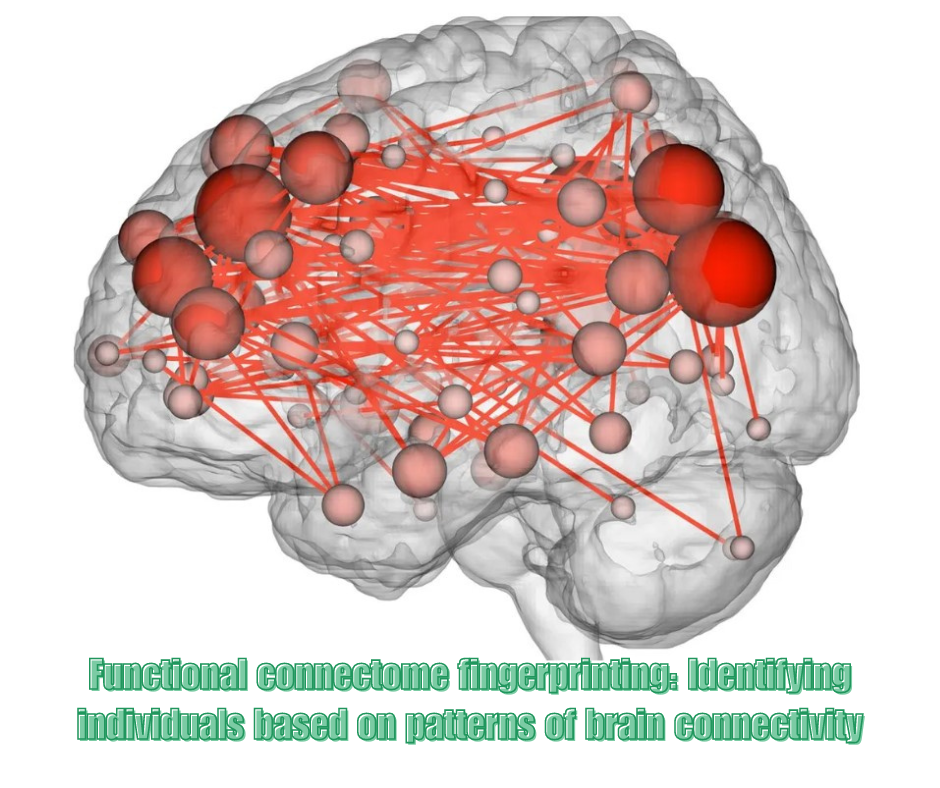 Now we come to the thing I really wanted to discuss in this blog. This particular kind of brain map ~ the pattern of neural activity your brain keeps as a plan for your movements. This is what people asked me about after the last blog I wrote "Time Sensitive". This is where science tells us chiropractic spinal manipulative therapy (SMT) changes the brain and aids in improving movement patterns, healing and chronic pain management.
Here is an excerpt from my blog "Time Sensitive" (read more here):
The brain keeps tabs on where the various parts of your body are by collating data on joint position from your muscles. With this feedback from your joints and muscles the brain then creates a map of where you are in space. It uses this map to pre-plan your movements so it can then send out instructions in a coordinated fashion to your muscles to get the task done.
Crisp, clean brain maps make for coordinated, smooth movements.
Blurry, fuzzy, disorganised brain maps make for jerky, unbalanced and unconsciously poor movements. An example of this might be whacking your elbow as you walk through a doorway or having trouble balancing on a previously rolled ankle. This because the brain (with its fuzzy map) doesn't have a clear picture of where your elbow actually is hanging in space or doesn't have a clear picture of how to coordinate the muscle action in your ankle to keep it stable to balance on, respectively.
"Brain map" is a term that refers to a pattern of brain activity that happens when you do a particular thing or movement. There are brain maps for everything you do ~ from stepping forward with your right leg to winking cheekily at a friend or creating the flourish on the last letter in your signature.
These brain maps are constantly being remodelled and remoulded in response to how we use our body. They can take up more or less space in our brain according to how often we do that particular thing or activity. This is a function of neuroplasticity (read more here) and the fact our brain is changing and adapting to our world throughout our lifetime.
So, these brain maps ~ if we use them often they are crisp, clear and take up more space in our brain. These crisp, clear, big brain maps trigger actions which are precise, balanced and controlled. The brain uses the brain map to orchestrate coordinated action within the body which translates to a symphony of beautiful movement such as an elite hurdler running a race or a master woodworking craftsman coaxing a bird out of a piece of wood.


If we don't use these brain maps then they become blurry, smudged, disorganised and smaller. Research has also shown us that these deteriorated brain maps are associated with greater perception of pain.
Blurry brain maps result in poor movements and greater pain.
Let's look at an example or two ~ Our hurdler has an accident. She falls and breaks her collar bone. It's not bad enough to need surgery, but it will need to be kept still while it heals, so her arm is kept in a sling for four weeks. She does not use the brain map for shoulder movement very much through those four weeks and it becomes blurred, fuzzy, disorganised and smaller. With time the collar bone heals and our hurdler returns to using that arm, but with the poor brain map her shoulder and arm do not move well. Nor is her hurdling so elegant, as she hasn't been able to train across that time. It takes more time and steady usage of the arm and body to build both the musculoskeletal structures in the region and the brain maps for shoulder movement and hurdling back up to good order and function.
It doesn't take such an accident to cause our brain maps to deteriorate. Just lack of use. A 40 year old doesn't do summersaults as well as they did as a 10 year old (unless they have done them regularly throughout their life) because they haven't kept that particular brain map crisp and clear by using it.
If a desk worker develops the habit of sitting poorly at their desk for 8 hours a day absorbed in their work, their joints and muscles will deteriorate (the hardware), but so too will the brain maps for good posture (software). Strength work can rebuild the muscle condition, but without polishing that brain map for good posture the desk worker will still have poor posture.
So why am I, a chiropractor, talking about brain maps?
Many people come to the chiropractor with the hope of resolving a pain or discomfort. They arrive with an understanding the chiropractor will help to resolve a problem in their physical frame. In contrast, as a chiropractor, I consider myself as someone who works with the nervous system (as well as the musculoskeletal system). In working with the nervous system, the goal of the care I provide is a better functioning body, but the research shows I achieve this by working to clarify brain maps.
Current research is showing that chiropractic spinal manipulative therapy (SMT, or adjustments) stimulates the brain to clarify, polish and restore crisp clear big brain maps. This assists in resolving and managing lower back pain, neck pain, headaches and many other conditions. It also contributes to managing chronic pain (pain that has lasted longer than the three months required to heal most tissues in the body). Chiropractor and brain cartographer, that's me!!
References:
-
Kasthuri N, Hayworth KJ, Berger DR, Schalek RL, Conchello JA, Knowles-Barley S, Lee D, Vázquez-Reina A, Kaynig V, Jones TR, Roberts M, Morgan JL, Tapia JC, Seung HS, Roncal WG, Vogelstein JT, Burns R, Sussman DL, Priebe CE, Pfister H, Lichtman JW. Saturated Reconstruction of a Volume of Neocortex. Cell. 2015 Jul 30;162(3):648-61. doi: 10.1016/j.cell.2015.06.054. PMID: 26232230. https://pubmed.ncbi.nlm.nih.gov/26232230/
-
Kimberly Siletti et al., Transcriptomic diversity of cell types across the adult human brain. Science382,eadd7046(2023).DOI:10.1126/science.add7046 https://www.science.org/doi/10.1126/science.add7046
-
Finn ES, Shen X, Scheinost D, Rosenberg MD, Huang J, Chun MM, Papademetris X, Constable RT. Functional connectome fingerprinting: identifying individuals using patterns of brain connectivity. Nat Neurosci. 2015 Nov;18(11):1664-71. doi: 10.1038/nn.4135. Epub 2015 Oct 12. PMID: 26457551; PMCID: PMC5008686. https://www.ncbi.nlm.nih.gov/pmc/articles/PMC5008686/
-
Stavrinou ML, Della Penna S, Pizzella V, Torquati K, Cianflone F, Franciotti R, Bezerianos A, Romani GL, Rossini PM. Temporal dynamics of plastic changes in human primary somatosensory cortex after finger webbing. Cereb Cortex. 2007 Sep;17(9):2134-42. doi: 10.1093/cercor/bhl120. Epub 2006 Nov 16. PMID: 17110591. https://pubmed.ncbi.nlm.nih.gov/17110591/
-
Schabrun SM, Elgueta-Cancino EL, Hodges PW. Smudging of the Motor Cortex Is Related to the Severity of Low Back Pain.Spine (Phila Pa 1976). 2017 Aug 1;42(15):1172-1178. doi: 10.1097/BRS.0000000000000938. PMID: 25893342. https://pubmed.ncbi.nlm.nih.gov/25893342/