
3 Signs You’re Ageing Brilliantly (And They’re Simpler Than You Think)
Reviewed August 2026
I spend a lot of time tossing out catchy snippets like, "Motion is lotion", "Move it or lose it", and "Move that body baby!!" You may or may not think I'm talking to you (hint: I am), and you may think I'm aiming at you taking action on my encouragement to move your body and stay strong in the now, and you would be right, but I also have a long term goal.
My goal, as the chiro on your health team, it to help keep you fit, strong and able with a polished up nervous system that helps you achieve the goals you're aiming for and living your best life. This applies to the teenager fast bowling at cricket, the pregnant mum, the environmental warrior who is working to revegetate the national park, the desk jockey who is orchestrating the South Road underpass, the Nana who is wrangling grandkids and the bloke who's training for the next half marathon...and everyone else.
 My behind-the-scenes goal, that I don't verbalise a lot, is that long term goal. It's about prevention. I know, and the research backs me up in this ~ resoundingly! ~ that if I can help keep your body moving well, and keep you strong as you age, then your days moving forward will be better. Better quality of life. That sounds like a great goal to me.
The thing is, "strong, fit and active" translates in practical terms to "staying at home and independent longer". Now, I think the vast majority of us like that idea. A lot.
Just saying, "I want to be fit strong and able" sounds excellent. But you could say it's a bit of a loose goal. Today I want to help you put a stick in the mud. To work out where you are at and provide a little incentive or momentum. A prompt to help you start taking action, with the goal of optimising your golden years to be active, engaged and independent.
So, that stick in the mud.
Here are three little daily movements that tell us a lot about how the body is ageing:
- Getting up and down off the floor easily.
- Balancing to put your knickers or jocks on (not sitting down to do so or hanging onto something while you do it).
- Getting yourself out of bed easily.
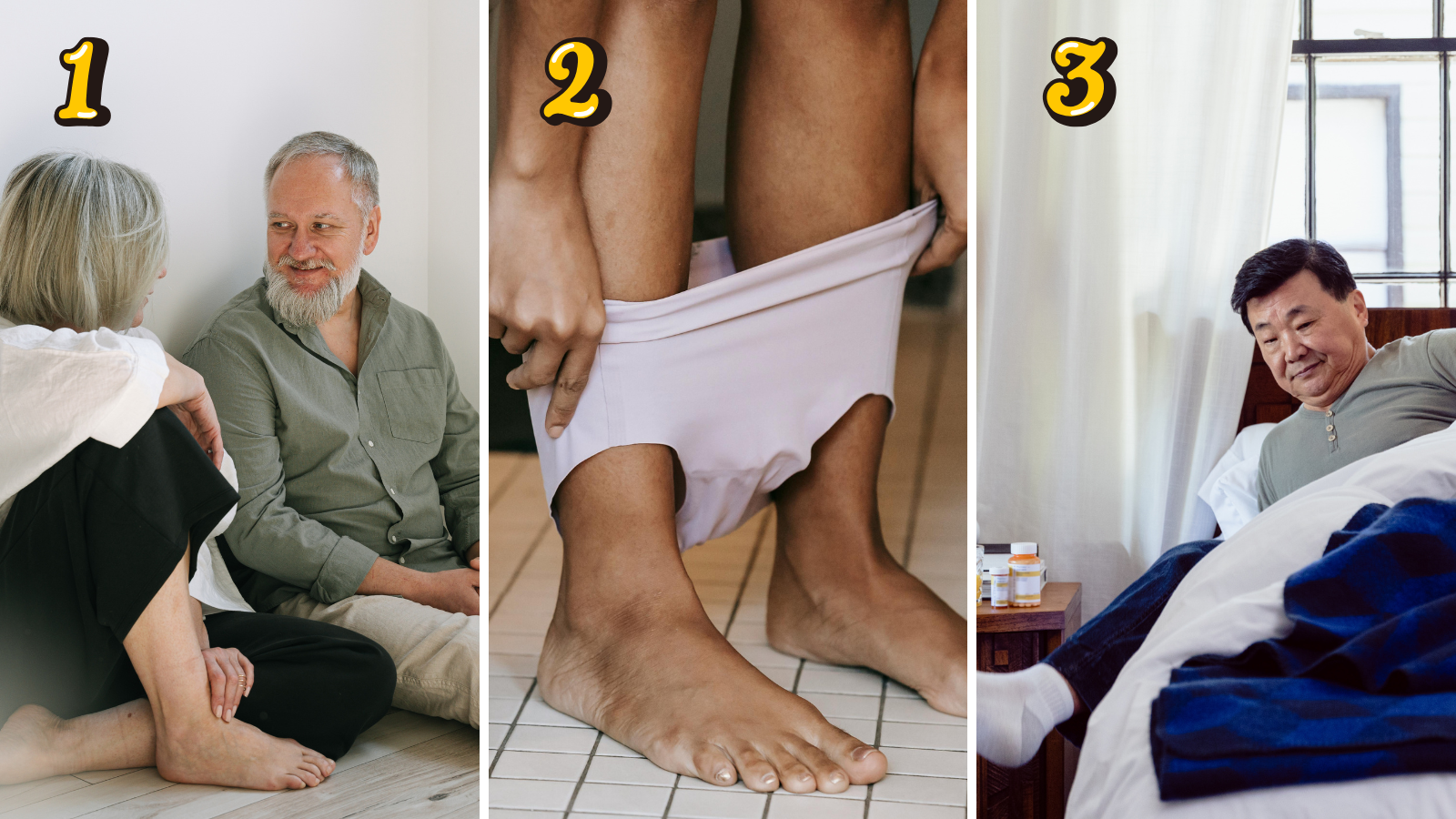
Can you do these things with grace? Are you ageing brilliantly??
I have people in their 20's who come to see me who would say "No." to that question. Equally so for each decade beyond that too... Don't lose heart though ~ our brain's brilliant neuroplasticity (read more here) means you can change this!
Being able to get yourself down to the floor, being able to sit there and being able to get yourself back up to standing unassisted indicated two things in the scientific literature:
- Good balance, strength and flexibility ~ which are vital for staying active and functioning well as you age.
- A very reliable indicator for mortality!
Here's how you test yourself:
Sit-to-rise Test
The test is scored by starting with 10 points and subtracting a point for every time a person uses and hand, knee or other support and half a point whenever the person is wobbly or unsteady.
The person starts standing, sits down on the floor and then rises to standing again. (without using hands, knees, furniture or another person for assistance).
10 ~ no supports or wobbling
4.5-7.5 ~ approx. 3 times more likely to die in the next 12 years
0-4 ~ 6 times the risk of dying (especially from cardiovascular disease)
Putting on your underwear without sitting or holding onto something to balance you requires balance, strength and mobility. This hints at falls risk and decreasing independence.
So how long should you be able to balance on one leg?
Test yourself and find out your actual balance-based age:
have a partner time you and be there to prevent falls
stand bare foot on a hard floor
cross your arms
close your eyes
lift one foot such that the raised foot is near, but not touching the other ankle (stand on your dominant leg)
begin the timer when the foot leaves the ground
stop the timer when you either
uncross the arms
move the raised foot away from the standing limb or touch it to the ground
o move the weight bearing foot to maintain balance
repeat the test three times and average the results (add the three times together and divide by three to get your average time)
What is your actual balance-based age?
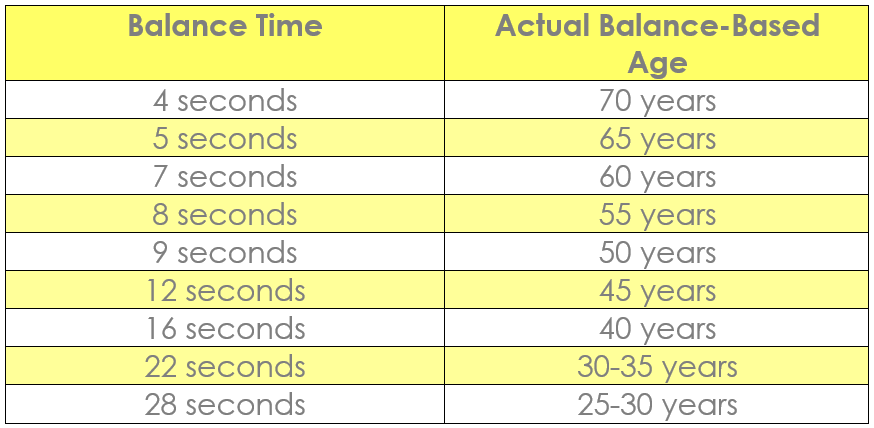
You can improve your balance with only a little effort – frequent small novel input stimulates the brain to beef up its balance ability. Have a conversation with Dr Tamara about how to do this.
Yes, we need to stay strong as we age, but balance is another element we need to maintain. To keep our balance polished up we need to practice! The neuroplasticity of our brain gives us the ability to get better at balancing with practice. Faster than you'd think. Balance is another "use it or lose it" skill. Talk to Dr Tamara if your "actual balance based age" is higher than your chronological age and you'd like some help with this.
Being able to get yourself out of bed requires core control, strength and mobility. If you can't transition yourself in and out of bed and need assistance...that's the path to assisted living. Gives a whole new incentive to maintain your core exercises beyond washboard abs or looking good in your bikini next summer, doesn't it?!
Balance. Strength. Mobility.
Independence. Longevity. Quality of days.
Sobering, hu?
The interesting thing is that most of us like the idea of staying well and active because we envisage living well going forward. No one's goal is being unwell, and physically or mentally limited or requiring living in a care facility because we can not care for ourselves.
...but for optimal outcomes, a little maintenance of this wonderful body of ours is required.
Don't worry. We've got your back (!). Most people who come through our door at the Adelaide Chiropractic Centre come as they are looking for help to deal with a problem or a pain. We are good at helping with those complaints. Once we've delt with the initial crisis though, we're working to educate, change habits, promote good lifestyle choices and to improve these elements ~ balance, strength and mobility.



Chiropractic care is great at spines, joints and nervous system regulation, and also very good at helping with balance, strength and mobility. That polishing up of the nervous system I mentioned above. We are forward planning. This is how we help you promote ability and independence as you gather twinkles in your wrinkles!!
If you fall short on your expectations regarding our 3 little daily movements mentioned above, have a conversation with Dr Tamara at your next visit to the ACC. She can help keep your body in condition so independent living is not just a dream.