
Fish, Fatty Acids and Inflammation
Reviewed August 2026
Someone asked me about fish oil and how it helped joints recently. It's a good story, but it also has many moving parts and mind-numbing jargon...or so I'm told. For this reason my team has ensured I include a TL;DR clause at the end of this blog ~ a summation of the main points for those who would prefer a brief interpretation of the detail. For everyone else, please read on to learn about the link between fish, fatty acids and inflammation.
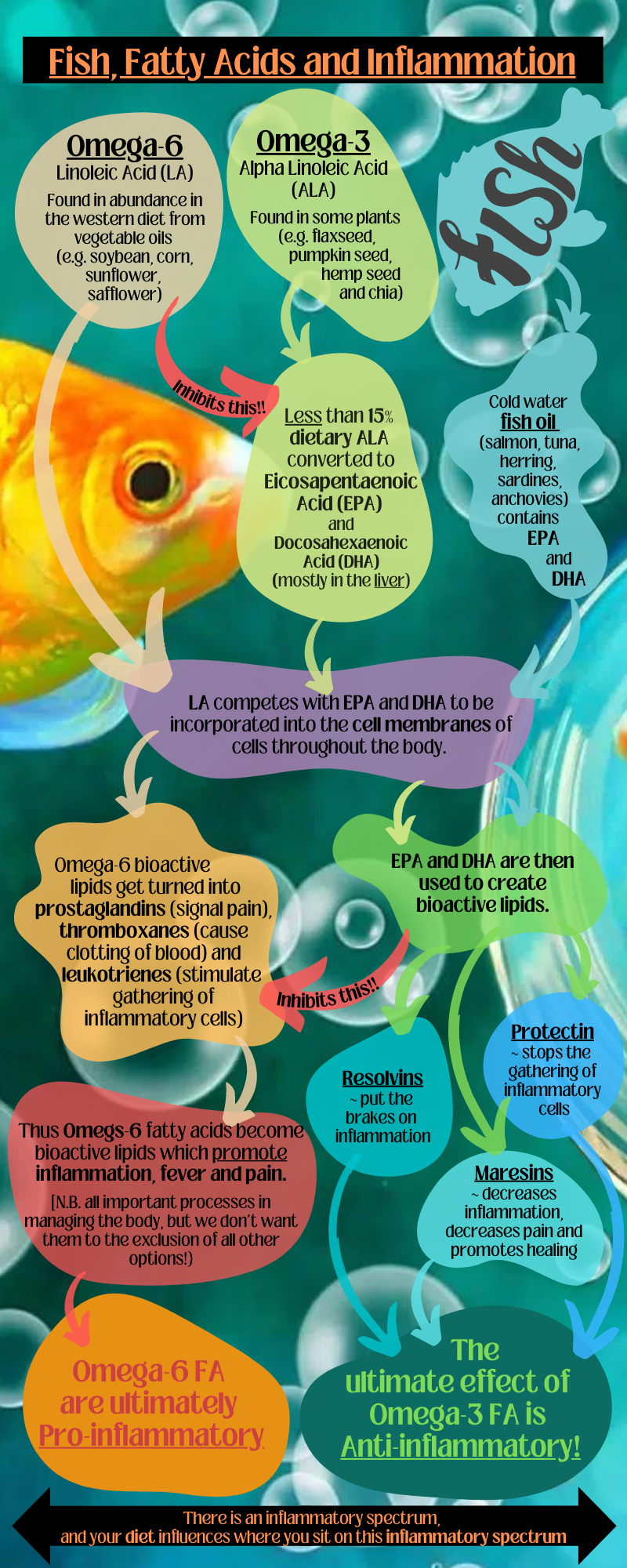 So, the crux of all of this is that the walls of the cells in our body are made of fatty acids (FA). Some of these FA our body can make from scratch, some it cannot. The FA our body cannot make are called essential FA. To create the essential FA we need to provide the body with precursor molecules in our diet. There are two essential FA: Omega-6 FA and Omega-3 FA (incidentally, for the curious, the 6 vs 3 designation denotes the chemical shape of the molecule).
Omega-6 Fatty Acid: Linoleic Acid (LA); found in abundance in the western diet from vegetable oils (e.g. soy bean, sunflower, safflower, corn).
Omega-3 Fatty Acid: Alpha Linoleic Acid (ALA); found in some plants (e.g. flaxseed, pumpkin seed, hemp seed, walnuts, pecans, hazelnuts, kiwifruit, chia); converted to Eicosapentaeoic Acid (EPA) and Docosahexaenioc Acid (DHA) in the liver.
Depending on the make up of your diet, the membranes of the cells throughout your body are composed of different concentrations of LA, EPA and DHA.
Omega-6 FA (LA) are the base unit which gets turned into bioactive lipids (molecules that have another job in the body) that have pro-inflammatory roles (signal pain, cause blood clotting, stimulate the gathering of inflammatory cells).
EPA and DHA are the base units that become anti-inflammatory bioactive lipids (stops the gathering of inflammatory cells, puts the brakes on the inflammatory process, decreases inflammation, decreases pain and promotes healing)
The western diet is notoriously omega-6 heavy. It is believed that this is one of the reasons why our bodies become more pro-inflammatory with age. We know that increasing background levels of inflammation in a body are related to increasing incidence and severity of chronic disease processes. This includes cardiovascular disease, diabetes, cancers, inflammatory arthritis (like Rheumatoid Arthritis) and osteoarthritis.
[N.B. Inflammation is not all bad! We need inflammation to heal ~ read more HERE]
The ratio of LA to EPA/DHA in your cell membranes reflects where you sit on the pro/anti-inflammatory scale. It follows then that, if our goal is to decrease inflammation in our body and avoid those disease processes associated with chronic inflammation, we should try to increase the proportion of EPA/DHA in our cell membranes.
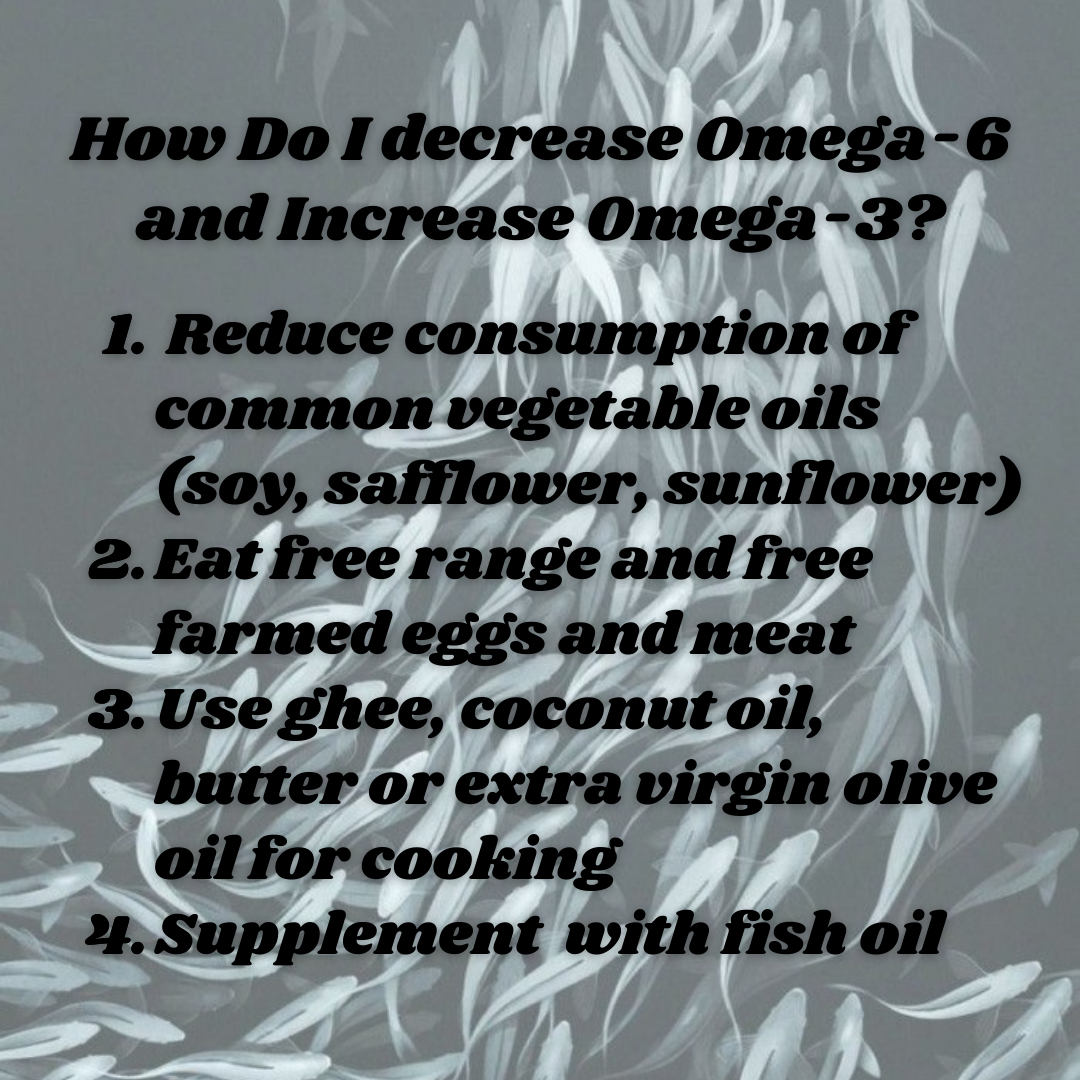 How do I increase omega-3 and reduce omega-6 FA? Glad you asked!
- Reduce your consumption of common vegetable oils ~ most (like soy, safflower, sunflower etc.) have high levels of omegs-6 and very low levels of omega3. They are also heat sensitive and oxidise to trans-fats when used in cooking (which are not good for you and another story).
- Eat free range and free farmed eggs and meat ~ factory farmed eggs and meats are higher in omega-6 as these animals are fed high omega-6 grain-feed
- Use ghee, coconut oil, butter or extra virgin olive oil for cooking ~ these oils are heat stable and won't further distort your omega-6 to 3 balance.
- Supplement with fish oil.
Getting the right dose of omega-3 fatty acids (FA) to achieve a significant change in inflammatory state and change a chronic disease such as rheumatoid arthritis (RA) is tricky.
Research suggests you need 2.7 grams of omega-3 FA daily to reduce joint inflammation in RA. Furthermore, the scientists have established a lower dose of 0.45 grams of omega-3 FA is useful for managing osteoarthritis (OA) and reducing the need for non-steroidal anti-inflammatory (NSAIDs) drugs. Lower doses have also been seen to benefit heart health and general health.
It turns out it's very hard to eat enough Omega-3 FA each day to hit the therapeutic dose. At best, of the ALA you consume, only 8-15% gets converted to EPA/DHA in our cells. The best dietary source of EPA/DHA is cold water fish (salmon, tuna, herring), and EPA and DHA actually come from the algae the fish eat. You still can't eat enough cold water fish each day to hit the daily therapeutic dose of EPA/DHA to reduce inflammation.
So the idea of supplementation comes to the fore. Oil or capsules?
Here we insert a reminder to read the packaging on your supplements ~ most "1000mg" fish oil capsules only contain 300-400mg of omega-3 FA. That equates to 9-14 standard fish oil capsules, or 5-7 concentrated fish oil capsules, per day. That's a LOT of capsules...and possibly not a very cost-effective way to go about achieving a therapeutic dose of omega-3 FA for RA.
In the mid 1980's fish oil as a supplement was just coming to light in Australia. A savvy Rheumatologist at Adelaide's own Royal Adelaide Hospital, Professor Les Cleland, was trialling fish oil to help treat inflammatory diseases. Getting a cost effective, therapeutic dose, however, was proving challenging.
Professor Cleland began liaising with Melrose, a local South Australian company, to resolve the issue. Together they created an environmentally sustainable (100% wild caught and sustainable sardines and anchovies), high quality (tested to ensure no heavy metals or other contaminants), concentrated (64% total EPA and DHA) fish oil to use as an omega-3 FA supplement which is priced in the affordable bracket for the average person. It is still sold at the RAH as the premium fish oil supplement today. The therapeutic dose for RA mentioned above is achieved by taking 15ml of fish oil, or 5-7ml (a teaspoon) of concentrated fish oil daily.
Some tips:
- Keep the oil in the fridge – this damps the taste (though Melrose do create a pleasant lemon and lime flavour)
- You can split the dose – optimal dose taken part in the am and part in the pm
- Can be taken with or without food (or in shakes and smoothies)
- Fine to have on an empty stomach
- It can take up to three months to notice change in RA symptoms, so if you begin this supplementation, give it the three months before you decide how beneficial the exercise has been for you.
- Side effects?
- Usually well tolerated, but can cause mild stomach upsets in some people (heartburn, nausea, diarrhoea)
- Despite the anti-inflammatory effect omega-3 FA have at the cellular level the research shows there is no association between taking fish oil and increased bleeding or any interaction with blood thinners like aspirin or warfarin. Regardless, it is recommended that you consult with your doctor if you are planning to have surgery or are planning to take fish oil when you are taking warfarin or the like.
- Note that fish oil and fish liver oils (like cod liver oil or halibut liver oil) are different. Fish liver oils contain lots of vitamin A. Too much vitamin A is toxic (especially when pregnant). If you take the fish liver oil in the doses recommended for arthritis you may exceed the RDI for vitamin A. To increase your omega-3 FA intake consume pure fish oils, not fish liver oils.
When joints are inflamed, conventional wisdom suggests we should take anti-inflammatories to reduce pain, heat, and congestion in the tissues and promote healing. Over the counter non-steroidal anti-inflammatories (NSAIDS ~ e.g. neurofen or voltaren) are designed by clever biochemists to act on pro-inflammatory biolipids (the ones made from omega-6 FA). In this way the NSAIDS work to change the pro/anti-inflammatory balance of biolipids in your body and promote a decrease in inflammation. Useful in an acute episode, but problematic for a person with chronic inflammation as prolonged NSAID use has some nasty side effects, including aggravating your gut (read more here).
The research shows that supplementing your diet with fish oil (EPA/DHA) promotes a shift away from chronic inflammation by altering the AL:EPA/DHA ratio of biolipid precursors in your cell membranes. This without upsetting your gut!
So to the TL;DR ~
Supplementally taking a therapeutic dose of quality fish oil daily will change the essential fatty acid balance in the cell walls throughout your body. This serves to reduce the background state of inflammation in your body and shift you away from chronic inflammation. Reduced background inflammation has been shown to alleviate symptoms of chronic disease such as rheumatoid arthritis, osteoarthritis, cardiovascular disease, cancers, and depression. It's good stuff!
References
-
https://www.rahresearchfund.com.au/melrose-and-the-royal-adelaide-hospital-australian-fish-oil-market-pioneers/
-
https://arthritisaustralia.com.au/managing-arthritis/living-with-arthritis/complementary-treatments-and-therapies/fish-oils/
-
https://www.melrosehealth.com.au/health-hub/post/why-fish-oil
-
Cleland, L et al 2005 "Fish Oil: what the prescriber needs to know" https://arthritis-research.biomedcentral.com/articles/10.1186/ar1876
-
Ifigenia Kostoglou-Athanassiou et al 2020 "The Effect of Omega-3 Fatty Acids on Rheumatoid Arthritis" https://www.ncbi.nlm.nih.gov/pmc/articles/PMC7362115/
-
James, M, Proudman, S and Cleland, L. 2010 "Fish oil and rheumatoid arthritis: Past present and future https://www.researchgate.net/publication/44637500_Fish_oil_and_rheumatoid_arthritis_Past_present_and_future
-
https://www.healthline.com/nutrition/17-health-benefits-of-omega-3
-
Calder, P 2013 Br J Clin Pharmacol. "Omega-3 polyunsaturated fatty acids and inflammatory processes: nutrition or pharmacology?" https://www.ncbi.nlm.nih.gov/pmc/articles/PMC3575932/#:~:text=Mechanisms%20underlying%20the%20anti%E2%80%90inflammatory,of%20inflammatory%20genes%2C%20activation%20of
-
https://themedicalbiochemistrypage.org/omega-3-omega-6-fatty-acid-synthesis-metabolism-functions/#:~:text=Pathway%20for%20ALA%20conversion%20to,endoplasmic%20reticulum%2C%20ER)%20enzymes.
-
https://ods.od.nih.gov/factsheets/Omega3FattyAcids-HealthProfessional/