
Blog 26 ~ Nocturnal Leg Cramps
Reviewed August 2026
Being woken in the middle of the night with an excruciating cramp in your calf is exceedingly unpleasant and very common. 50-60% of adults (and 40% of people over 40 years of age) experience nocturnal leg cramps in their lifetime (1,2). 20% of sufferers have symptoms bad enough to seek medical attention (1). The cramps last an average of 9 minutes and can be followed by hours of recurrent episodes (1). You'd think resolving such a common malady would be done and dusted by now, but it's not so.
Muscles are simple beasts. The reasons why they might cramp fall into five main categories: poor blood supply to the muscle; poor nerve supply to the muscle; mineral depletion; muscle fatigue; and drug side effects (for details see the info graphic).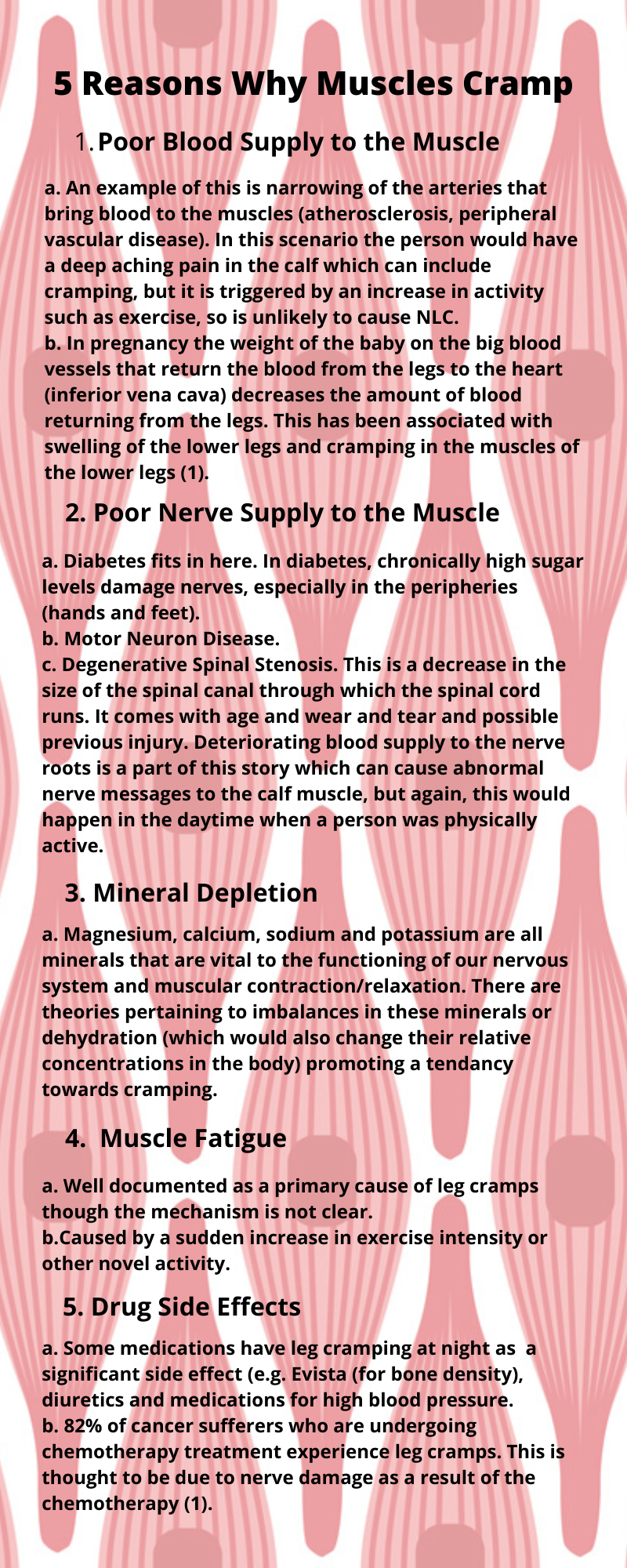 It's a long list. Despite all of that, the most common reason given for nocturnal leg cramps is that they are idiopathic – yep, they don't know (1,2,4).
The fact that NLC happen when we're asleep rules out poor blood supply and poor nerve supply to the calves as being a causative factor because for these mechanisms to come into play there needs to be an increase in physical activity – it doesn't matter how exciting your dreams might be, that's not going to happen while you're asleep.
So on to mineral depletion as a cause of NLC. There has been lots of talk about magnesium supplements helping with cramping muscles, and there's a wall of variations available on your pharmacist's shelves which infer validity to this claim, but recent research finds little to prove the case(1,6,7,8,9). Ironically, the one cohort of papers that support the idea that magnesium supplementation can help with NLC is with pregnant women (1,2). That seems a strange discrepancy to me as a woman's muscle physiology doesn't change when she's pregnant.
Kris Frost (Nutritional Therapist of The Optimal Gut) postulates these results might be more a reflection of how well the digestive systems of the people in the studies were working rather than a true representation of whether magnesium supplements can help with NLC or not. Maybe the pregnant women were being a bit more diligent with their diet than the standard cohort was and their guts were working better for it and able to absorb the magnesium better? She goes on to point out that you can fill your belly with only the best of food products and quality supplementation, but if the gut is not functioning properly and absorbing all those wonderful nutrients then they will go straight through and out the other end with no benefit to the body at all.
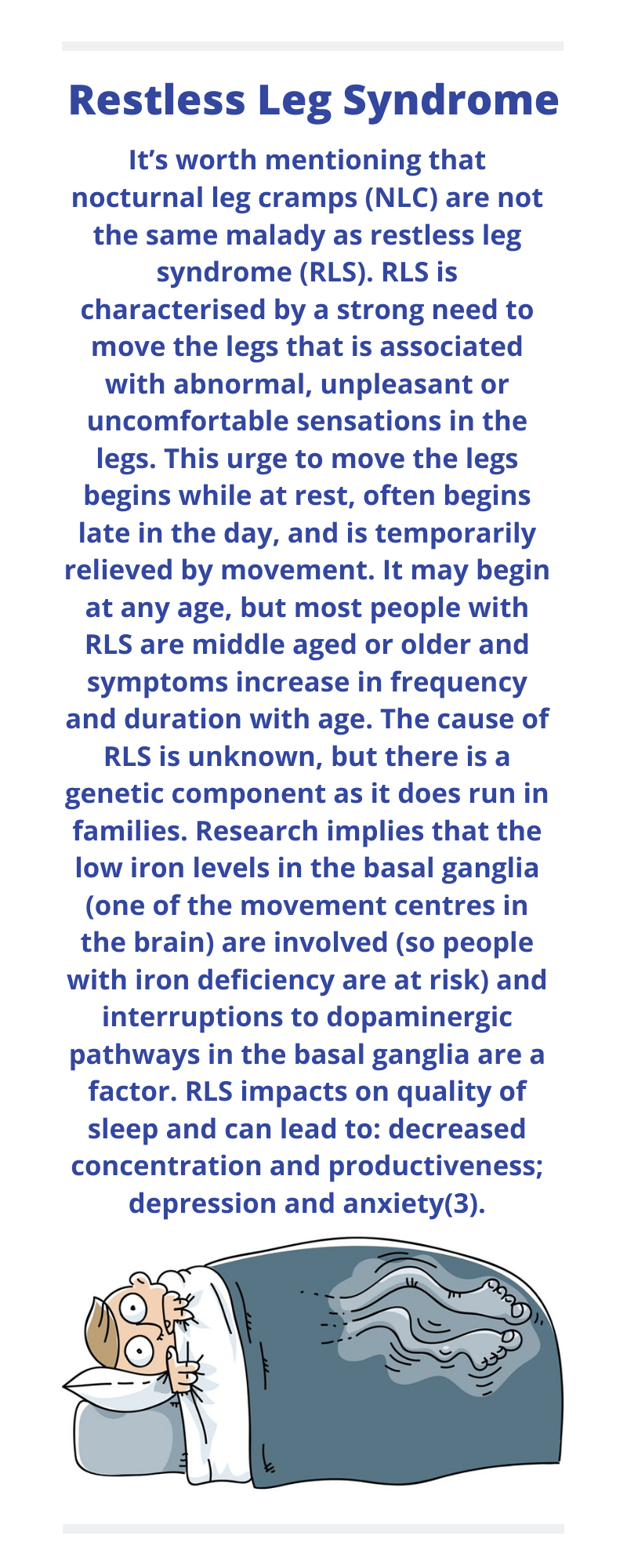
Another snippet Ms Frost dropped into this conversation was an observation that caffeine can really mess up how well our digestive system absorbs the goodness from our food. One coffee will limit absorption through the gut wall for 3 hours after drinking it and caffeine is known to interfere with the absorption of certain essential minerals, including magnesium, from the gut (11). So even if you "only have two weak coffees a day", that's six hours out of the 24 hour day that your gut won't be shuffling the goodies from your diet into your body. There's more bad news for coffee drinkers - "restless leg syndrome" is considered to be a common side effect of caffeine consumption (often confused with NLC - read more in the side bar below)(10).
 Magnesium is an essential mineral in the body. It is involved in a whole array of vital functions including the regulation of muscle contraction and relaxation, and regulation of vascular tone (so it controls blood supply to the muscles too). In our practice we have had many people who have benefited from taking magnesium supplements to manage muscle spasm and NLCs, so this discrepancy with the current science is perplexing. Is it just placebo?
I spoke with our local pharmacist, Mr Brad Price, asking how he reconciled the empirical evidence with the current research. His response is below:
"The lack of ‘evidence' for the efficacy of Magnesium does not mean it is not effective for a significant amount of people, but rather insufficient research has been performed to date. The fact that as a naturally occurring mineral, Magnesium cannot be patented by one company, has contributed to this, as it makes return on investment more difficult"
So, to paraphrase, big pharma can't make significant money from magnesium (because they can't patent a naturally occurring mineral) so they're not interested in spending money on thorough scientific studies on the topic. Economics shooting knowledge in the foot (or the NLC!). It seems reasonable to go with the empirical evidence then.
Magnesium deficiency can be caused by reduced intake (it's in cereals, legumes, nuts and green leafy vegetables, however food processing can deplete the natural levels of magnesium in food to 3-28% of raw levels), poor absorption in the gut as mentioned earlier, increased losses through the kidneys (as in diabetes and alcoholism), a side effect of medications, times of increased need (pregnancy and growth), and in cases of excessive sweating (12).
So, that wall of supplement options available in the pharmacy and health food shop – which kind is best? That brings us back to chemistry, but only for a little  . It turns out that, even if you're getting a good amount of magnesium in your diet and you don't have any other complications, only 5-10% of the magnesium you put into your mouth will cross the gut barrier and move on into the body to be used. This is because the elemental magnesium is charged and will bind to the inner wall of the gut preferentially (12). To solve this dilemma biochemists have coated the magnesium with amino acids, which are essential to body function and thus get given the fast track through the gut and into the circulation to be taken where the body needs them – the magnesium hitches a ride, and once in the blood stream can achieve the goals of supplementation (e.g. less NLCs!). The magnesium-amino acid complex is called an "amino acid chelate". So if you're looking for an effective magnesium supplement (that will be absorbed efficiently in your gut) on that wall of offerings, ensure it is an amino acid chelate.
Let's have a closer look at the biomechanics of the calf. In modern days we rarely work the calf through its whole length (squatting, walking barefoot). Instead we spend more time sitting and with our calf in a mid-range length (e.g. by wearing shoes with heels, even men's shoes have a slight heel!). So our calves are not in optimal condition just because of our sedentary lifestyle. Add to this postural issues, which can make the calf muscles work a lot harder throughout the day, and the calves become "pre-loaded for trouble". This is where chiropractic care can help.
The chiropractor will assess your whole body and review lifestyle factors to identify where there are vulnerabilities in the biomechanics of your body. This global approach will work to reduce fatigue and strain on the calf muscles. Addressing posture (both through the day and sleeping position in bed) and balance with brain mapping exercises will work to integrate better function throughout and ease the load on your calves.
There are also sensors (called golgi tendon organs, or GTO) in the tendons of the calf muscles that measure the tension in the tendon. When the GTO register that there is no tension in the tendon they stimulate the muscle to reflexively contract and this can lead to cramping. This can happen when we are lying in bed, still, with our toes pointed towards the end of the bed because the covers are tucked in tight or are too heavy.
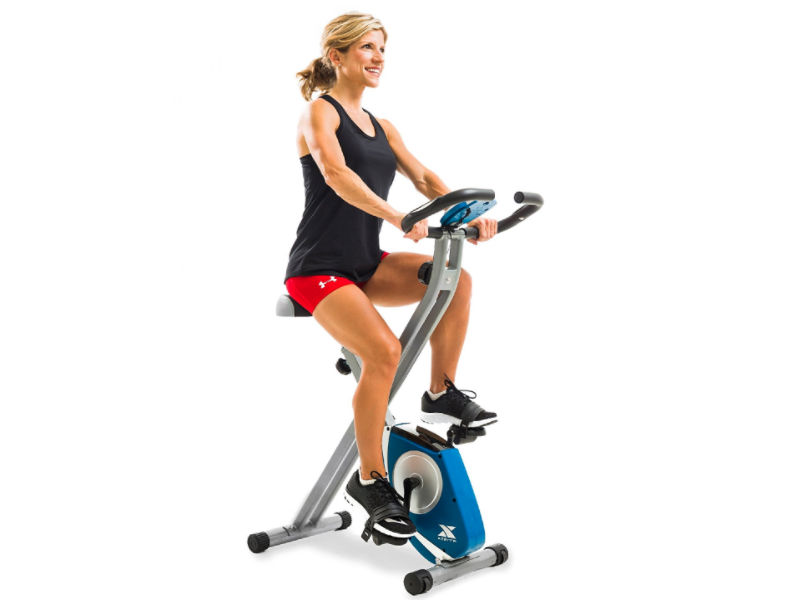
These biomechanical elements of NLC are likely the reason why research shows that stretching the calf muscles and/or a few minutes on a stationary bike before bed time can relieve NLC (1,2).

So what do you do if you're waking up with NLC in the night? First see your GP and cross the nasties off the list (including side effects of any medications). Then see your chiropractor to identify any postural issues and begin restoration of good habits (during the day time and in bed) and building strength back into your body. Give us a call at the Adelaide Chiropractic Centre on 8221 6262 and make a time ~ we can help.