Empathy V’s Compassion (what kind of carer are you?)
Reviewed August 2026
Empathy is the ability to place yourself in another's shoes and feel what they are feeling. When you are empathising, you feel what that person is feeling, you have the chemical responses in your body that go along with those feelings and your body experiences that same stress. Over time this has an impact on your own health and wellbeing. This can leave a person in a place where the quality of their caring along with their own quality of life is impaired (2).
Compassion is defined as a deep awareness of the suffering of people and a desire to help them. A compassionate person has a strong feeling of sympathy, caring concern and sorrow for the misfortune of others, but from a slightly greater emotional distance. There is still ample heartfelt willingness and desire to help alleviate pain and suffering, but with a more durable and positive emotional connection between carer and patient/client (2).
Often this conversation is broached with the professional carers in our world: the medical staff, the allied health professionals, the emergency workers, our teachers. However, I see it in all walks of life: the parents, people looking after elderly or disabled family or friends, perfectionists of any stripe, people existing under a load of unreal expectation where the resources are not enough to meet the need. We've all seen people who have had their sense of self and their wonder in the world worn down by the load they carry. I think it's a topic that we all need to consider periodically and do a self check to make sure we're not making life harder than it needs to be for ourselves.
Why is a chiropractor writing about empathy, compassion and headspace? Because I see many people in my practice who care too much, at home or at work, and slip from compassionate engagement in their world to an empathy that drains them and impacts on their head space and health. We need to care to be engaged in life, to contribute to society and to maintain a sense of self-worth. I'm not saying don't care! However, if we blow past that threshold from compassion and dwell in empathy for too long there is a price that is paid by our personal health and the health of the relationships around us.
As Professor Christophe Berney (specialist laparoscopic gastrointestinal and hernia surgeon in private practice and lecturer at UNSW Clinical School) states ~ in the world of professional carers we know this emotional exhaustion (aka compassionate fatigue or burnout) can lead to
"impaired patient care, inability to offer emotional support to others (decreasing empathy), depression, substance misuse and, in some occasions, suicide."
"Perfectionists, who tend to feel guilty if they don't perform as well as they would like to, are at a higher risk of burnout"(2).

On an individual basis, in our chiropractic practice, this emotional fatigue will show up as increased tension and biomechanical dysfunction in a body progressing to things like headaches and heightened neurological sensitivity. Little body aches get amplified and become big issues. There is a risk of developing a chronic pain...if the person has not come to us with it in the first place. As chiropractors, we know that in this scenario, we need to have a conversation with the person about their headspace and how they are managing life's rollercoaster just as much as we need to help them with their pain in the frame. Where necessary we refer people for counselling or encourage them to take on mindfulness...good head space promotes healing.
Do you care too much? Hmmm....and how long is a piece of string? Our personal thresholds for these loads, and the life issues we're dealing with, will vary as much as our finger prints do. Only you can make that call. However, some people are oblivious as to the impact their caring for others is having on them and the people around them (at home or at work), so here is a list of side effects of caring too much. These side effects can come on quickly, or build over a period of time. It may be helpful to ask someone who loves you (and who will be truthful with you) if they can see you exhibiting any of these signs of emotional fatigue or burnout.
Possible signs of Compassion Fatigue (1):
[N.B. The first four are particularly relevant, but you need to be experiencing many of those symptoms listed below to have Compassion Fatigue; and it's important to acknowledge that many of these signs and symptoms are associated with mood disorders, depression and anxiety]
- Deep physical and emotional exhaustion
- Pronounced loss or deterioration in empathy for patients/clients, loved ones and/or colleagues
- Feelings of worthlessness and inefficacy (at work)
- Irritability
- Feeling overwhelmed and depleted
- Chronic dissatisfaction with work-related issues (ie. politics and resourcing)
- Loss of interest of motivation for helping
- Extreme state of physical and mental stress
- Hyper arousal and hyper vigilance
- Preoccupation with thoughts about the suffering and traumatic experiences of others
- Anxiety
- Feeling numb or shutdown
- Anger and irritability
- Dread of working with certain patients or seeing ill loved ones
- Irrational fears
- Hypersensitivity or insensitivity to emotional content
- Impaired ability to make decisions and care for patients
- Low mood
- Low motivation generally
- Loss of passion and enthusiasm
- Unhappiness
- Sense of foreshortened future
- Exaggerated startle response
- Difficulty concentrating
- Self-doubt
- Increased use of alcohol or drugs
- Intrusive imagery or dissociation
- Stress-related illness, headaches, digestive issues
- Absenteeism
- Sleep changes
- Nightmares
- Appetite and weight changes
- Loss of interest in social activities or connecting with others
- Relationship issues
If you are wondering whether you are experiencing compassion fatigue or burnout, Clinical Psychologist Nicole Ferrar of LIFT also suggests completing a self-score ProQOL questionnaire (click on this link to access). It's a short, 30 question questionnaire which can help you assess how effective you feel you are in your position (compassion satisfaction) and conversely, if you are at risk of burnout or secondary traumatic stress (the latter meaning exposure to trauma and stress in the workplace). Sometimes it's good to have a stick in the mud and also to identify when you need to implement some changes.
So, if you find life's rollercoaster has shifted your take on the world sideways emotionally and you're not managing the load well...what do we do about it? Dr Ferrar and Professor Berney are on the same wavelength. Both recommend ~
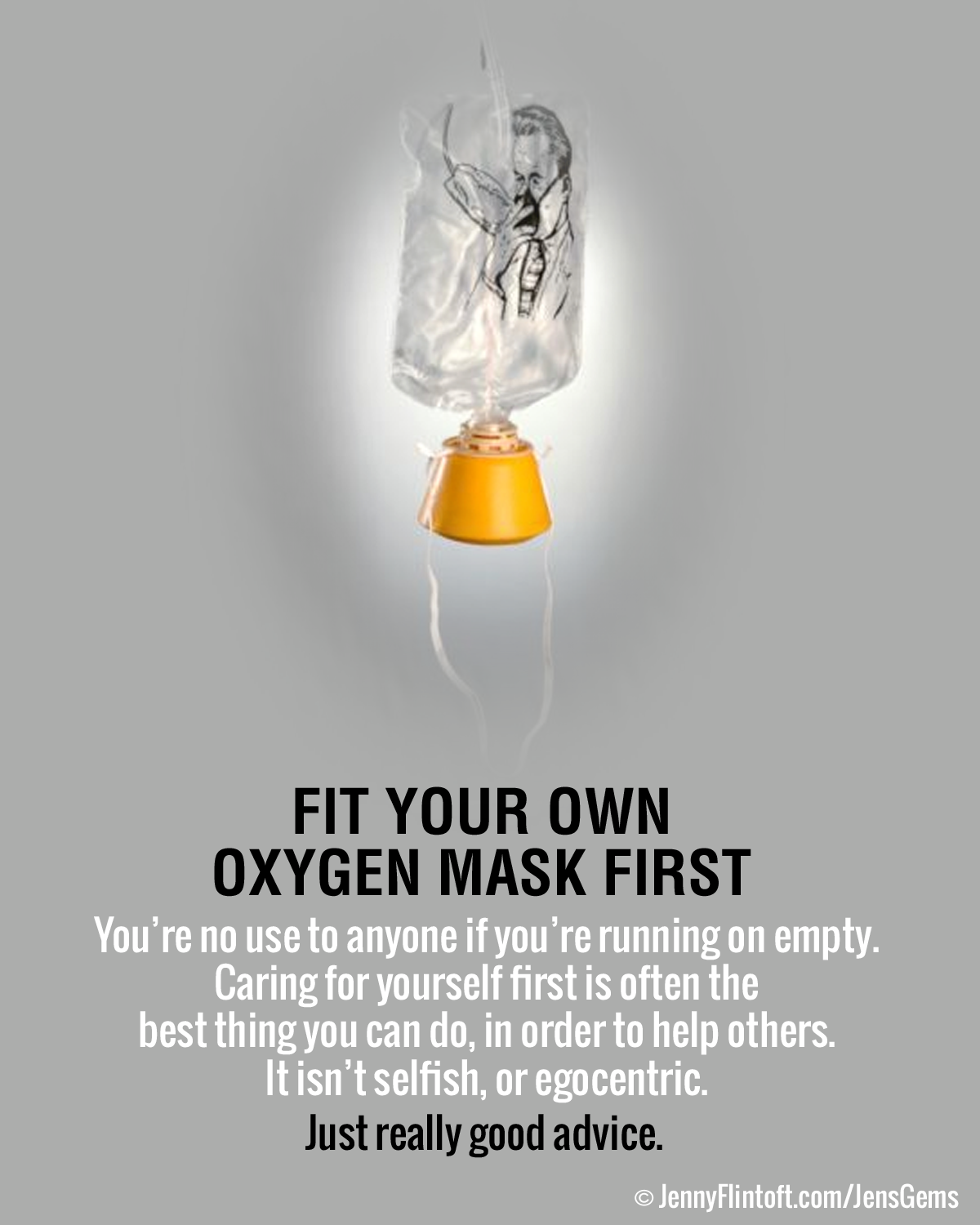
The flight attendants have got it right. If you don't keep yourself in good working order then you cannot take care of anyone else.
Take care of your headspace. Ideally we should spend as much time on our headspace each week as we do on our physical fitness – yes, that's 3 and ½ hours on each every week (there can be some overlap, for example when a runner slips into a meditative rhythm as they run).
- Use your breathing to flip your neurology from fight/flight (sympathetic stress response) to calm and easy (parasympathetic rest/heal/build) ~ deep slow breathing filling your belly with the out breath longer than the in.
- Consider practising mindfulness. Popular, but also effective, this combination of techniques come together to bring you consciously into the present so you don't dwell on past injustices or worry about future possibilities. Jon Kabat-Zinn created Mindfullness Based Stress Reduction (MBSR) in 1979. It is quite widespread now and a very useful tool to help people manage their headspace in today's busy world. More information and courses can be found at adelaidemindfulness.com These techniques have been shown to have "significant improvements in psychological distress, anxiety, emotional exhaustion, depression and burnout" (3,4).
- Dr Ferrar is speaking to carers in a piece she wrote for LIFT here, but I think it applies to us all. She asks,
"What are you saying to yourself? While at work? When feeling stressed or distressed? When feeling anxious? Or angry and irritable? While caring for someone?
"What we think and tell ourselves about ourselves, the world and others, has a profound and direct impact on how we feel – emotionally and physically. So by gently challenging our thoughts and checking their accuracy, we make way for new thoughts and new ways of looking at a situation. This in turn can influence our emotions in a positive direction.
"For example: If you are feeling overwhelmed, burdened or inadequate in your capacity to help patients or your loved one – stop and think, ‘who is responsible for their entire well-being or longevity?' It's probably not you... Notice how you are judging, criticising or assessing yourself and consider shifting your attention to your efforts and good intentions, rather the outcomes of your patients or loved one. Try doing this by asking yourself – what if being kind and present for my patient/loved one is enough? Be open to the possibility that you are actually doing a good job and all that you can."(1)
- Focus on gratitude. Focussing on the things you are grateful for in your day can shift you away from resentment, frustration and regret. It can help you build resilience and has been shown to improve sleep.
Another resource that can be useful to help get your headspace in better condition is the website  . This website is sponsored by the Australian Government Department of Health and the Clinical Research Unit for Anxiety and Depression (CRUFAD) at St. Vincent's Hospital, Sydney. This Way Up offer free online courses created by psychiatrists and clinical psychologists. They are fantastic tools for those of us who might like to manage their headspace at home in their own lounge room. Titles include:
- Coping with Stress
- Intro to Mindfulness
- Managing Insomnia
- Student Wellbeing
At this point I think it's important to acknowledge that there are people out there who will dump their own emotional junk on any available person, family included. Similarly, sometimes the caring load is foisted upon you and you need to make a choice as to whether this is really your challenge to manage or not. It is okay to say no and politely decline to take on someone else's rubbish. With your headspace in good condition you can recognise this coming and choose not to take it on. Who needs that extra load?
This headspace stuff is vital. With this in place you can sit more readily in compassion, where you can care about and help others without drowning under the emotional load that can come with it. You can respond to other's pain and need with a positive emotion, such as loving care, and not get sucked into the vortex of negative emotion.
At the same time we need to care for our physical bodies. If we don't take time to maintain the body (fitness, strength, diet, sleep) then no matter how willing the heart, the body will not keep up.
Our carers are gold. Whether at home or in the workplace, they deserve to be bright and shiny, reflecting the joy in their life, not tarnished and dull and full of resent. I know which kind of caring person I'd like in my world and the kind of carer I want to be. Please put your oxygen mask on before you go out into the world and start giving of yourself.
At the Adelaide Chiropractic Centre we can help get your frame in top nick and we can put your feet on the right path, and recommend extra help where needed, when it comes to working on your headspace. We'll help get that oxygen mask fitted. Give us a call and make an appointment on 8221 6262 today.