
The Intervertebral Disc
Reviewed August 2026
The IVD is a disc shaped piece of fibrocartilaginous tissue that sits between every two vertebrae of the spine (except C1 and C2 at the top of the neck as there is some cool anatomy there that lets you turn your head side to side, but no IVD). Looking from above, the disc is slightly kidney bean shaped with the dent at the back following the shape of the vertebral body, allowing space for the vertebral canal where the spinal cord travels down the spine. The IVD is made of concentric rings of fibrocartilage that are stiffer and stronger on the outside (this is called the annulus fibrosis (AF)) and get progressively less dense (or have progressively more water content) as you move towards the centre. The gooey centre bit is called the nucleus pulposis (NP). Engineers will recognize that this clever structure works like a hydraulic disc with the gooey stuff moving within the fibrous bands to allow movement between two adjacent vertebrae. Without IVDs we'd be moving with a stiff spine much like the classic robot!
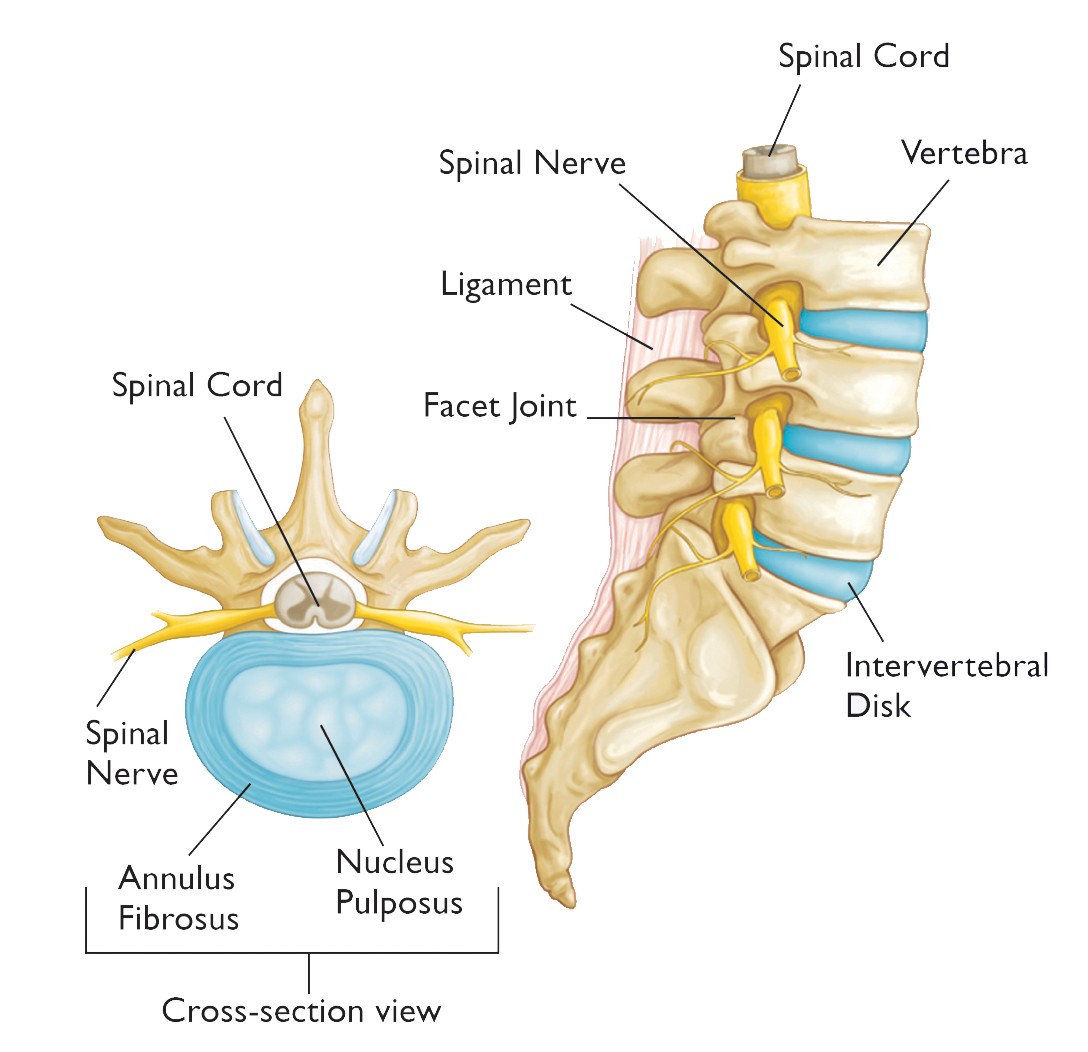
So how do we damage discs?
The IVDs most commonly damaged are the L4/5 and the L5/S1 discs in the lower back and the C6/7 and C7/T1 discs in the neck. Lower back disc injuries are more prevalent than neck disc injuries. With the exception of a traumatic incident, rarely is a disc damaged in a one off event.
For the lower back, more often it is a repetitive twist/bend/lift combo movement over years. Classically what happens is as follows:
- Earlier in life this action causes a break through one of the inner fibrocartilaginous rings of the AF and a deeper lower back pain of lesser duration occurs, the end result being the NP sitting slightly off centre towards the break.
- There can be multiple like events located in a similar arc of the disc across years. It happens in this similar arc of the IVD because this is where the AF rings are under increased load due to the previous injury. These events can become more frequent and take longer to resolve with time.
This is, of course, only IF a person doesn't get the memo their body is sending them in the guise of LBP and change the way they're using their body accordingly!
- As the NP works its way towards the edge of the disc (and incidentally toward the spinal cord and all the related neurological structures) it can create a disc bulge as the integrity of the AF declines. This disc bulge protrudes into the spinal canal to some degree.
- Disc bulges that are central and broad based (across a larger arc of the disc surface) are generally less troublesome and have a better prognosis than those that are off to one side near the intervertebral foramen (IVF – where the spinal nerve leaves the spine) and are more focal (shorter arc of the disc surface involved).
- Usually after multiple episodes of deeper AF damage (experienced as deeper local LBP which resolves with time, but quicker with care) there is an episode where the resultant disc bulge produces radicular symptoms (neurological symptoms in the limb).
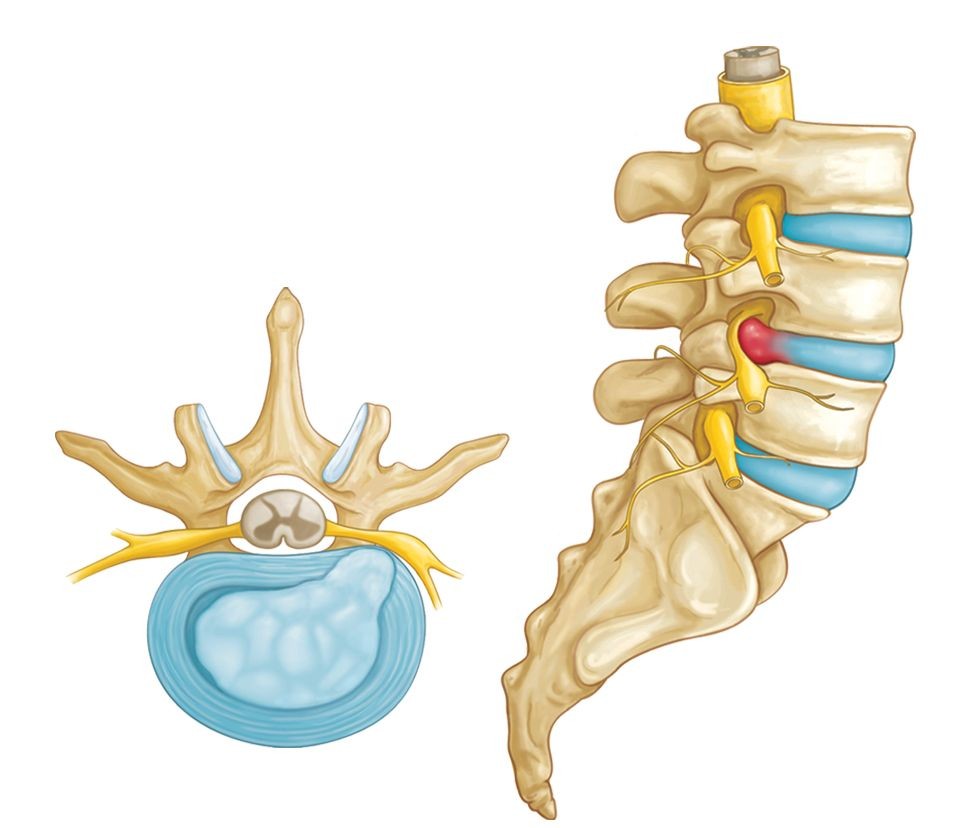
N.B. The red here indicates the inflammation,not direct pressure of the IVD on the spinal nerve.
- The damaged elements in the AF of a bulging disc trigger an inflammatory response (Inflammation Blog). It is this influx of immune cells and the associated chemical swamp that they create in the area that triggers most of the symptoms associated with a disc bulge. The chemical swamp irritates the sheath of the spinal nerve and can cause radicular symptoms (such as pain or pins and needles in the leg if we're talking about a lower back disc injury). The swelling caused by the local inflammation can put pressure on the local tissues and feel much like a deep and tender bruise.
- The brain will register the injury and throw all the surrounding musculature into spasm to support and protect the injured spine. This muscular spasm will cause the person to move and walk poorly, which is called an antalgic posture. The antalgic posture can become a source of secondary problems such as muscular imbalance and poor movement patterns that become hard wired in the brain if they persist too long. Patterns that need to be dealt with in rehab if they're not to cause potential future musculoskeletal problems for that person.
- Rarely, and in extreme situations (e.g. trauma), the AF can separate the whole way to its surface and NP material can move into the spinal canal. This is a medical emergency and will require surgery.
Interestingly there is no nerve supply to the disc, so the disc doesn't hurt – the inflammatory swamp caused by the deranged disc tissues irritates the local nerves. If these are the nerves that supply the anterior structures of the disc there might be central deep pain; if the local spinal nerve is irritated then there will be symptoms (pain, pins and needles, change in sensation such as crawling ants or running water) in the limbs affecting the piece of skin that is supplied by that spinal nerve. This can be triggered by a focal disc bulge deforming the spinal nerve sheath, but the mis-firing of the nerve is more due to the chemical swamp in the area than mechanical pressure on the nerve. It is NOT usually like the classical image of the brick on the garden hose limiting water/information flow!
The only exception to the disc not being the source of pain is when blood vessels (which have a nerve supply of their own) grow into the IVD to repair the disc. However, that is only after serious IVD injury and another story.
Another quirk of the awesome human body – spinal nerves can be irritated by the local chemical swamp of inflammation due to the IVD damage, but they can also be irritated by being stretched. So if the disc bulge means all the neurological structures are displaced towards the left and the right spinal nerve is stretched, that body may have their symptoms in their right leg (instead of on the side of the disc bulge).
Research shows that 40% of low back pain cases that walk into a chiropractor's office are related to disc damage (30% are facet joint problems and 22.5% are sacroiliac joint problems).
Statistically speaking, if a person counts their years as being under 50 years of awesomeness then LBP is more likely to be IVD in origin (over 50 years of awesomeness and the facet joints are the more likely culprit).
So how do we take care of our IVDs to prevent these episodes and what do we do if we've injured our IVD?
Prevention – keep your body moving, keep your body strong, always use good lifting techniques (don't twist/bend/lift), avoid a sedentary lifestyle. There are always times in a life where the maintenance of our frame slips away from us – it is in these times of deconditioning that we perform actions as though we were still 17 and strong as the proverbial ox...and pay the price. Try and keep your body strong and your inner 17 year old on a short leash!
When you have an episode of LBP – get it checked out by a musculoskeletal specialist (chiropractor or physiotherapist) straight away. Appropriate care and advice will promote a quicker and better outcome and avoid the potential pitfalls of poor motor patterns.
Disc injuries can take 3 months to heal with good care (though the individual may not experience symptoms for that whole three months). If the pain persists beyond the 3 month point then chronic pain becomes a problem. This requires specific guidance to shift the brain's perception of the injury. We have written several blogs on the topic of chronic pain which would be worth reading (here). I would also recommend reading David Butler and Lorimer Moseley's book "Explain Pain" which we regularly lend out to our patients.

At the Adelaide Chiropractic Centre we deal with disc injuries every day. If thorough analysis dictates you need a referral for other interventions, we will refer you on accordingly. In most cases, however, conservative care is the best option to work your way back to good function and quality of life after a disc injury. Please call the ACC now on 8221 6262 and make an appointment to discuss how we can help you reach your health goals.