
Neuroplasticity
I wrote my first blog on neuroplasticity many years ago when it was a bright new shiny word in the lexicon of people who work with the nervous system and brain, like me. Our understanding and appreciation of the practical application of neuroplasticity, and wonderfully complex nervous system, has grown since then ~ so I wanted to refresh how I present this data. Hopefully in a more relatable manner, and to gift you with understanding and tools to make your everyday better.
When I went to university, they were still teaching that we were born with a set number of nerve cells in our brain and this number was whittled away through the course of our lives. The understanding was that we could do nothing to increase the number of nerve cells or slow down this inevitable degradation. It was all rather gloomy!
As recently as the last 10 years we have learned this is not so…and we’ve learned so so much more!!
We now know that the brain changes throughout our lives. It is adaptable, rather like plastic is, which is where the term “neuroplasticity” comes from. The brain changes in response to our every-day experiences ~ tying our shoelaces (again), reading about natural disasters in the news, unexpectedly catching the toddler that threw themselves at you with great glee, explaining to a friend why Schroedinger should never have been allowed to have pets, wheezing uncomfortably after a face full of exhaust from the peak hour traffic, belly laughing at a cheeky joke, whacking your elbow as you rush through a doorway, dancing in the kitchen while you cook a curry, dealing with an online bureaucratic frustration…life.
As we get older, up to 80% of what we do every day is the same. We settle happily into routine and habits (good and bad). This means repeating actions, thought processes, types of foods, conversations over and over again…and this reinforces certain patterns of activity in the brain. There is a school of thought that cites this repetition as a possible reason time seems to go by faster as we age. There are less new or novel experiences that make out brain sit up, pay attention and CHANGE. Have you noticed that the people who are out there looking for new experiences or interactions or learnings are the ones who are more sprightly and engaged in the world? You could almost say that they are living their life to the full…
That moment of pondering aside, the things we do more develop more significance in the hard wiring of our brain. They form a “deeper path” and it becomes easier for our brain to function in that way…the thought process can become a rut that we have trouble thinking outside of. Now, if that’s a policy to be kind in our actions wherever possible (and it’s always possible), great. If it is a negative idea that triggers behaviours where we shoot ourselves in the foot…not so great. You can click on this link to take you to a short youtube video from Sentis which gives a visual depiction of neuroplasticity with respect to headspace.
Sentis ~ short YouTube video on Neuroplasticity
Your brain adapts to your every day experiences ~ physical, mental and emotional ~ rewiring itself to meet the demands we throw at it. This is a function of neuroplasticity. It is the ultimate expression of “use it or lose it”…which is a phrase I throw around a lot!
The pros and cons of neuroplasticity:
Some real world examples of neuroplasticity working against us are:
Hearing loss and dementia.
There are two points in the functional cascade where neuroplasticity may work against us:
(a) When hearing becomes hard work
When it becomes difficult to hear and make out what someone is saying, a person may gradually stop trying to decipher the sounds ~ just not bother.The brain needs regular practice to turn sounds into words and meaning. If those pathways are used less and less, the brain may become less efficient at processing what it hears and converting sounds to understanding.
(b) When hearing loss leads to social withdrawal
When conversations become difficult, tiring or frustrating, people may start avoiding social situations altogether.Less conversation means less sensory input, less cognitive stimulation and fewer opportunities to engage with the world around us. Over time, this reduction in social and cognitive engagement may contribute to changes in brain function and is one of the pathways being investigated in the relationship between hearing loss and dementia.
The important message?
Hearing loss is not simply about the ears. It can affect how we communicate, how much we engage with the world, and how much work our brain has to do to make sense of what we hear.So if your hearing is changing, don't just turn up the TV and hope for the best! Getting your hearing checked and addressing hearing difficulties can help keep you connected, engaged and using those important brain pathways.
There are many reasons why someone’s hearing may deteriorate over time. What matters here is what happens after hearing becomes more difficult.
Balance loss, falls, fear of falling… and living small
Our sense of balance, knowing where we are in the gravitational field and constantly adjusting to keep ourselves upright within it, requires our brain to conduct a symphony orchestra’s worth of information from and to the body. The neurological detail involved is truly extraordinary! [You can read more about balance here]
One of our brain’s main priorities is to keep us safe. So, after a fall, it is completely understandable that we become more cautious about how we move. Let’s face it, being bruised and broken is not much fun, and wanting to avoid a repeat performance is perfectly reasonable.
The problem comes when that caution continues long after the body has healed.
We may start avoiding uneven surfaces, steps, unfamiliar paths, busy places or even going for a walk. But these are exactly the sorts of environments that challenge our balance system and give the brain the information and practice it needs to keep us steady.
Use it or lose it applies here too.
When we progressively avoid movement and situations that challenge our balance, we give our brain fewer opportunities to practise and maintain these incredibly complex pathways and connections. Over time, through neuroplasticity, this can contribute to reduced confidence and declining balance.
And then something bigger can happen.
We stop going for walks.
We avoid places we used to enjoy.
We say no to catching up with friends because getting there feels too hard.Our physical world becomes smaller. And our life can become smaller with it.
The goal isn't to never fall. It's to use our neuroplasticity to keep building the confidence and capacity to move safely through the world.
Loss of strength → degeneration of our frame and joints → losing the ability to do the things we love
This is perhaps the most visible version of the “use it or lose it” concept.
As we get older, it is not uncommon for us to do less physical work and gradually lose strength. Ironically, we are seeing this pattern more and more in younger people too, as work, transport and leisure become increasingly sedentary. [You can read more about sedentarism here]
Your brain is constantly sending signals that help your body build, maintain and adapt its muscles and bones. It responds to the demands we place on our body. Challenge the body and the brain gets the message: “We need this.” Stop challenging it and that message changes.
This is where neuroplasticity meets bioplasticity. Our nervous system adapts to what we repeatedly ask of it, while our bones, muscles and other tissues also adapt to the mechanical demands placed upon them.
Regular resistance and weight-bearing activity gives the body a reason to maintain strength and bone density. This might be weights, Pilates, bouldering, walking, swimming or simply finding ways to regularly challenge your body.
Without enough of this stimulus, muscle mass and strength can decline, contributing to sarcopenia, while bone density can decrease, contributing to osteoporosis and increased fracture risk.
And these changes don't happen in isolation.
Our muscles, bones and joints are all part of one wonderfully interconnected system. When strength and capacity change, so can the way we move and load our joints. I see this every day. Less strength and endurance through the upper back can change how the neck and shoulders are asked to work. Reduced strength and control through the hips and glutes can change the way the lower back and pelvis are loaded.
Your body adapts to what you ask of it. So keep asking it to be strong, capable and useful. Because strength isn't just about lifting weights. It's about keeping the ability to do the things you love.
It’s not all doom and gloom though. Neuroplasticity is a two way street. The upside of neuroplasticity is that you can change the situation at any time by applying the “use it” end of the equation.
You can make your brain's neuroplasticity work for you in so many ways. It takes: recognition that something could be working better for you; a choice to make a change; persistence and repetition of the new process over time...till the new pattern of firing in your brain becomes the default setting.
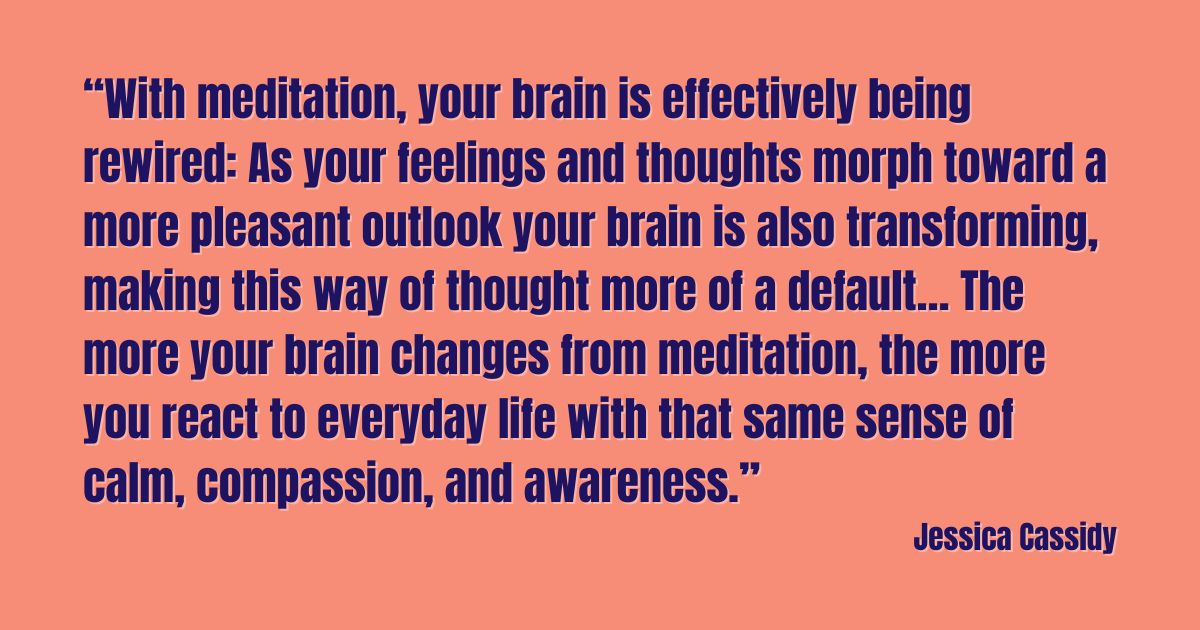
I like this quote from Jessica Cassidy about how meditation changes the brain ~

And here’s the good news ~ adaptation isn’t just something that happens when we are young. Our human brains are capable of change throughout life.
So, what can you do with this information?
The good news is that neuroplasticity is a two-way street. The same remarkable ability that allows the brain to adapt to what we repeatedly do also gives us the opportunity to change what isn't working so well for us.
It starts with noticing.
Maybe you have stopped doing something because it has become difficult. Maybe you have developed a habit that no longer serves you. Maybe you are avoiding a movement because you are worried it will hurt. Maybe stress has become your default setting. Or perhaps you have simply settled into a routine that is comfortable, but not necessarily helping you feel your best.
Once you notice it, you have a choice.
Try something different.
Then practise it.
And practise it again.
And again.
Your brain pays attention to repetition. With time, the new pattern becomes more familiar, more efficient and, eventually, more automatic.
And this is the bit I really want you to take away from all of this:
You are not stuck with the brain you have today.
Your brain is listening to what you do, what you think, how you move, what you practise and how you interact with the world around you. Every day is giving your nervous system information. So give it some good information.
Move in ways that challenge you.
Learn something new.
Try the thing you've been avoiding.
Spend time with people who make you laugh.
Give your brain novelty.
Give your body a reason to be strong.
And when something isn't working for you, don't assume it has to stay that way.
Small changes, repeated often, can create surprisingly big changes over time.
Your brain is adaptable. Your body is adaptable. And you have more influence over that process than you might think. That's neuroplasticity.
Perhaps the simplest way to remember it is the phrase I throw around all the time:
“Use it or lose it.”
But I'd add one more thought:
Use it to build the life you want to keep living.
Dedication ~ this piece is for a wonderful patient who was studying psychology when I wrote my first piece on neuroplasticity. She was after a more in depth explanation than her teachers were giving her at the time. I hope this iteration fills in more of the blanks for you.