
Regulation ~ defining a tricky thing
Regulation. The word feels like a mouth full of pebbles to say, but it’s kind of empty, or doesn’t have much oomph on the meaning font. It feels wishy-washy.
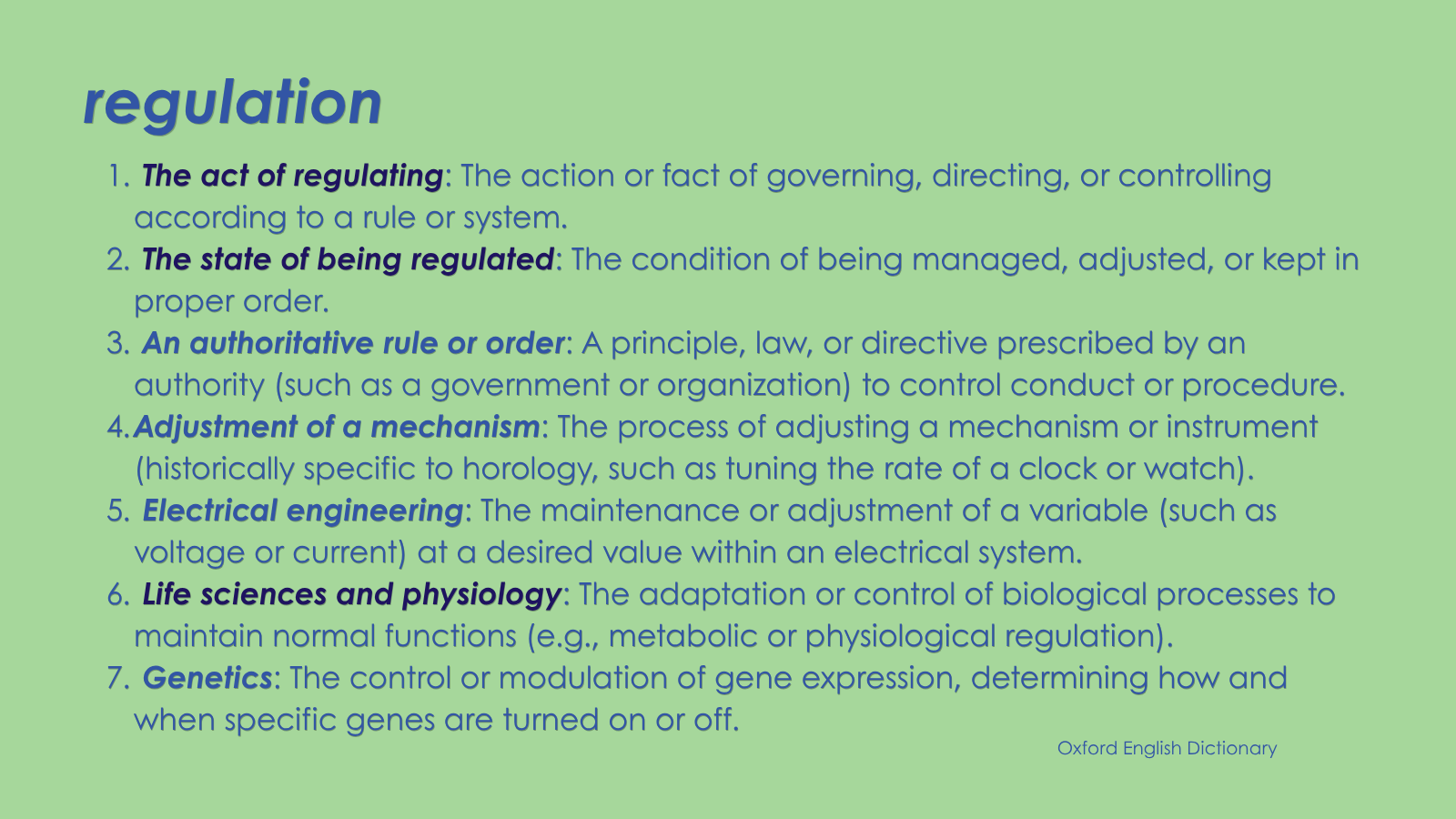
I wanted to talk about regulation from the perspective of a chiropractor, but when I looked up the official definition, I found a potential reason for my “wishy-washy” perception of the word. The Oxford English Dictionary lists SEVEN different meanings for the word “regulation”! Here they are:
SIMPLY, REGULATION MEANS TO ADJUST
MANAGE OR CONTROL SOMETHING SO IT WORKS WELL.
This is with particular reference to complex systems. Examples include: the legal system to manage society; the ability of a horologist to fine tune a mechanical watch so it keeps time; and health carers to assist people in maximizing their health and wellbeing. As Lorimer Moseley (clinical neuroscientist) says, “we are fearfully and wonderfully complex.”
So, this clarifies my thoughts.
The human body is a complex system. The human body has a self-regulating system referred to as homeostasis. Homeostasis is where the body responds to internal and external changes (detected by the nervous system) to bring functions back towards healing, balance and optimal function.
Sometimes homeostasis can be overwhelmed ~ like when there’s just a little too much on your plate (you forgot that little 2 letter word “no” that maintains healthy boundaries in your world…); if you sustain an injury (emotional or physical); or if your system succumbs to a bug (you become sick). Given time, the correct fuels and feeling safe, homeostasis will promote self-regulation within the body and healing will occur (within the limitations of matter ~ imagine me winking here).

Given this list, as a chiropractor, I use the word regulation in three different ways in my work.
I work to regulate the nervous system and in doing so, promote homeostasis, balance and healing in the body. This happens on three levels:
Promoting clear communication between the brain and the body. The information travels both directions here and needs to be clear for homeostasis and optimum function to be achieved.
Working to optimize alignment and posture sets the body up for optimal biomechanical function. Happy bones, muscles, joints, ligaments and fascia. This keeps people moving well, preventing injuries and lifts function those extra few percentage points for the athletes out there.
In chronic scenarios (problems a person has been carrying for over 3 months) the brain creates “work arounds” so we can still achieve our daily goals (e.g. walking funky to avoid putting pressure on a sore knee so we can still move around and do the things we need to do in the day). This is absolutely normal in the short term and a part of healing. However, in the long term this can create non-ideal movement patterns…which can become habit…and then the brain considers that way of moving normal…while other parts of the body suffer as a consequence…and the dysfunction can cascade (read more here). In this scenario, chiro care is working to rehab both the physical issue that brought the person through the door (whether it’s the first injury, the consequential adaption that brought them through the door…usually both) AND the brain. At the level of the brain we are working to polish up brain maps (read more here), build control and coordination; and then optimize strength. As you can imagine, this takes time.
Concurrently, I work to regulate the autonomic nervous system (ANS). This is the automatic part of the nervous system that runs all the things we don’t have to think about ~ like breathing, having our heart pump blood around our body and digesting our food (read more here). This is also the part of the nervous system that regulates our stress levels.
Mental/emotional upsets can build up in a person, bringing them to a state of anxiety and this is also expressed physically. People can be consciously aware of this or not. We see this expressed in a variety of ways: extra muscular tension, headaches, grinding teeth and sore jaws, back and neck pain, shortness of breath (where a person is not using the full volume of their lungs to breathe).
Chiropractic care helps to regulate your stress levels by introducing cues of safety to your nervous system so it can move away from fight/flight/anxiety/tension/stress and towards rest/recovery/calm/healing.
This is why, after chiro care, many people take a deeper breath, the tension leaves their body and their shoulders drop. They often say they could have a nap. The chiro care has down-regulated their autonomic nervous system away from the stress their body had been holding.
Incidently, kids can’t self-regulate their emotions…which can be so much fun with a toddler or a teenager (yep, that was sarcasm, picture me rolling my eyes here). It is the role of the adults in their world to create safety cues for them and bring calm to their world, and then to teach them how to do this themselves as they become older. Chiropractic care can help to settle these growing nervous systems.
Regulating the ANS is the main reason people keep coming to the chiropractor for care when they are pain free. They’ve learnt that regular maintenance care doesn’t just decrease the frequency and intensity of pain. Chiro also helps to reduce their stress levels and how that stress shows up in their body, no matter what life has thrown at them since their last visit.
Beyond my treatment room, I give people tools and strategies to promote a healthier environment in their work-places and their homes. This helps to regulate their nervous systems by introducing constructive habits and by mitigating those elements that have a deleterious effect on their health and wellbeing in their everyday lives. The people who follow through on these suggestions reap even better results from their chiropractic care.
So, through hands on care and education, chiropractic care helps to regulate your “fearfully and wonderfully complex” body, aiming to help you balance your physical and mental wellbeing.
DOES YOUR SYSTEM NEED SOME FINE TURNING SO YOU CAN BE AT YOUR BEST?

References
Amjad et.al. "The effects of 12 weeks of chiropractic spinal adjustments on physiological biomarkers in adults: A pragmatic randomized controlled trial." Published: December 11, 2025 https://doi.org/10.1371/journal.pone.0338730
Haavik, H.; Niazi, I.K.; Amjad, I.; Kumari, N.; Ghani, U.; Ashfaque, M.; Rashid, U.; Navid, M.S.; Kamavuako, E.N.; Pujari, A.N.; et al. Neuroplastic Responses to Chiropractic Care: Broad Impacts on Pain, Mood, Sleep, and Quality of Life. Brain Sci. 2024, 14, 1124. https://doi.org/10.3390/brainsci14111124