
Standing Desks
Reviewed August 2026
The human frame is built for standing, running and throwing things like spears. How many Olympic javelin throwers do you know? Any people of a Palaeolithic persuasion who impale their dinner each day? No? Me either.


In contrast, being a chiropractor in the CBD, I see and help oodles of people each day who do the reverse ~ sedentary sitters who hold their spine in a persistent "C" shape and wonder why they feel pain. I can help these desk bound bods get moving again, and, just as importantly, give them the tools and strategies to keep their bodies moving and well. One of those tools/strategies is upgrading their work station to include a standing desk.
I don't like to count the number of years I've been spruiking the benefits of standing desks, but it totals almost three decades now (I'm peeking through my fingers at that reality – eek!). Back when I was a brand new shiny chiro, standing to do computer work was considered weird and requesting a standing desk at work was something only those who had had spinal surgery were entitled too...and then under sufferance due to cost. Thankfully today that has changed. Not to my aspiration where all office workers and students have a standing desk, but they are spotted through many workplaces and it's not a radical concept...despite ongoing resistance from those who pay for such workspace tools.
Today I wanted to remind you why I continue to advocate for standing desks in your workplace ~ both in the office and when you're working from home. The essence of it is that you only have one body. One spine. You can work with it, or against it, but you will have to deal with the long-term outcome of your daily choices in terms of quality of days going forward. Here's my argument for including a standing desk in your tool kit for living life well.
Okay, so as I mentioned above, our spine is built for standing and movement. We have the discs between the vertebrae which act like hydraulic joints allowing our spine to move (read more here). The bones are arranged in gentle curves when we look at the spine from the side (read more here) that imbue a vertical shock absorption effect and (with the facet joints on the back of the vertebrae) allow for twisting movements of our body. This entire mechanism protects our central nervous system, provides sensory feedback to the brain so we know where we are in space, and facilitates movement of our body.
This structure NEEDS movement! Why? I'm glad you asked ~ there are three reasons.
Firstly, to keep the discs healthy (movement is required for the cells of the disc to receive nutrients and have their waste removed). No movement and the discs degenerate. Hello arthritis.
Secondly, to trigger feedback from the multifidii so the brain knows where you are in space and can pre-plan and orchestrate the movement of your body with finesse (read more here and here). No movement and the brain is flying blind using old data and you'll bump your elbow walking through doorways or move poorly and be at risk of damaging yourself. Feeling uncoordinated or clumsy?
Thirdly, there is a steadily growing mountain of scientific evidence detailing the overall health consequences of living a sedentary lifestyle (that's jargon for sitting too much most days). Research shows functionally we need to sit less and move more to have more and better quality days (read more here). If we don't, our risk of chronic disease (Diabetes, cancer, cardiovascular disease) increases markedly! Also, sitting all day and then having huge gym or exercise sessions in the evening won't fix this. We need regular movement to stay fit and healthy long term.
So how do standing desks help you?
- The first way standing desks help us is to get us moving more. Sitting less and moving more promotes healthier spines, better coordination and balance (lower falls risk) and reduce your risk for chronic disease.
- The second benefit of using a standing desk comes through improving your posture.
"I want to get old gracefully. I want to have good posture, I want to be healthy and be a good example to my children." Sting
There is an orientation of our frame where things just work better. When in this particular alignment: our joints work as they were built to; we get optimum power out of our musculature; neurological communication throughout the body is unimpeded and clear; our respiratory and cardiovascular systems can achieve peak performance; it even promotes clarity of thought and a more positive outlook on life which means a person is more productive and more pleasant to spend time with.
I'm talking about posture...a seemingly small and inconsequential thing that can have such huge impacts on a person's every day. For each person, posture is the sum of a collection of habits: how they use their body; their fitness regime; their diet; their headspace. When posture moves away from the optimal there are consequences. This often takes the form of pain in the frame, but that can cascade over time to affect other elements of quality of life (such as state of mind and lung capacity) leading to dis-ease and dysfunction. Oh, posture is not the be all and end all of quality of life, of course, but it has wider reaching impacts on life than most of us are aware of.
As a chiropractor, I'm working with people on their frame and their posture every day. We work to optimise alignment and retrain the brain, to encourage strength and good lifestyle habits. The vast majority of people walk in my door requesting help to resolve a pain. Working to optimise their posture ~ at work, rest and play ~ is a big part of how we get them back on track.
It is impossible to maintain good posture sitting down. Impossible. Although Occupational Therapists have done all the science and created all the work arounds (ergonomic chairs, computer mice, adjustable monitors etc. etc....) and this makes it better, we are still just not built for sitting or for being still for long periods of time. And by "long periods of time", I mean, the maximum time we should sit is 20-30 minutes. Yep, 30 min max!!!
Our bodies are built to stand, move. When we can do this our posture is better. The standing desk makes this possible in an office setting. [Please note, this is hugely relevant for all the students out there too!!].
Here are some quotes from my patients as to why they value their standing desk:
"The freedom to shift between standing and sitting is great. I am more comfortable in my body. Also, for some tasks I focus better when sitting and with others standing and moving aids my productivity. It just works."
"I just don't get the low back pain or headaches now."
"I'm standing taller and feel less tension in my shoulders and neck. I'm not hunching any more."
"My body just feels better. I don't get the low back ache I did when I sat all day."
"You don't realise just how much stiffness and pain you accumulate sitting at a desk."
"Truly, it costs so much less to keep your body well when you have and use a standing desk."
Bespoke ergonomic arrangement of the desk/chair/computer complex matters. Have a conversation with me at your next visit to the Adelaide Chiropractic Centre to clarify what would work best for you. With the ergonomics sorted, in my perfect world a person would stand all morning till lunch and the sit/stand every 30 minutes through the afternoon. Standing and sitting with good posture will keep the spine and body moving regularly and well. It can take some time to build the stamina for this aspirational vision, but you can begin by alternating between standing and sitting every thirty minutes and build up to that goal. Getting out of the office and going for a 30 minute walk in your lunch break would be the icing on the cake.
Types of standing desks available range in quality, complexity and price. The important things to be mindful of are:
- the height range that they traverse ~ those people at the extremes of height may find some offerings do not have the range they require.
- the mechanism for raising/lowering the desk ~ having to lift the desk top can challenge an unhappy spine further; a winding mechanism can be a significant deterrent to a person swapping between sitting and standing regularly; electric buttons that can be preset to the required heights are best.
- size matters ~ ideally the entire desk top shifts up and down. If it is just a surface with your monitor and keyboard then ergonomics can be compromised by needing to lean to the side to deal with paperwork/phones etc.
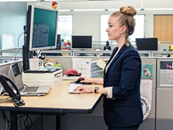
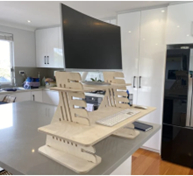
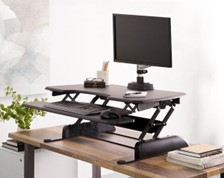
If you have a standing desk - PLEASE USE IT and USE IT WELL!!
Remember ~ you can have all the best gadgets and tools for your work, but unless you change your habits and use them well, you're not going to be any better off. Research shows even though we may start using one with the best of intentions, many readily drop back into old sitting habits over time. I'm aware of entire government departments who have upgraded their office space to include standing desks for all (when people have agitated for that option) and the vast majority of the people who work there have dropped back to sitting all day. Amazing.
Below are some general reminders of best use as per Safe Work Australia (though I would argue having your eyes level with the centre of the screen is better for reducing forward head carriage (read more here)).
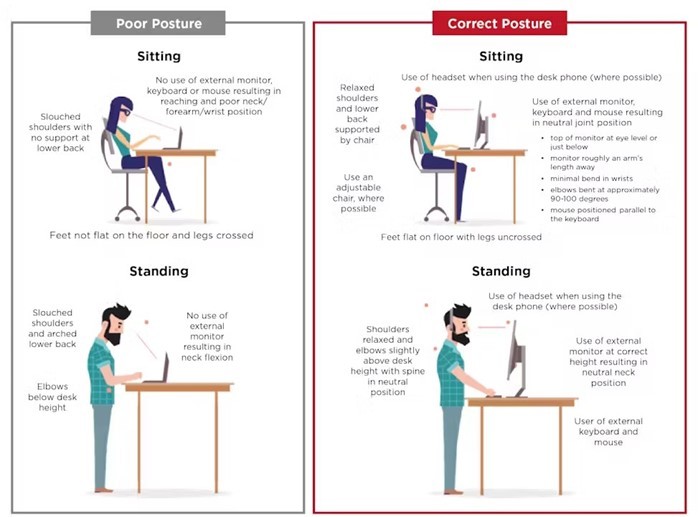
Is there such a thing as standing too much? Good question. Things to be mindful of:
- It can be challenging to build the stamina to stand for a length of time and there may be some grumbly muscles as you build the required stamina and strength (like taking up a new gym exercise).
- If you begin with musculoskeletal complaints (back pain, neck pain, headaches, hip/knee/ankle/foot trouble), using a standing desk may be a big ask to begin with. However, with informed guidance, I believe there is a way to make a standing desk a valuable element of your recovery.
- People with cardiovascular issues leading to varicose veins or swelling of their lower legs may struggle to stand for longer periods and need to tweak this plan.
Each body is different, so please consider the advice above as generic. Talk to Dr Tamara for clarification regarding your individual needs.
Sit Less. Move More.
References
-
Lee H, Lee Y. Effects of Postural Changes Using a Standing Desk on the Craniovertebral Angle, Muscle Fatigue, Work Performance, and Discomfort in Individuals with a Forward Head Posture. Healthcare (Basel). 2024 Dec 4;12(23):2436. doi: 10.3390/healthcare12232436. PMID: 39685059; PMCID: PMC11641771.
-
Chambers AJ, Robertson MM, Baker NA. The effect of sit-stand desks on office worker behavioral and health outcomes: A scoping review. Appl Ergon. 2019 Jul;78:37-53. doi: 10.1016/j.apergo.2019.01.015. Epub 2019 Feb 19. PMID: 31046958. https://affinityhealthhub.co.uk/d/attachments/chambers-et-al-2019-sit-stand-desks-scoping-review-apperg-1574689638.pdf
-
https://theconversation.com/is-standing-at-your-desk-actually-better-than-sitting-heres-what-the-evidence-says-212618